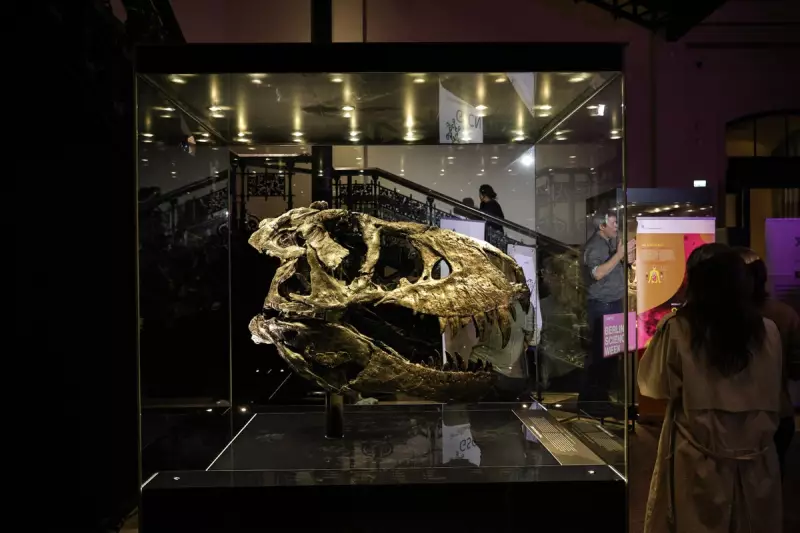
A groundbreaking new study has dramatically rewritten the life story of the Tyrannosaurus rex, revealing that the fearsome predator took a staggering 40 years to reach its full, eight-tonne size – a growth period 15 years longer than previously believed.
New Technique Uncovers Hidden Growth Rings
Until now, palaeontologists estimated the age and growth rate of dinosaurs like T. rex by counting annual growth rings in fossilised leg bones, much like dating a tree. The prevailing science suggested these giants stopped growing around age 25.
This latest research, published in the journal PeerJ on Friday 16 January 2026, employed a revolutionary approach. Scientists, led by Professor Holly Woodward of Oklahoma State University, examined bone slices from 17 tyrannosaur specimens under specialised light. They then applied an advanced computer algorithm to detect hidden growth rings missed by earlier methods.

"This is the largest data set ever assembled for Tyrannosaurus rex," said Professor Woodward. "Examining the growth rings preserved in the fossilised bones allowed us to reconstruct the animals' year-by-year growth histories."
A Protracted Path to Apex Predator
The findings paint a new picture of a more gradual, prolonged development. "Our results suggest that the Tyrannosaurus rex species complex grew more gradually and over a longer lifespan than indicated by prior models, with a protracted period of subadult development," the study authors wrote.
By stitching together growth records from multiple specimens, the team created a detailed composite growth curve. Co-author Nathan Myhrvold explained, "The composite growth curve provides a much more realistic view of how Tyrannosaurus grew and how much they varied in size."
This extended adolescence may have been a key to the tyrannosaur's dominance. "That could be one factor that allowed them to dominate the end of the Cretaceous Period as apex carnivores," noted study author Jack Horner of Chapman University in the US. The long growth period meant younger T. rexes could fill different ecological roles before maturing into the ecosystem's top predator.
Debate Over Species Classification
The research also fuels an ongoing debate about tyrannosaur classification. The study indicates that many specimens previously identified as T. rex may belong to other species. Some smaller fossils might represent a separate small-bodied species, potentially "Nanotyrannus," rather than juvenile T. rexes. Even some large specimens are suspected of being two or three distinct species.
While these theories remain hotly contested, the study's authors argue their algorithmic method offers a more objective way to determine relative age and construct species-level growth curves, suggesting a potential revision of standard bone growth study techniques.
The image of the T. rex as a rapidly maturing monster is now replaced by that of a slow-growing titan, whose four-decade journey to adulthood was crucial to its reign at the end of the age of dinosaurs.