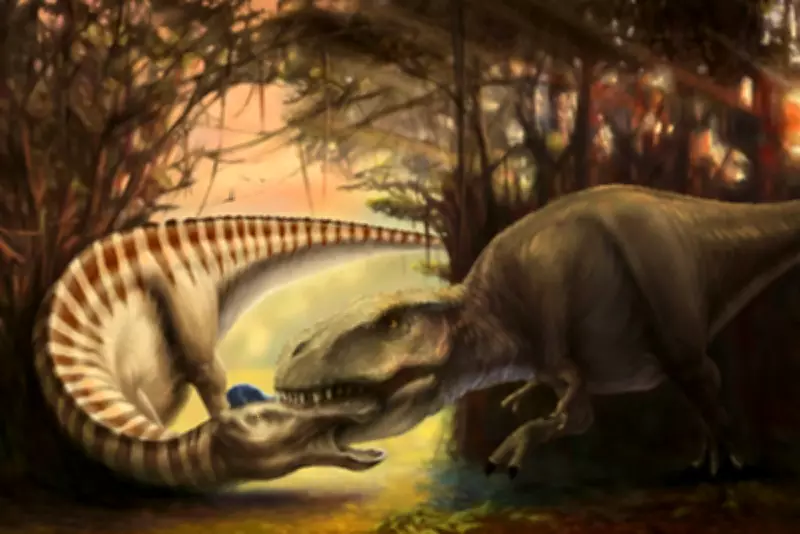
T-Rex Tooth Embedded in Skull Reveals Dinosaur's Final Combat Moments
A remarkable fossil discovery has provided a chilling snapshot of the final moments in the life of a giant duckbilled dinosaur, offering unprecedented evidence of a deadly face-to-face encounter with a Tyrannosaurus rex over 66 million years ago. The skull of the plant-eating Edmontosaurus, unearthed at the Hell Creek Formation in eastern Montana, USA, in 2005, contains a crucial detail: a tooth from another dinosaur embedded within its bone structure.
This embedded tooth has now been analysed in a new study published in the journal PeerJ, allowing researchers to reconstruct the violent interaction that led to the Edmontosaurus's demise. "Although bite marks on bones are relatively common, finding an embedded tooth is extremely rare," explained Taia Wyenberg-Henzler, an author of the study from the University of Alberta.
Identifying the Predator Through Fossil Evidence
Scientists compared the structure of the fossilised tooth with those of other carnivorous dinosaurs known to inhabit the Hell Creek Formation during the Late Cretaceous period. Their analysis conclusively showed that the tooth most closely matched the distinctive dental features of a Tyrannosaurus rex. To gain further insight, researchers conducted detailed X-ray scans of the skull, revealing the precise positioning of the tooth within the Edmontosaurus's nasal region.

"The great thing about an embedded tooth, particularly in a skull, is it gives you the identity of not only who was bitten but also who did the biting," Dr Wyenberg-Henzler emphasised. The location of the tooth suggests the T-Rex delivered its bite during a direct confrontation, likely as the two dinosaurs met face-to-face. "This paints a terrifying picture of the last moments of this Edmontosaurus," she added, highlighting the visceral nature of the discovery.
Reconstructing a Deadly Encounter
The embedded tooth indicates that the T-Rex bite was delivered with significant force, possibly to maintain control over a struggling animal during combat. "The amount of force necessary for a tooth to have become broken off in bone also points to the use of deadly force," Dr Wyenberg-Henzler noted. This finding provides valuable new insights into the feeding behaviour and predatory tactics of the Tyrannosaurus rex, suggesting a more aggressive and confrontational hunting style than previously documented in some cases.
John Scannella, another study author, expressed excitement about the behavioural evidence captured by the fossil. "A fossil like this is extra exciting because it captures a behaviour: a tyrannosaur biting into this duckbill's face," he said. The skull shows no signs of healing around the tyrannosaur tooth, indicating that the Edmontosaurus likely died either from the bite itself or shortly thereafter, with the injury occurring at or near the time of death.
This discovery not only sheds light on the violent interactions between predator and prey in the ancient ecosystem but also enhances our understanding of dinosaur combat dynamics. The Hell Creek Formation continues to be a rich source of paleontological treasures, offering glimpses into a world dominated by giants whose final moments are now being vividly reconstructed through meticulous scientific analysis.