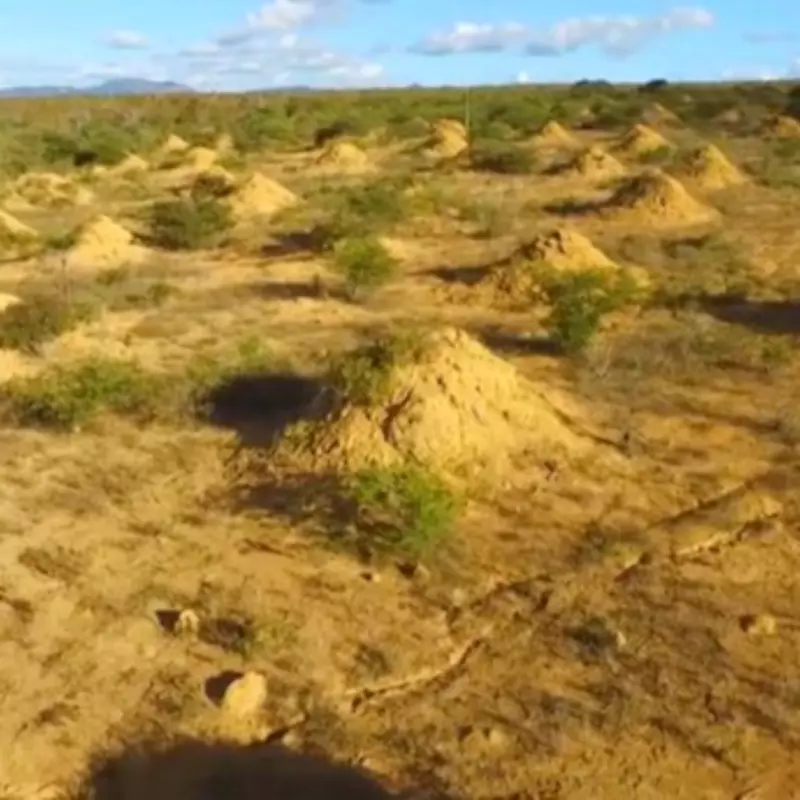
While human-made wonders like the Great Wall of China are often mistakenly thought to be visible from space, a truly colossal natural construction in Brazil can indeed be seen from orbit. This remarkable feat was not engineered by humans but by the diminutive Syntermes dirus termite species, which has created an enormous collection of mounds covering an area equivalent to Great Britain.
A Vast Insect Metropolis
These termite structures, known locally as "murundas," stand approximately 7 feet tall and can measure nearly 30 feet across. Individual mounds can take thousands of years to complete, but the sheer number of them—estimated at 200 million—creates a landscape so extensive it's visible from many miles overhead. The total volume of earth moved by these tiny insects amounts to approximately 10 cubic kilometers, enough material to construct four thousand pyramids each matching the size of Egypt's Great Pyramid of Cheops.
Engineering Without Blueprints
To put this achievement in human terms, it would be equivalent to people erecting a building four times the scale of Dubai's Burj Khalifa or 320 times as high as London's Big Ben—all accomplished without architectural plans, engineers, or modern construction regulations. The termites responsible for this megacity measure just over half an inch in length, yet they've created one of the most extensive biological construction projects on Earth.

Subterranean Cities and Seasonal Survival
Researchers have determined that these visible mounds are essentially the waste heaps for an extensive network of connected underground "cities" that stretch for numerous miles. The termites subsist almost entirely on decomposing leaves from a single tree species found in the neighboring caatinga forests, which only drop their foliage once annually.
Stephen Martin from the University of Salford, who spoke to New Scientist in 2018 about the discovery, described the termites' frantic feeding strategy: "It's like if all the supermarkets were open for one day a year—the person with the fastest car would get the most food. You need a network of roads to get to the supermarket as quickly as you can because you're in open competition with other colonies."
Ancient and Undisturbed
The region's tough, arid, and relatively barren soil has proven ideal for termite construction while being unappealing to farmers, allowing these structures to remain undisturbed for up to 4,000 years in some cases. Although local communities have been aware of the mounds for centuries, the true scale and remarkable consistency of the formations were only recognized relatively recently when they were spotted in satellite imagery.
Martin recounted his initial discovery: "I looked on Google Earth and realized they're everywhere in this area, but I could find nothing about them online." This technological perspective revealed what ground-level observation had missed—the breathtaking scope of this insect metropolis.
Mysteries of Termite Society
Research has uncovered several puzzling aspects of these termite colonies. Unlike most termite societies built around a single egg-laying queen, investigators have been unable to locate any royal chambers within the mounds they've excavated. This absence leaves both the structure of the colonies and their true size as ongoing mysteries.
Additionally, researchers have established that each mound does not represent a distinct colony, as there appears to be no hostility between termites from neighboring "murundas." However, when termites are removed from their original mound and relocated to one several miles away, confrontations inevitably occur. The precise boundaries of each termite colony remain undefined.
Survival Strategies Unknown
Another conundrum facing scientists is how these termites survive when their primary food source is only available during such a brief annual window. Martin noted the puzzling aspect of their survival strategy: "We don't know of any [termite] species that hibernate, but maybe they do." This question highlights how much remains to be discovered about these industrious insects and their remarkable construction project.

The termite megacity of Brazil stands as a testament to what can be achieved through collective effort over millennia, creating a landscape so vast it can be seen from space and challenging our understanding of insect societies and their capabilities.