California's 'City of Trees' Faces Heartbreaking Loss of Historic Eucalyptus Canopy
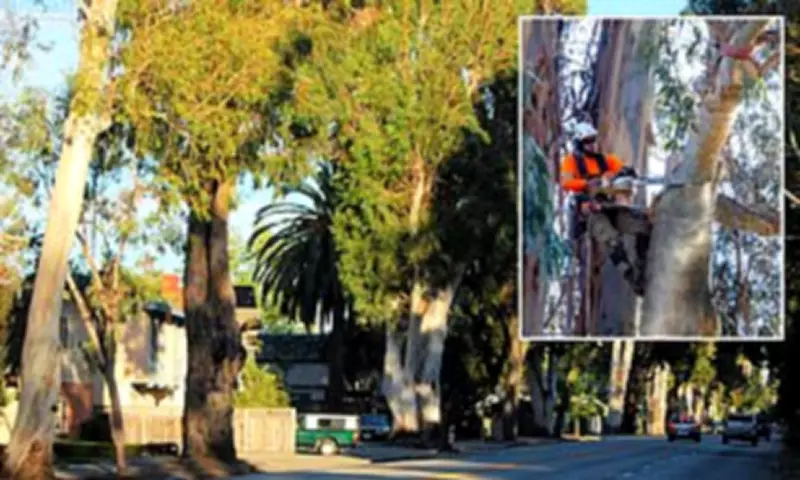
Residents of the picturesque California suburb of Burlingame are grappling with profound loss as their cherished eucalyptus trees, which have defined the community for generations, are being systematically removed. Known affectionately as the 'City of Trees,' Burlingame has long taken immense pride in its 400 eucalyptus specimens that create a magnificent two-mile leafy canopy over El Camino Real, the historic 600-mile road that traverses California.
The Painful Reality of Tree Removal
Since January, the California Department of Transportation (Caltrans) has been cutting down these iconic trees using cherry-picker trucks, leaving residents feeling disoriented and emotionally adrift. 'It's like going to a town where I don't know where I am. It's like I need a map,' lamented Jennifer Pfaff, President of the Burlingame Historical Society, in an interview with the SF Chronicle. The visual transformation has been so dramatic that longtime residents report feeling lost in their own community.
Safety Concerns Driving the $173 Million Project
The tree removal is part of Caltrans' comprehensive $173 million roadway rehabilitation project for El Camino Real, designed to 'maintain the trail as a safe, accessible, and reliable transportation corridor.' Despite their beauty and historical significance, the 150-year-old eucalyptus trees have created serious public safety hazards. Their expansive root systems have caused significant sidewalk damage throughout the neighborhood, making pathways nearly impassable for wheelchair users and those with walkers.

Additionally, overgrown branches have created dangerous visibility issues for drivers, and many trees have become unhealthy, posing substantial risks of collapse during storms. 'All of us who drive El Camino know it's in bad shape,' acknowledged Burlingame Mayor Michael Brownrigg, highlighting the community's difficult reckoning with balancing preservation and safety.
Years of Debate and Eventual Compromise
Burlingame has historically prioritized tree preservation, even implementing zoning ordinances to prevent commercial development along the road's edge to protect the canopy. The conflict between the city's desire to preserve all trees and Caltrans' position that road repairs couldn't proceed with the trees in place created what Mayor Brownrigg described as 'a real impasse.'
After extensive negotiations and the formation of the El Camino Real Task Force to advocate for the trees, a compromise was finally reached. The solution involves planting over 400 new trees along the roadway, including eucalyptus of a slimmer variety that sheds less bark, along with elm trees. 'But there was a real impasse between the city, who wanted to preserve all of the trees and then fix the road, and Caltrans, who said, "Well, we can't fix the road if we leave all the trees,"' explained Mayor Brownrigg.
Looking Toward a Different Future
While Jennifer Pfaff now understands the necessity of the removal, the emotional impact remains significant. 'Particularly the large ones, they're always embedded in your head when you're driving along,' she shared, capturing the deep personal connection residents have with these natural landmarks.
The road will remain bare and canopy-less for decades as the new trees mature, despite eucalyptus trees growing relatively faster than other species. 'It's going to be tough visually for a while, for all of us who've lived here for all this time,' Mayor Brownrigg acknowledged during a community meeting, while offering perspective: 'But they say that you plant a tree not for yourself, but for your kids.'
This bittersweet transition represents both an end to a beloved chapter in Burlingame's history and the beginning of a new legacy that prioritizes safety while attempting to preserve the community's identity as the 'City of Trees' for future generations.