The forecast had promised warm spring sunshine, ideal weather for a forest bathing class. Instead, a squally shower arrived without warning, and participants ended up hugging tree trunks more out of necessity than mindfulness. In full leaf, the mature beech grove canopy would have kept them dry, but this early in the season, the leaves had only just unfurled, letting the rain through to saturate jumpers. For a while, the group listened in silence as the foliage changed its voice, a dry whisper deepening into a steady, percussive patter.
Thankfully, the downpour passed as quickly as it had arrived. Light filtered through the leaves, and the group drifted back along the path until the trees opened into a small clearing. The instructor suggested that they sit on a semi-circle of fallen trunks, urging them to feel the texture of the rough-stalked feather moss (Brachythecium rutabulum) cushioning their makeshift benches. Flasks were passed around, the nettle and chamomile tea offering welcome warmth.
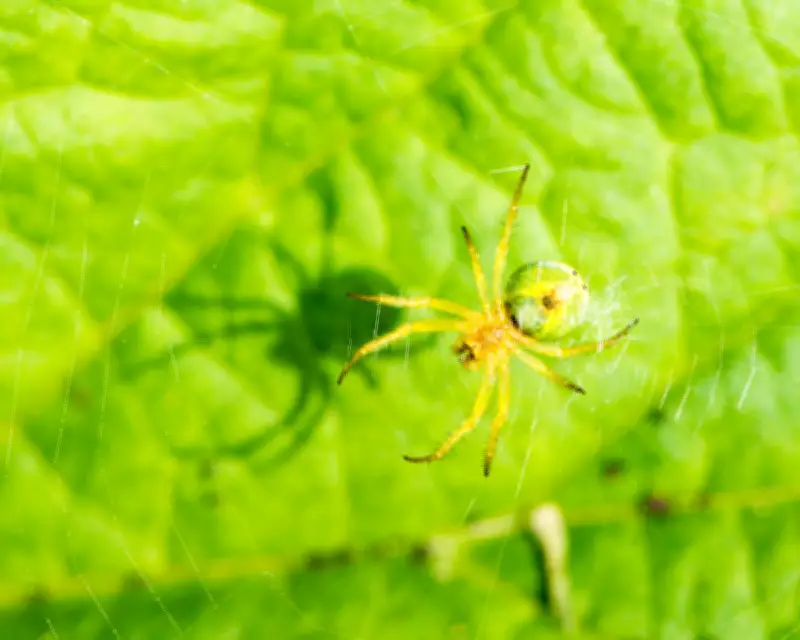
The woman beside the author lifted her hat from her lap and paused, peering into its shallow crown. There was a cucumber spider inside. Its abdomen was just 5 millimetres long but an eye-catching yellowish-green, with a conspicuous red mark just below the spinnerets. Against the black fleece of the author's sleeve, the spider was startlingly vivid, its cryptic camouflage compromised. However, when coaxed onto a low branch in the diffuse beech light, the green was perfectly leaf-matched, and the spider disappeared seamlessly into the surrounding foliage.

Five species of cucumber spider occur in Britain, but only two are common: Araniella cucurbitina, first described in 1757 by Swedish arachnologist Carl Alexander Clerck as Araneus cucurbitinus, before being reassigned to its current classification in 1942; and Araniella opisthographa, originally described as Araneus cucurbitinus opisthographa by Polish arachnologist Władysław Kulczyński in 1905, then later recognised as a distinct species. They often share the same habitat, can typically only be distinguished by microscopic examination of their genitalia, and are believed to hybridise on occasion.
The author offered a finger, and the spider stepped from woven straw to skin. After a moment's orientation on the knuckle, it began moving upward, tracing the contours of the hand. Clambering onto the sleeve, its colouration became startlingly vivid against the black fleece. The author coaxed it back onto a finger and gently guided it onto a low branch, where it disappeared into the leaves, demonstrating the effectiveness of its camouflage in its natural environment.