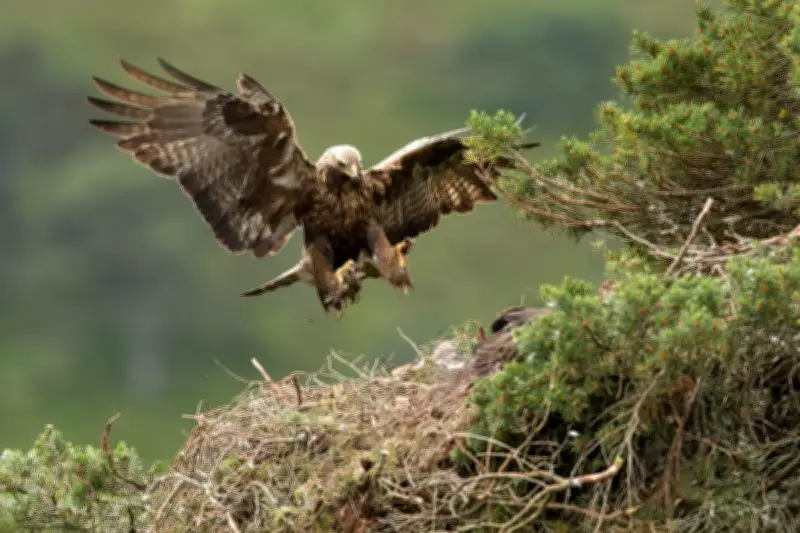
Golden Eagles Poised for Historic Return to England After 150-Year Absence
England could soon witness the triumphant return of the golden eagle, a majestic bird of prey absent from its skies for over a century and a half. The government has unveiled new funding to investigate a formal reintroduction programme, marking a potential turning point for one of the nation's most iconic native species.
A Legacy Lost and a New Hope
Once a common sight across the English landscape, golden eagles were systematically persecuted to near extinction during the Victorian era. Sheep farmers and gamekeepers, viewing the powerful raptors as a threat to livestock and game birds, drove their numbers down. This decline was later compounded in the 20th century by the devastating effects of agricultural pesticides on the birds' fertility.
For the past 150 years, sightings in England have been exceedingly rare, with only a few isolated pairs recorded. The last known individual died in the Lake District in 2016, leaving England without a resident population, even as healthy numbers persisted north of the border in Scotland.

Scientific Backing for a Comeback
A groundbreaking new study by Forestry England, published recently, provides the scientific foundation for this ambitious project. The research concludes that England now possesses the requisite environmental capacity to sustain golden eagle populations once again. It has identified eight prime "recovery zones," predominantly located in northern England, as the most suitable areas for reintroduction efforts.
However, the study cautions that establishing stable, breeding populations in these regions is a long-term endeavour, likely taking more than a decade to achieve.
Government Commitment and Funding
In a significant move, Environment Secretary Emma Reynolds has approved an initial £1 million in government funding to pave the way for a comprehensive recovery programme. This financial backing could enable the release of juvenile eagles, aged six to eight weeks, as early as next year.
"This government is committed to protecting and restoring our most threatened native wildlife – and that includes bringing back iconic species like the golden eagle," Ms Reynolds stated. "Backed by £1 million of government funding, we will work alongside partners and communities to make the golden eagle a feature of English landscapes once again."
Building on Scottish Success
The initiative seeks to replicate the remarkable success of a major restoration project in Southern Scotland, where golden eagle numbers have recovered to record levels. Satellite tracking data reveals that some of these translocated Scottish birds have already begun exploring territories across the border in northern England.
The new funding aims to support these pioneering individuals while facilitating targeted reintroductions. Forestry England's research suggests that Scottish eagles could be regularly observed in northern England within ten years, though establishing breeding pairs will take longer.
Partnerships and Community Engagement
The charity Restoring Upland Nature (RUN) will lead the project in collaboration with Forestry England and other partners. "This presents a truly exciting and potentially game-changing moment for the return of golden eagles to Northern England," said RUN chief executive Cat Barlow.
"Our priority will be to listen, to work in partnership, and to ensure that golden eagle recovery supports both nature and the people who manage these landscapes, so that everyone can enjoy the thrill of seeing golden eagles flying high once again across the uplands of the UK."
Mike Seddon, Chief Executive of Forestry England, emphasised the importance of a careful, inclusive approach: "This funding means we can build on the good work we have begun, taking the time to build support and engage with local communities, landowners and land managers and conservation organisations."

Broader Conservation Goals
This £1 million investment forms part of a larger £60 million species recovery fund announced by the Environment Department last week. The golden eagle project is intrinsically linked to the UK's legally binding environmental targets: to halt the decline in species abundance by 2030 and to reduce the risk of species extinction by 2042, using 2022 levels as a baseline.
The potential return of the golden eagle, a celebrated bird mentioned over forty times in the works of Shakespeare and boasting an impressive two-metre wingspan, represents more than just a conservation victory. It signifies the restoration of a crucial apex predator, vital for maintaining the balance of entire ecosystems, and the rekindling of a lost piece of England's natural heritage.