Federal Government Approves Massive NT Land Clearing Without Full Environmental Assessment
The federal environment minister, Murray Watt, has granted approval for the bulldozing of nearly 3,000 hectares of tropical savanna in the Northern Territory, bypassing a comprehensive assessment under Australia's national environmental laws. This decision has ignited fierce criticism from conservationists and scientific experts who warn of dire consequences for biodiversity.
Scale of the Development and Environmental Concerns
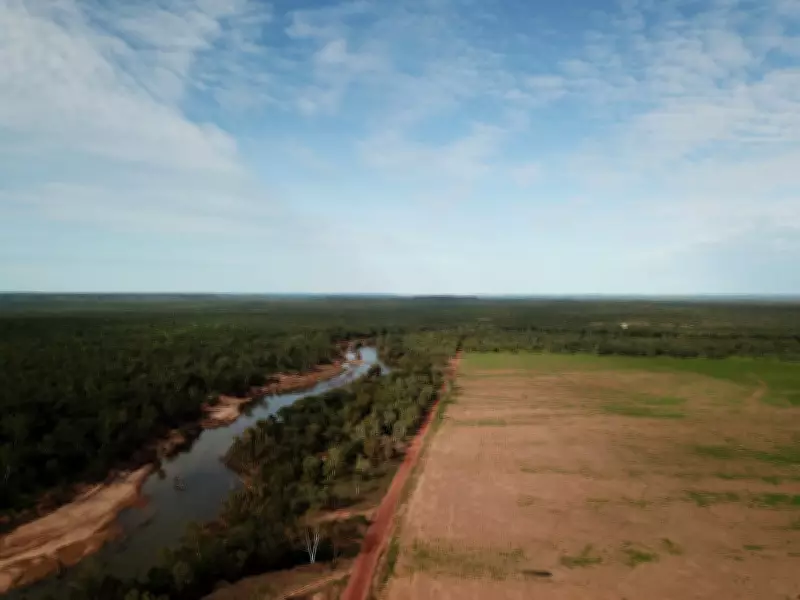
Top End Pastoral Company's proposed development involves clearing 2,723 hectares of woodland on Claravale farm and station in the Daly River region, an area approximately ten times the size of Sydney's central business district. The land is slated for agricultural use, including crops such as sorghum and cotton. This region is a critical habitat for multiple threatened species, including the vulnerable ghost bat, Gouldian finch, pig-nosed turtle, and red goshawk.
The Environment Centre of the Northern Territory (ECNT) has condemned the approval, stating it "effectively green lights the destruction of likely habitat for 13 threatened species." Executive director Kirsty Howey expressed profound dismay, remarking, "We're absolutely gobsmacked by this decision, which makes a mockery of Labor's promise to fix our broken nature laws."

Minister's Decision and Lack of Assessment
Minister Watt declared the development not a "controlled action," meaning it can proceed without an evaluation under the Environment Protection and Biodiversity Conservation (EPBC) Act for its potential impacts on threatened species and ecosystems. The government defended the move, stating that after "careful examination," the minister concluded the project was unlikely to have a significant environmental impact.
This decision was published last Wednesday, coinciding with Watt's announcement of a national interest exemption for US mining company Alcoa to continue clearing in Western Australia's northern jarrah forest. The timing has raised questions about the consistency of environmental oversight.
Specific Threats to Wildlife and Habitat
Claravale Station is home to caves that serve as roosting sites for a large colony of ghost bats, one of only six known maternity roosts for the species in the Northern Territory. While the known roosting habitat lies outside the development zone, the ECNT remains concerned because surveys have been limited. Howey noted that advice from the NT environment department suggests the development will come within two kilometres of these roosts, which support about 18% of the known NT ghost bat population.
Scientists, including Prof Euan Ritchie from Deakin University, emphasize the irreplaceable nature of Australia's tropical savannas. "Once Australia's tropical savannas are cleared by bulldozers and chains, at industrial scale, they will not return in our lifetime," Ritchie warned, highlighting the global significance of these ecosystems.
Development Details and Mitigation Measures
Top End Pastoral Company has proposed a three-stage development covering over 7,000 hectares. The recent approval pertains to the second stage, originally covering 4,585 hectares but revised down to 2,723 hectares to avoid some wildlife corridors and habitat. The company has already undertaken clearing for stage one under a separate NT government permit, covering about 1,200 hectares.
A spokesperson for the federal environment department stated that the minister's decision considered the combined impact of all clearing stages, including measures by the company to avoid and mitigate habitat impacts. "By refining the project design, the proponent has avoided clearing key areas of habitat and reduced potential impacts," the spokesperson said.
Legal and Policy Implications
The ECNT is exploring legal avenues regarding the application of national nature laws in the Northern Territory, arguing that such large-scale clearing should trigger federal assessment. The department spokesperson countered that "not all referrals under the EPBC Act are expected to result in significant impacts" and that the process demonstrates how agricultural land clearing must comply with the same rules as other industries under recent reforms.

Top End Pastoral Company declined to comment on the controversy. The decision underscores ongoing tensions between agricultural expansion and conservation efforts, with environmentalists calling for stronger protections to safeguard Australia's unique wildlife and ecosystems.