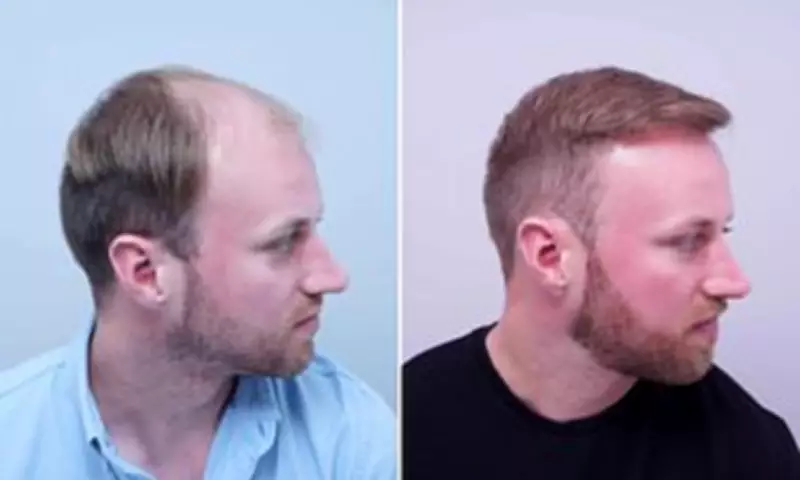
For several years, Alex Aitken's receding hairline led people to consistently mistake him for a man a full decade older than his actual age. The Manchester-based project manager recalls, 'People used to think I was in my forties when I was only just turning thirty. It became something that really bothered me.'
Early Signs and Growing Discomfort
Alex first noticed his hair thinning at the front of his head during his mid-20s, but initially, he wasn't overly concerned. Over time, however, as his hair loss progressed, he felt he looked increasingly older for his age, leading to gradual discomfort with his changing appearance. 'None of my friends had hair loss like I did,' he stated. 'I decided I had to do something about it.'
A Dramatic Transformation
Today, at age 33, Alex's appearance is remarkably transformed. He now looks no older than his late 20s and is regularly mistaken for being in that age bracket. The change came after he underwent a radical hair transplant three years ago, which gave him a full head of healthy, natural-looking hair.

'The change has been huge for me,' he explained. 'I'm not the sort of person who looks in the mirror and thinks, 'Oh my God, I look amazing,' because I'm not that vain, but the best way I can describe it is that I feel like a different person, like the version of myself I always should have looked like.'
Reflecting on the experience, Alex added, 'Looking back now, the whole experience has been completely worth it. Now, after having it done, when people assume my age, they usually say late twenties, so it's taken about six years off how I look. And seeing my hair come back definitely made me feel younger too.'
The Widespread Struggle with Hair Loss
Alex is far from alone in his battle against hair loss. A shocking 40 percent of British men will experience visible hair loss by age 35, with that figure rising to 60 percent by age 65. According to a new survey from the British Association of Hair Restoration Surgery, for more than half of these men, thinning hair causes a considerable knock to self-esteem. Just over one third worry that it will impact their confidence in social situations, while 34 percent, like Alex, fear that hair loss makes them appear older than they are.
Causes and Common Treatments
The causes of hair loss can vary significantly. The most common form, known as male pattern baldness, is linked to genetics and often runs in families. Some individuals may develop alopecia areata, where the immune system mistakenly attacks scalp tissue, causing hair to fall out in patches. Stress can also trigger hair loss problems.
In the United Kingdom, millions of men take medications such as finasteride and minoxidil, which are proven to slow down or even reverse hair loss. However, these drugs do not work for everyone and can have unpleasant side effects, including erectile dysfunction, low libido, depression, suicidal thoughts, and cardiovascular issues.
Surge in Hair Transplant Popularity
As a result, hair transplants have experienced a significant boom in popularity in recent years, with demand increasing by 60 percent in just the last five years. High-profile figures like Jude Law, Elon Musk, Gordon Ramsay, and Wayne Rooney have all reportedly undergone procedures to rejuvenate their hairlines.
According to Harley Street Transplant Clinics, approximately 30,000 men per year in the UK now undergo hair transplants. Additionally, around 1.8 million 'medical tourists' traveled to Turkey—a hotspot for affordable procedures—in 2023 alone. The surgical procedure typically costs around £5,000 and involves removing hair follicles from one part of the scalp and grafting them into areas with less coverage.
However, these treatments are not always successful. In some cases, particularly for patients with advanced hair loss, the procedure is unlikely to yield satisfactory results.
Alex's Decision-Making Process
For Alex, the decision to undergo surgery was not an easy one. Unconvinced that existing medications like finasteride or minoxidil would be effective and wary of potential side effects, he initially stuck to home remedies and over-the-counter solutions for the first few years after noticing his thinning locks.

He tried using Alpha Caffeine Shampoo—a product often recommended on social media that claims to fight thinning with a caffeine-infused formula—but found it made no difference. Alex also began using hair fibers to conceal thinning patches; these cosmetic products adhere to existing hair using static charge to create a thicker appearance. Yet, as his hair grew thinner, the fibers became less effective.
Eventually, on the cusp of his thirtieth birthday, Alex decided enough was enough. 'I hadn't considered surgery until that point, because I'd heard so many horror stories,' he said. 'But it got to the point where I needed to do something.'
Choosing a Safe and Local Clinic
Alex wanted to go somewhere he believed would make the procedure safe and comfortable, and where he could easily return if any issues arose. 'The only real worry I had before having the transplant was the things I'd heard from people I knew who'd gone abroad for a hair transplant to Turkey,' he explained.
'They didn't have very positive things to say about their outcomes. They talked about long-lasting pain and inconsistent results. You could also see that it wasn't natural; you could tell they had had a hair transplant.'
After conducting research and visiting several clinics in the UK, Alex chose the Farjo Hair Institute in London. He attended an initial consultation and signed up for the procedure on the spot. 'I wanted to go somewhere safe, convenient, and local, and the clinic was just that. I felt very comfortable immediately,' he remarked.
The Procedure and Recovery
On the day of the procedure, just weeks later, Alex arrived at 7 a.m. to have his head shaved and receive anaesthetic in his scalp. He describes this as the most painful part of the entire process. For the rest of the morning, as hair follicles were removed from the back of his head in large swatches, and throughout the afternoon, when clinicians carefully reimplanted the follicles into the top and front bald areas, Alex sat comfortably watching a film.
'That night, I felt like I was wearing a helmet—my head felt so numb and heavy from the anaesthetic,' he recalled. 'But apart from a tiny bit of blood on the pillow, it was fine.' Alex returned to work running his company, Woodside Design Joinery, the very next day.
For the following week, Alex's scalp felt slightly itchy, but this was easily soothed by a saltwater spray provided by the clinic. Any discomfort was instantly worth it just one month later when his hair began growing back without any bald patches. 'I was looking forward so much to my first haircut after the transplant,' he said. 'Before, getting my hair cut involved keeping the front and side bits as long as possible so I could comb them over—if the wind blew, however, I looked bald.'
Life After the Transplant
Today, Alex says he feels years younger—and looks it too. 'I'm 33, but people often think I'm in my 20s,' he noted. 'The whole experience was definitely worth it. It exceeded what I expected, especially in terms of how natural it looks. You'd never look at me now and know that I've had anything done, which is exactly what I wanted.'