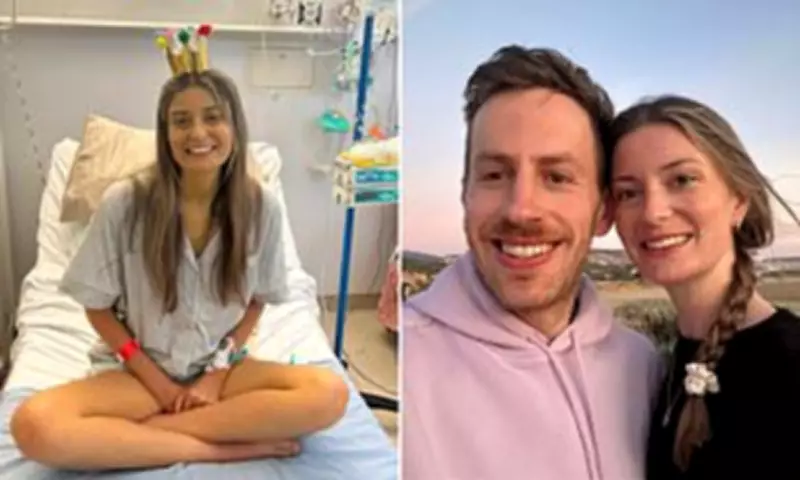
When Flo Moffat-Charles began suffering from persistent itching and exhaustion, she never imagined it would lead her husband to offer part of his own liver to keep her alive. The 31-year-old was first diagnosed with a rare chronic liver disease before receiving the devastating news that she had developed an aggressive cancer for which a transplant is the only cure.
The former event fundraising manager, who lives in Kendal, Cumbria, was diagnosed with Primary Sclerosing Cholangitis (PSC) in 2024 - a rare liver condition that attacks the bile ducts and dramatically increases the risk of developing aggressive cancers. After months of ongoing tests and monitoring, she was dealt a second devastating blow in January 2025 when doctors diagnosed her with cholangiocarcinoma, a rare and aggressive bile duct cancer that is notoriously difficult to detect and treat.
Now, in a cruel twist, Mrs Moffat-Charles has been told she does not qualify for a potentially life-saving liver transplant on the NHS under current criteria in England - despite transplantation being the only curative treatment for her cancer. Instead, she and her husband - who own a dog named Spencer - have been forced to look overseas in a desperate bid to save her life.

The couple have since discovered a specialist centre in Turkey willing to perform the complex transplant surgery, which takes part of Mr Moffat-Charles's liver to replace the cancerous section of his wife's. But the operation, alongside flights and hotels, comes with a staggering price tag of around £200,000.
In a remarkable show of public support, the couple's GoFundMe appeal to fund the procedure raised more than £100,000 within a week, with donations flooding in from complete strangers moved by the story. However, they still must raise around £70,000 for the procedure - which they hope will take place at the end of June.
Emotional Rollercoaster
Speaking to the Daily Mail, Mrs Moffat-Charles described the emotional rollercoaster of facing a potentially terminal cancer - and why her husband said donating part of his liver to save her life was 'not even a decision'. She said: 'I first started noticing symptoms that were really, really small things. I was more tired than usual and experienced itchiness - when I started to notice the itchiness that was when I realised something was probably up.'
This was in November 2023, but the formal diagnosis for PSC came in January 2024 following a liver biopsy, multiple blood tests and multiple scans. Cholangiocarcinoma is a really difficult cancer to diagnose. It grows silently and in some ways I'm quite fortunate – the fact I had PSC meant I was being closely monitored for potential cancers anyway.
I got the official cancer diagnosis in January 2025. There is a standard line of treatment for cholangiocarcinoma, which I was put on from April, and that involved two different types of chemotherapy and an immunotherapy. But the only cure is surgery. So, we knew from the off that the treatment I was going on wasn't curative.
Heightened Cancer Risk
Cholangiocarcinoma develops in the bile ducts - the tubes that carry digestive fluid from the liver - and is often only discovered once it has reached an advanced stage. Because symptoms can remain hidden for years, many patients are diagnosed too late for surgery, making liver transplantation one of the few potentially life-saving options.
Mrs Moffat-Charles said that although doctors warned her that she faced a heightened cancer risk because of the PSC and might eventually need a transplant, the expectation was this would be in years to come. She said: 'I was told at diagnosis about the high risk of cancers, that one day I might need a liver transplant - but they saw that being way in the future.'
After chemotherapy and immunotherapy successfully stabilised her tumour, Mrs Moffat-Charles said she had pinned her hopes on an NHS clinical trial - that includes a transplant - for patients suffering from both cholangiocarcinoma. However, she was ultimately deemed ineligible due to the dual nature of her illness.

She said: 'We were hopeful that we would be able to access a clinical trial, which is being run in England at the moment for patients who have PSC and cholangiocarcinoma. But due to various reasons, I don't meet the criteria for that clinical trial, and that would have offered me a transplant if I'd gotten on to that trial. That is why we are now seeking transplant options abroad because we obviously want to find a curative treatment.'
Extraordinary Operation
The extraordinary operation will involve surgeons in Istanbul removing the cancerous tissue from Mrs Moffat-Charles's liver before transplanting part of her husband's healthy liver in its place. A healthy liver has the unique ability to regenerate, meaning Mr Moffat-Charles's liver is expected to grow back to almost full size within six to eight weeks.
The hope is that the procedure will ultimately put Mrs Moffat-Charles's cancer into remission - and give her the chance to rebuild her life. And although the transplant will not cure her PSC, it will dramatically alter the quality of life. Mrs Moffat-Charles said: 'I can't wait to look in the mirror and not see jaundiced skin or yellow eyes. That makes me emotional to even say. But for myself and my husband, it ultimately comes down to spending quality time together.'
For Mr Moffat-Charles, the decision to become a donor was immediate. He said: 'I said it's not even a decision. I think when you are faced with what we're faced with, and your options are limited in terms of what you can do, and you get an opportunity to be able to do something that can save somebody's life - you just do it. There's no hesitation in making that happen.'
NHS Response
An NHS Blood and Transplant spokesperson said that sadly, there are 'not enough organs from deceased donors in the UK'. However, they said the 'transplant community works together to try and create fair policies which prioritise people who could benefit'. They said: 'Every transplant centre has to ensure that each patient they recommend for transplant can achieve satisfactory outcomes, to make the best use of precious donated organs.'
NHS Blood and Transplant supports the work of hospitals and commissioners on living donation. 'Living donation can be an increasing source of donor livers and there are new programmes to improve access for people who want to make a directed living liver donation. Doctors will still need to consider each case carefully and decide whether the operations are in the best interests of the donor and the recipient and whether they will achieve satisfactory outcomes.'
Financial Burden
While the Turkish hospital can carry out the surgery as an alternative option for Mrs Moffat-Charles, the financial burden on the couple remains immense. The £200,000 fundraising target will cover medical testing, flights, accommodation, the transplant itself, post-operative care and medication - as well as emergency costs if complications arise.
Josh explained: 'We're looking sort of northwards of sort of 200,000 pounds - it's the testing, it's the flights, accommodation, the transplant surgery itself, it's the aftercare, it's the drugs. This all does not come for free. That's why we're looking to raise that amount of money. It could be more depending if things don't go well or things go wrong. So, we want to make sure that there's enough there to support us in any instance that we kind of come into. It's also the fact that if we're both having surgery, we both need support whilst we're out there because we won't be able to support each other. We need to make sure we can have family there to look after us and get us home safely.'
Despite the daunting target, the response has left the couple overwhelmed by the outpouring of support from the public and strangers. Only one week after establishing their GoFundMe, they have managed to raise over half of their target. Mr Moffat-Charles said: 'I don't think that in any world we would have imagined that after four or five days, we'd have raised £135,000. I think it just sort of snowballed through the power of social media. We saw an outpouring of support, not just from our friends and families that were very generous, but from complete strangers as well. We had a £10,000 donation from someone that we didn't know. It just shows that I think people resonated with Flo's story in terms of the life that she had prior to cancer.'