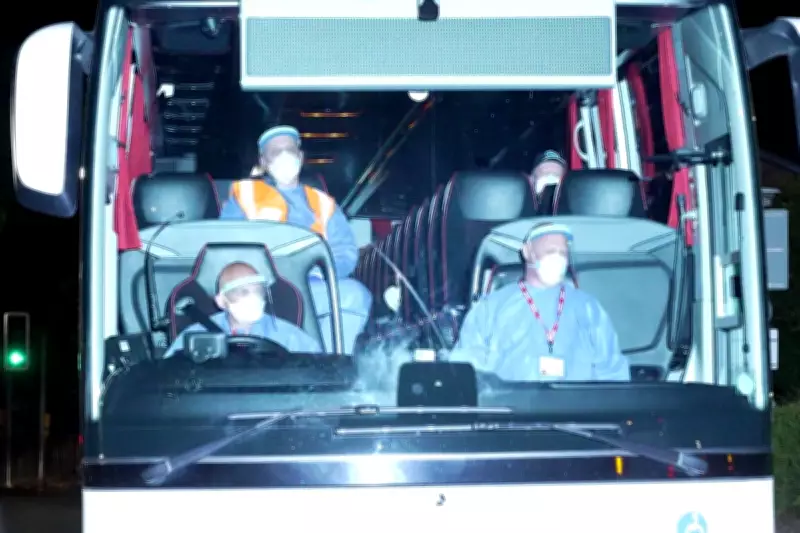
British passengers evacuated from a cruise ship affected by a hantavirus outbreak have arrived at an isolation facility after being repatriated from Tenerife. A chartered Titan Airways flight transported the passengers from the Canary Islands to Manchester Airport on Sunday evening.
Arrival at Arrowe Park Hospital
The 20 British passengers, who were tested for hantavirus before boarding the flight, were taken to isolate at the UK’s initial Covid quarantine site at Arrowe Park Hospital on the Wirral, Merseyside. One German national, who is a UK resident, and one Japanese passenger from the MV Hondius are also being monitored at Arrowe Park. The UK Government took the Japanese passenger at the request of the Tokyo government, and they will complete their isolation in the UK in line with UK Health Security Agency (UKHSA) guidance.
Strict infection control measures were in place throughout the journey to Arrowe Park, with passengers, crew, drivers and medical teams all wearing personal protective equipment such as face masks. Within a 72-hour period, the passengers will receive clinical assessments and testing at the isolation facility.

Facilities and Welfare
The Arrowe Park site has six storeys of self-contained flats with their own bedrooms, en-suite bathrooms, kitchen and lounge facilities. Janelle Holmes, chief executive of Wirral University Teaching Hospital NHS Foundation Trust, told the media that Arrowe Park would carry out “welfare checks on each individual.” She added: “There’s nobody being transferred to us that has been symptomatic in any way. There’s no impact on the hospital. Services are running as normal, patients should still attend their appointments.”
The hospital leader said if passengers develop symptoms, they will be taken to Royal Liverpool University Hospital, which houses the regional Tropical and Infectious Diseases Unit. Ms Holmes said hantavirus is “very different” to Covid and the risk to the general public is “really low.” She added: “You’ve got to have really, really close contact. It’s not like Covid or flu or those types of viruses.”
Isolation Procedures
After their isolation, public health specialists will assess whether passengers can isolate at home or at another suitable location based on their living arrangements. Britons returning to the UK will stay in self-isolation for 45 days and will not be allowed to take public transport to their homes. During the isolation period, passengers will have daily contact with UKHSA health protection teams to check their wellbeing and ensure they are supported to isolate safely.
Professor Robin May, chief scientific officer at the agency, said: “We are pleased to confirm that all British nationals onboard the MV Hondius have now safely returned to the UK and are being supported by UKHSA and NHS medical experts at Arrowe Park, who have worked at pace to prepare for the safe arrival of passengers at the facility. Staff at Arrowe Park have once again demonstrated their commitment and professionalism in responding rapidly to a health emergency, and we are very grateful. The risk remains very low for members of the general public.”
Public health minister Sharon Hodgson said: “None of the passengers are symptomatic but we will monitor them closely over the next 72 hours at the hospital, as part of a precautionary isolation period. With no cases or symptoms among them and both our stringent monitoring and isolation measures, the risk to the public remains extremely low.”
In a post on X, Foreign Secretary Yvette Cooper said: “Thank you to all those who worked around the clock to get passengers from MV Hondius back to the UK by special flight this evening with public health protections in place. The UK has worked with Spain, South Africa, the Netherlands and the WHO to coordinate safe returns.”

Evacuation Details
The MV Hondius arrived in Tenerife on Sunday morning, with Spanish authorities beginning evacuations of the cruise ship by nationality and ferrying passengers to a port by small boat. While they were being bussed from the port at Granadilla de Abona to Tenerife South Airport, some British passengers, clad in blue PPE, waved and gave thumbs up as they passed watching media. The World Health Organisation (WHO) said its goal was to finish the ship’s evacuation, with the exception of 30 crew members remaining on board, by 7pm on Monday. Passengers were told to leave their luggage on the ship and were only allowed to take a small bag with essential items such as their phone and passport.
The Spanish health ministry said on Sunday that 94 people of 19 nationalities had been taken off the cruise ship. One of five French passengers showed symptoms during their repatriation flight, French Prime Minister Sebastien Lecornu said on Sunday. In a post on X, he said all five were “immediately placed in strict isolation until further notice” where they will receive medical care and undergo further testing.
The 30 crew members and a nurse from the Netherlands, as well as the body of a passenger who died on board, will remain on the ship, which will sail to Rotterdam in the Netherlands where it will undergo disinfection, the WHO said.
Cases and Response
The WHO said on Saturday there had been six confirmed hantavirus cases linked to MV Hondius and four patients were in hospital. It added that eight cases, including three deaths, had been reported – with one previous suspected case being reclassified after testing negative for hantavirus. The UKHSA said three British nationals are included in the eight cases – two involve confirmed hantavirus and another is suspected. The two confirmed British cases are in hospital in South Africa and the Netherlands, while the third British national with a suspected case is being supported on the British overseas territory of Tristan da Cunha where they live.
Six paratroopers, an RAF consultant and an Army nurse from 16 Air Assault Brigade were parachuted onto the South Atlantic island, while oxygen supplies and medical aid were also dropped on Tristan da Cunha, which is normally only accessible by boat. The Ministry of Defence said it was the first time medical personnel had been parachuted in to provide humanitarian support.