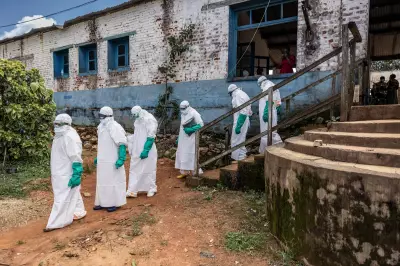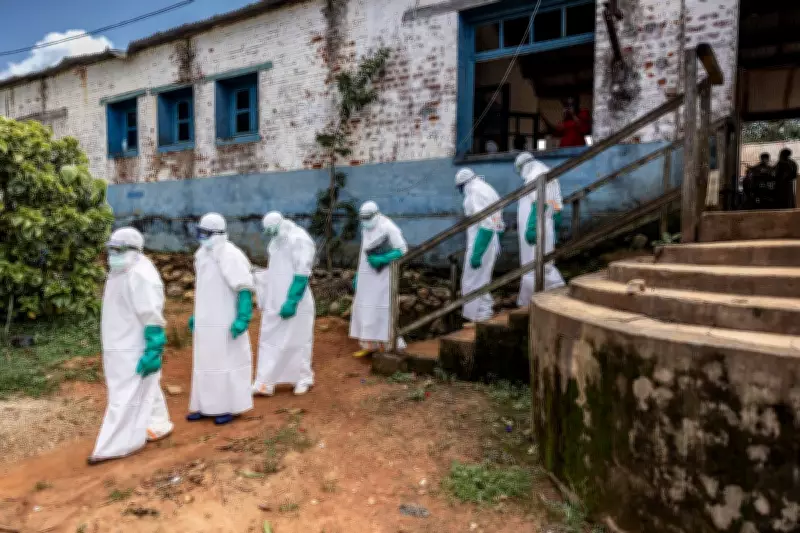
Few people have witnessed the devastating impact of Ebola as closely as Simon Mardel. Over the past three decades, the 69-year-old NHS consultant in emergency medicine has been at the forefront of the world's worst Ebola outbreaks. While nowadays, healthcare staff are equipped with layers of stifling PPE that limit their time on the isolation wards to a maximum of 40 minutes, when Mardel first became involved in the 2000 outbreak in Gulu, northern Uganda, (at the time the worst in history) he and colleagues wore just a surgical mask, apron, gloves and eye protection and worked 12-hour shifts at a time.
That close and prolonged proximity to patients has afforded him a rare clinical understanding of Ebola and the cruelty of a disease which poses the gravest risk above all to those who care for the dying. In the 2000 outbreak, for example, Mardel lost more than 20 colleagues alone, the last of whom was the esteemed medical superintendent of the hospital where he worked, Dr Matthew Lukwiya. After he started feeling unwell, Mardel gave him a medical examination during which both men realised he had developed telltale edemas (swelling of the ankles) which they had previously discovered during the outbreak as an early indicator of particularly severe infection.
As the disease takes hold, patients suffer from extreme vomiting and diarrhoea, leaving them severely dehydrated and dangerously weak. The virus triggers waves of inflammation throughout the body, which can lead to blood vessels to leak fluid and blood pressure to plummet; vital organs including the liver and kidneys then begin to fail. In some cases, internal bleeding compounds the damage, which is when you get the horrific images of Ebola victims bleeding from their eyes. But ultimately, it is the combination of dehydration, circulatory collapse and multi-organ failure that prove fatal.

A person who has died from Ebola remains highly infectious as the virus can persist in bodily fluids after death, which is why specially trained teams use strict protective measures during the handling and burial of Ebola victims. Mardel ended up caring for his friend in a makeshift intensive care unit he helped build, before his patient eventually succumbed to the virus. "The hardest working cleaners, nurses and doctors, they are the ones who are at the highest risk," he says. "It takes out the best people in healthcare in these environments."
Over recent weeks, these former colleagues and friends have been foremost in Mardel's mind as the current outbreak in the Democratic Republic of Congo (DRC) continues to spiral out of control. Already it is the third largest outbreak of Ebola ever recorded with more than 1,000 cases and 233 deaths, including numerous healthcare workers and three Congolese Red Cross volunteers. The World Health Organisation (WHO) has declared it a public health emergency of "international concern".
However, this week aid agencies have raised concerns that there could be far more undetected cases with the outbreak possibly starting in January and spreading unchecked for several months before being officially confirmed by the Congolese Ministry of Health on 15 May. The current outbreak, for example, has already crossed over to Uganda, with possible cases also being detected in Brazil and Italy before later being ruled out by health authorities in each country. This is a situation exacerbated by attacks on clinics fuelled by misinformation shared on social media which has also led to people avoiding hospitals and other healthcare facilities.
With the latest outbreak being caused by the rare Bundibugyo strain of the virus for which there is no vaccine, there are fears it could potentially surpass the 2014-2015 outbreak in West Africa, where more than 11,000 people died. Mardel, who during that outbreak was working as the clinical case coordinator for the WHO in Sierra Leone, describes observing this latest tragedy unfold as like "watching a train crash in slow motion". Of particular concern, he says, is the lack of understanding about the true scale of the current outbreak and how far and fast it is spreading through undetected cases. "I think it's safe to say it could be unprecedented," he says. "The words an epidemiologist should never want to hear are 'unrecognised chains of transmission'."

Mardel's involvement in the current outbreak is at a state of remove. He retired from his full-time NHS role only a month ago and is now working as a locum consultant in emergency medicine in various locations across the north of England. But, even monitoring the situation from his rural Cumbria home, he has seen enough parallels with the mistakes of previous outbreaks – not least around failing surveillance of cases and poor infection control — to fear that this could be the worst yet. "I'm worried that a lot of the lessons haven't been learned," he says.
This year marks a grim anniversary of sorts: 50 years ago the Ebola virus was first detected in then Zaire in 1976 and there have been 17 outbreaks in DRC alone since. Following the turn of the century, Ebola outbreaks have been gaining in speed and ferocity, spreading rapidly across borders. Mardel believes that it is "only a matter of time" before the disease spreads out of Africa into countries and healthcare systems that are entirely unprepared to contain its spread. His biggest immediate fear, he admits, is that this current outbreak will end up in Nigeria, Africa's most populous country with 250 million inhabitants. The virus also flared up here in the 2014 outbreak, with Mardel involved in its containment. He says that only an astonishing amount of good fortune prevented the disease from fully taking hold and warns it will not be the same second time around.
"The potential to amplify in hospitals is phenomenal," he says. "You could get one in and potentially 20 or 30 or even 50 coming out." One of the important and largely unexplored drivers of Ebola outbreaks is the link with illegal gold mining. Early on in his career, Mardel spent several months alone in DRC investigating links between marburg disease (a viral haemorrhagic fever near identical to Ebola which is also harboured in bats) and an illegal gold mine. He describes recording hellish scenes from the deep shaft mine of more than 1,000 men working for days underground amid putrefying corpses killed in rockfalls and drinking water streaming down the walls of caves streaked with layers of bat excrement. The 2014 Ebola outbreak has also been traced to a deep mining area in Guinea, while the latest outbreak started in the Ituri province of DRC and in particular the gold-mining towns of Mongbwalu and Rwampara.
His many years of experience has taught Mardel that speed is the most crucial ally in providing treatment to people who have contracted the disease. "All the data shows that by five days, and by some markers three days, the die is cast and you can start to see who is going to die," he says. This speed is equally important with regard to tracking the virus. If you have an outbreak of 100 cases, he argues, then that is already 2,000 or so contacts who need to be traced by epidemiological surveillance teams. As cases continue to appear far away from Ituri province, Mardel fears we may already have lost control. "They are lagging behind," he says, "and if that is the case, even though DRC has a lot of experience with Ebola, then I think we are in trouble."
While Mardel admits the link between gold mining and the beginning of an outbreak remains something of a hunch, what is undisputed is that they are communities which provide the conditions for rapid spread with clusters of relatively affluent young male workers, prostitutes, and private healthcare facilities and pharmacies with poor infection control. On a personal and professional level, he has seen at first hand the worst that Ebola can do. But left to ravage an entire continent, and possibly beyond, is a nightmare scenario increasingly, he believes, within the realms of possibility.