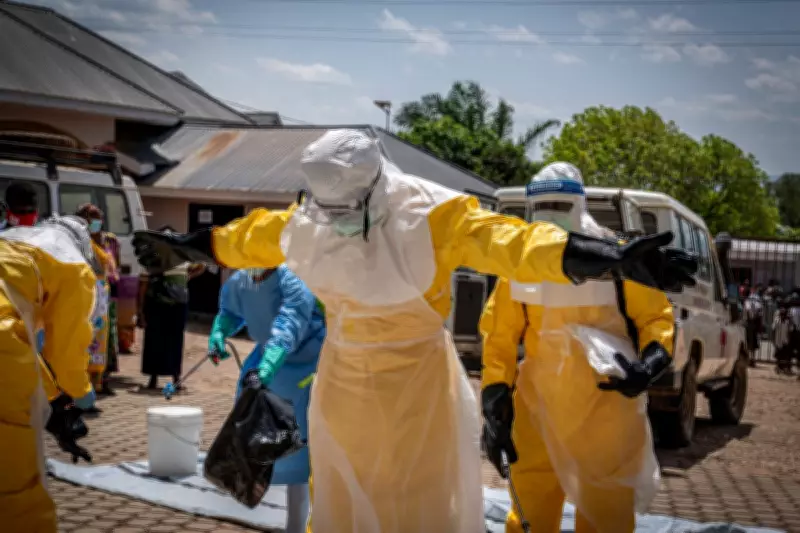
One in three people at the epicentre of the deadly Ebola outbreak in the Democratic Republic of Congo (DRC) do not believe the virus is real, a major hurdle in containing the spread of the disease, according to a new survey by ActionAid.
Misinformation and Denial Widespread
The rapid needs assessment conducted across three health zones in Ituri province found that only 64 per cent of residents believe Ebola is real and not linked to spiritual or mythical causes. Ngone Ngobba Jean Claude, a resident of Lita village, told ActionAid: “In the community, people can’t bring themselves to believe in this disease. Some call it a satanic disease, while others believe it was invented to make money. Others say that doctors are lying, while others believe that taking strong alcoholic drinks makes them immune.”
Aime Lotsove, a woman from Lita, added: “There are a lot of rumours here about diseases. Some say Ebola doesn’t exist, others say Ebola was created. I think what we could do for ourselves is to prevent this disease from coming here to our neighbourhood, because a cure is still not easy to find, but prevention is always better.”

Pierre Basola, a 56-year-old resident of Bunia, around 30 miles south of Lita, is among the sceptics. “These people should stop bothering us. They just want to get rich,” he told the Associated Press. “Let’s not forget that Ebola is a white man’s invention,” he added before refusing further comment.
Outbreak Escalates
The outbreak, declared on 15 May, has resulted in at least 223 suspected deaths and nearly 1,000 cases, with evidence suggesting the virus was spreading weeks before the official declaration. The military governor of Ituri province likened the struggle to contain the virus to a “war,” stating: “People in affected areas are not receiving enough food.” He called for a “swift response,” including strengthening staff capacity to prevent Ituri “descending into catastrophe.”
Isaac, a teacher at Nyama Primary School in Lita, described the psychological toll: “Here, psychologically, we are very affected, very unsettled because as soon as one gets a headache, we think it might be the Ebola virus. Everywhere, we feel uneasy, both within our families and in the community. Everywhere, fear reigns.”
Global Health Officials Sound Alarm
The World Health Organisation (WHO) director-general, Dr Tedros Adhanom Ghebreyesus, said the organisation is “urgently scaling up operations” to contain the virus, noting that the Bundibugyo type of Ebola virus responsible for the outbreak currently has no approved vaccine or treatment. However, he warned that “the epidemic is outpacing us” and called on neighbouring nations to take action, with cases already found in Uganda.
Dr Jean Kaseya, head of the Africa Centres for Disease Control and Prevention (CDC), was even more pointed: “It’s so bad. It’s so bad.”
Combating Myths and Fear
Saani Yakubu, Country Director of ActionAid DRC, highlighted the broader challenge: “We are not just fighting a deadly virus, we are fighting myths, fear and deep-seated suspicion.” He added: “We are working hard to conduct awareness-raising sessions in the communities to debunk a lot of the myths and misinformation. These sessions are being held to help people better understand the risks, reduce fears and misinformation, as well as encourage protective behaviour in line with the guidelines provided.”
This article has been produced as part of The Independent’s Rethinking Global Aid project.