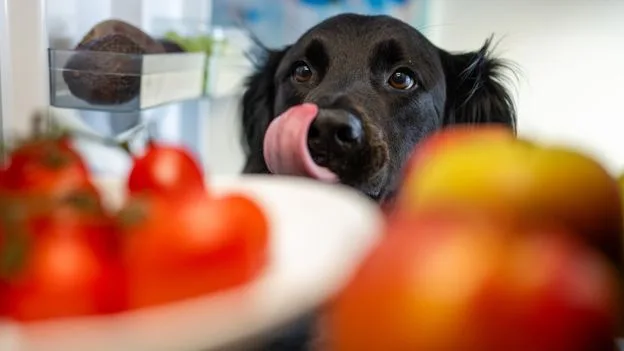
Dog owners who feed their beloved pets 'like humans' have taken aim at older generations' views on nutrition and insisted the trend 'isn't just a fad'. More so than ever before, owners are spoilt for choice when it comes to deciding how to feed their canines, with many now doing away with dry kibble, and instead opting to provide more freshly cooked, homemade meals.
The rise of alternative pet diets - including vegan, gluten-free, grain-free, sustainable and organic options, among others - could mean the days of old-fashioned kibble are truly numbered. Pet food brands have tried to mirror this shift by creating pre-packaged meal ranges that sound fit for humans, such as lamb curries, casseroles and roast dinners.
But the prevailing belief amongst owners, particularly younger dog mums and dads, is that fresh is best - with some spending hundreds of pounds each month to feed their pets better. New research has revealed that 76 per cent of dog owners in Britain expect their pets' food to be the same quality as their own.
Meanwhile 68 per cent are now adding superfoods to their dogs' meals - with the top seven ingredients including sardines, bone broth, blueberries, Greek yoghurt, turmeric, kefir and chia seeds - according to a Pets at Home survey in March. The retailer also found that 35 per cent of owners are willing to make cuts to their own food budget to feed their dogs better, with the average Briton spending £33 per month on human food for their canine.
However these costs are in the hundreds for some. One Sunderland woman revealed in March that she spends £200 per month on 'human food' for her two golden retrievers. That's more than her own shopping bill.
Mags Burns, 65, told ChronicleLive that a cancer scare in 2011 was a 'wake-up call' for her and her dogs. She said: 'Once I was cancer-free, I still decided to eat healthier for myself and my family. And because I do that for myself, I do that for my pets too. Because, really, my dogs are part of my family. So if I was feeding a child, I would feed the child healthy food. I do the same with the dog.'
Experts believe the 'humanisation' of pets, alongside our improved understanding of nutrition, can explain this shift, which owners claim has had massive health and wellbeing benefits for their dogs.
Retired charity worker Michelle Cleary, 55, feeds her pampered poodle Tallulah freshly prepared meals of scrambled egg, salmon, chicken and steamed vegetables, oatmeal, and Greek yoghurt. These are often topped with chia seeds, turmeric, ginger, fish oils and bone broth powder. The three-year-old pup was diagnosed with early-onset arthritis after her leg 'popped out' - so her owner looked for ways to improve Tallulah's mobility.
Ms Cleary, from Weston-super-Mare, Somerset, said: 'I take turmeric, black pepper, oils etcetera, so I thought "what would help Tallulah?". It was a whole different ball game when I introduced probiotics to her diet. The difference is absolutely brilliant, she's a much happier dog. Tallulah was really struggling - she stopped running, jumping and was miserable. Now she eats like we eat… she has completely changed and is now a much more bouncy dog.'
She's also a bit of a diva, according to Ms Cleary. 'When we're out she gets so much attention but she won't touch dog treats. People try to feed them to her but she's not interested… I don't buy processed dog treats anymore,' she said. Instead, the 55-year-old will make Tallulah homemade snacks in the air fryer which are made up of oats, peanut butter, sweet potato and banana with 'dog-friendly' sugar, turmeric and black pepper.
On the change in her poodle's diet, the retiree said: 'You don't know what your dog is eating with all the additives and preservatives [in off-the-shelf dog meals]. You want to know what your dog is eating is healthy.' She added that the trend of owners feeding their dogs 'like humans' is 'not a fad at all' - and others agree.
Executive assistant Jane Bray, 64, feeds her 12-year-old pomeranian poodle Buddy 'roast dinner-style' meals of chicken breast, liver or lamb, often served with vegetables and potatoes or family leftovers. Now her children have left home, Ms Bray, from Stratford-upon-Avon, West Midlands, has more money to spend on Buddy's diet which she switched up after discovering last year that he had a mystery allergy.
She said: 'I had always fed Buddy packet dog food. When my children were both at school I obviously cooked meals every night for them [but since they left home]... I'm not cooking as many fresh meals. We always had meat, potatoes and vegetables and when they went to university I used supermarket dog food more than ever, but as Buddy got older he started losing fur and had lots of scabbing from allergies. The problem came from feeding him normal packet dog food. I went to the vet and got him tested for allergies which cost me £400 and found out he was allergic to beef.'
She moved away from supermarket brands and instead now serves Buddy, who Ms Bray bought for her son because 'he was always on the computer', only 'very, very high quality' dog food. 'I batch cook lamb mince, chicken liver, anything other than beef. I'll have a packet of vegetables for myself and split it with him.' These are topped with powdered supplements which have helped the 12-year-old's fur to grow back.
Ms Bray said: 'You don't know what's in dog food packets. They're very often [written] in foreign and you don't know the food standards [of where it came from]. It's like feeding your own children, you love your dog like your children and they're part of the family. You want the best for them.' Despite Tallulah's acquired taste for fine dining, however, Buddy won't touch Greek yoghurt and isn't fed any kinds of seeds.
Civil servant Amy Walters, 35, serves up daily meals packed with superfoods for her 12-year-old golden retriever Woody after he began to suffer from 'skin issues' three years ago. Woody is fed chia seeds, bone broth, blueberries, strawberries, salmon oil and eggs and Ms Walters said she has seen noticeable differences in his skin and overall health once she transformed his diet.
In the morning Ms Walters feed her golden retriever eggs, blueberries and strawberries, and in the evening carrots and salmon oil, in addition to his main courses, which she said are good for his joints as a senior dog who also has trouble with his hips. The civil servant describes the dishes she prepares for Woody as 'dog adapted family meals' - often pet friendly versions of the food she cooks for herself and her athlete husband.
Ms Walters said: 'This makes it more exciting for him than plain bowls of kibble. He sees these extra bits as a treat. Salmon oil and coconut oil make him much more mobile now than before I fed him these ingredients.' Speaking on historic attitudes to dogs' diets, Ms Walters said: 'People are afraid of change. The older generations said dogs were fine with traditional diets [but they caused] gastro issues. It's silly not to try something new. My parents had dogs and in those days most people didn't have the same readily available information we have about nutrition today. It's more accessible and there is more food available now. Since Covid there are a lot more dog owners with more modern ways of thinking when it comes to feeding their dogs.'
Dog nutritionist Cam Wimble, 32, said the dietary shift is 'fantastic' as freshly cooked meals, including superfoods, can lower cancer rates and improve digestion and life expectancy. He told the Daily Mail: 'Owners are moving away from old diets, and the effects become so obvious with cancer rates and digestive issues. A large part of dogs having these issues comes down to food. Owners are more aware of these issues now. It was always going to happen, much like us humans and the shift in how much nutrition is important to us. It comes from research on humans' health.'
'This isn't just a fad, we can see the results. People see diets as aspirational in a certain sense. It's the same for dog owners with higher levels of ownership, there's a level up in the way we look after dogs. It's not a case of people blindly following the latest fad, there are genuine health benefits being visible in dogs. For every 10 per cent increase in processed foods in a dog's diet, there is an equal increase in the chance of them developing cancer. Those individual ingredients, such as kefir which is a natural probiotic, can help dogs with gut problems and create a stronger immune system. Sardines are great for joint problems.'
Dog owners from the older generation of processed food see this change as silly but dogs being fed whole foods makes a difference to their health. Philippa McNamara, of Pets at Home, said: 'Our research tells us more and more people are looking to nurture the important relationships in their lives, that pets are more like an extended family member. We wouldn't feed children unhealthy food, and owners are applying the same principle to feeding their dogs by adding things like nutrients to their diets. One of the big trends is that people want to be the most loved, favourite family member [by their pets]. Food is one way to win that loyalty.'