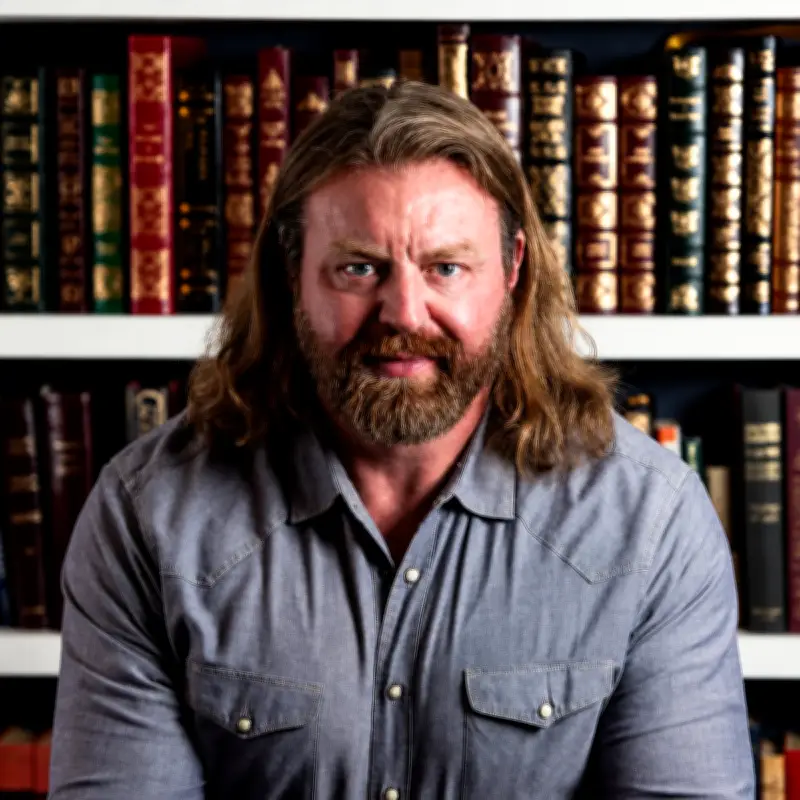
Bryan Hubbard, the Republican Party’s unlikely psychedelic evangelist, becomes even more animated when asked about his experiences of tripping — despite being forced to repeatedly witness his own passing during a high-dose psilocybin mushroom trip a few years ago.
“Whenever death would come, I was always in a hospital, all these tubes coming out of me, all my family gathered around my bed, crying and shaking their heads,” he says, sitting beside a journalist on a sofa in a Shoreditch hotel lobby bar. “Then I would pass away, and I would enter an indescribably beautiful celestial plane. It’s going to make me cry thinking about it, oh my…” The 50-year-old lawyer from Tennessee is welling up, overcome by the memory of the profound experience. He takes a couple of seconds to wipe away his tears and continues: “I was flooded with the most ineffably joyful, all-encompassing love that I think one has the capacity to feel, then I’d be reborn,” he says with a preaching pastor’s poetic flair. “I felt the love of God in a way that I had never felt in my life.”
A Republican Psychedelic Advocate
Hubbard, who is in London to speak at the SXSW conference, would not be seen dead in tie-dye, not even during a hallucination. He is a lifelong GOP voter and practising Christian who did not trip until 2018. Somehow, he has become “the Republican psychedelic whisperer” making the gospel of psychedelic reform palatable throughout Red country. It was earlier this year that Hubbard set in motion a historic chain of events that led US President Donald Trump to sign an executive order accelerating research into psychedelic therapies and expanding access to end-of-life patients — the biggest green light yet for an oft-maligned field long caught in the crosshairs of a politically motivated war on drugs.

From Oval Office to UK Mission
“Ibogaine was presented as a life-saver for US soldiers who are killing themselves at a rate of 22 per day. I think that moved the President’s heart,” Hubbard said. “I want to assure you that my presence here is the most concrete affirmation that God has a wonderful sense of humour,” Hubbard told Trump to laughter in the Oval Office, standing next to podcaster Joe Rogan, before the president signed the order on April 18. Hubbard had appeared on Rogan’s podcast on April 1 alongside former Texas governor Rick Perry to share their success in persuading more than half a dozen states to fund psychedelic drug development trials. Not for psilocybin, but a far more intense psychedelic called ibogaine, which has been credited with saving the lives of countless war veterans by providing respite from crippling PTSD and traumatic brain injury symptoms, while also giving people addicted to drugs a window free from painful withdrawals to recover. Early research suggests that ibogaine not only increases serotonin production but that of new growth proteins in the brain — with a single trip far more impactful than one experience with any other psychedelic.
“When the camera went off and microphones were mute,” Hubbard recalls of the moment after recording the podcast, “I looked at Mr Rogan and said, ‘I need a favour’, and he said, ‘What’s that?’ I said, ‘Would you be willing to ask the President to meet with us to discuss the medicalisation of ibogaine in the US?’ He said, ‘I’ll do what I can’.” Fast forward a couple of weeks and Rogan revealed in the White House that he had texted Trump with information on ibogaine’s benefits, and the President promptly replied: “Sounds great. Do you want FDA approval? Let’s do it.”
The whole experience was like a fever dream for Hubbard, the CEO of advocacy group Americans for Ibogaine. “The concept of ibogaine was presented to Donald Trump as a life-saving therapeutic treatment for United States soldiers who are coming home and killing themselves at a rate of 22 per day,” says Hubbard. “I think that moved his mind, it moved his heart.”

Emancipation Medicine and the UK
Hubbard worked as a workplace compensation lawyer for 16 years before being appointed chair of Kentucky’s Opioid Abatement Advisory Commission, tasked with dispensing funds from pharmaceutical companies to help mitigate the opioid epidemic. That’s when he started advocating for ibogaine — even undergoing the trip with the “emancipation medicine” twice himself. It wasn’t long before he was waxing lyrical about ibogaine’s potential to help end the opioid epidemic.
Ibogaine is the least studied of all the main psychedelics, mostly because the trip’s intensity can in rare cases lead to death, almost always if the patient has an unknown heart condition, or has recently taken contraindicated drugs. That makes safety screening all the more important. “Ibogaine is a serious medication,” acknowledges Hubbard, “and it has to be administered in a clinically controlled medical setting.” At this point the interview steps outside of the hotel and onto Shoreditch High Street.
“I don’t get the sense necessarily that the British people as a whole are very much into individualised expressions of emotionality,” says Hubbard, who lives in Lexington, Kentucky, with his wife and his two daughters. “There is a tremendous sense of social isolation.” But if, for example, Scotland followed the lead of Texas and funded a trial into ibogaine, it could set in motion a chain of events that might persuade Westminster to sanction legal access to psychedelic therapies. Standing in front of two double-decker buses, he sets out his stall in his southern lilt: “I’m here seeking to bring psychedelic medicine to Great Britain from America.” And with that, he goes back into the hotel for a well-earned late-afternoon nap before continuing on a surreal quest that he is convinced was divinely anointed.