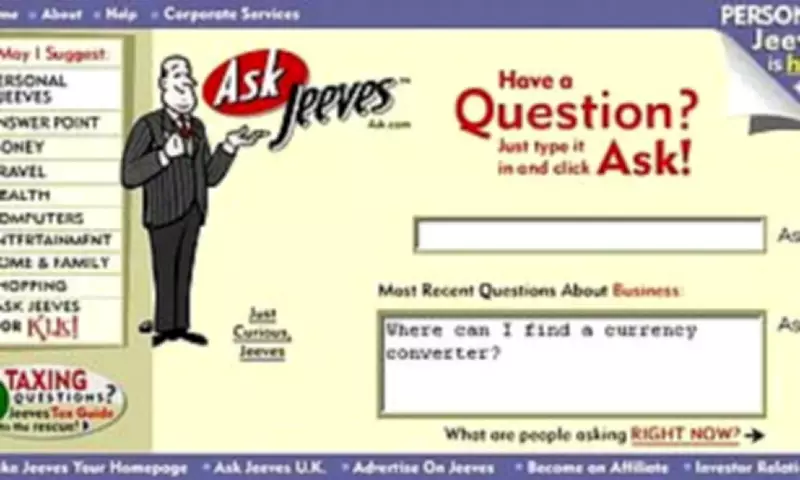
For a generation of early internet users, Ask Jeeves was the most courteous corner of the web: a place where questions were asked in plain English and answered, at least in theory, by a genial digital butler. Now Ask.com, once the home of Ask Jeeves, appears to be slipping quietly into history, its homepage carrying a farewell message that signals the end of one of the internet's most recognisable pioneers.
Farewell Message from IAC
In a statement published on the site by InterActiveCorp (IAC), which has owned Ask.com since 2005, it reads: 'Every great search must come to an end. As IAC continues to sharpen its focus, we have made the decision to discontinue our search business, which includes Ask.com. After 25 years of answering the world's questions, Ask.com officially closed on May 1 2026.'
'To the millions who asked... We are deeply grateful to the brilliant engineers, designers and teams who built and supported Ask over decades. And to you - the millions of users who turned to us for answers in a rapidly changing world - thank you for your endless curiosity, your loyalty and trust. Jeeves' spirit endures.'

The Rise of Ask Jeeves
Long before the dominance of Google, and now uncontrollable supremacy of AI generative-text tools such as ChatGPT, Ask Jeeves formed part of a first wave of search engines that tried to make sense of it all. The site - and its suited, dapper avatar - was created in June 1996 by Garrett Gruener and David Warthen in Berkeley, California, and launched to the public a year later. Alongside rivals such as MSN Search (now Bing) and Yahoo!, it offered a congenial gateway into the digital world, with the added personality of a seemingly knowledgeable human being.
Users were invited to type full questions, not just keywords, and received an outwardly human-like answer. It gained such traction it was later sold for $1.85 billion (then £975 million) by IAC and media mogul Barry Diller.
The Mascot Jeeves
The site's mascot, Jeeves, was lifted from the stories of PG Wodehouse, notably the short story Carry on Jeeves (1925), in which he takes on the role of the faultless valet to the unlucky Bertie Wooster. It was a scene that hit British screens through the television adaptation Jeeves and Wooster (1990), where Stephen Fry's unflappable performance opposite Hugh Laurie brought the characters to life. Jeeves, the ultimate 'gentleman's gentleman', embodied the precise qualities a bewildered early internet user might hope for - discretion, clarity and the ability to conjure answers from sometimes chaotic requests.
Peak Popularity and Decline
The site became one of the top visited sites in the 1990s and 2000s, attracting more than 1 million queries a day within just two years. It also had a massive Jeeves balloon float down Central Park West during Macy's 1999 Thanksgiving parade. However, Google started to move away from offering only blue links to images, news, maps and shopping. The site began to answer questions with answer boxes, delivering faster and more accurate results.
The site dropped the 'Jeeves' and was rebranded to Ask.com in 2006, in a bid to sound more contemporary and overtake Yahoo Answers as a Q&A site. It then in 2010 focused completely on a Q&A approach. However, it got washed away in the tide of Google, Yahoo Answers and Quora - leading to its eventual closure on Friday, 30 years after it was developed.
The site's demise follows in the footsteps of past internet juggernauts, including the iconic sites of Grooveshark, Microsoft's Clippy and Hotmail.