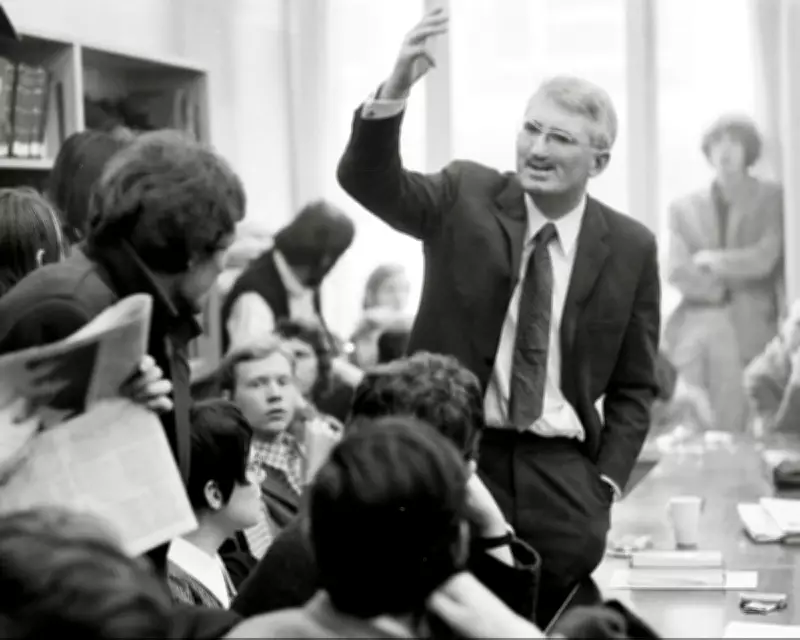
Jürgen Habermas, Philosopher Who Championed Enlightenment After Nazi Era, Dies at 96
The renowned philosopher and social theorist Jürgen Habermas, a steadfast defender of humane Enlightenment values, has died at the age of 96. His life and work were profoundly shaped by his early experiences during the Nazi regime, which he later sought to overcome through rigorous intellectual inquiry and advocacy for democratic discourse.
Early Life and Wartime Experiences
Born in Düsseldorf in 1929, Habermas grew up in Gummersbach near Cologne. As a teenager during the Second World War, he was a member of the Hitler Youth and, at age 15, was sent to the western front to man anti-aircraft defences. He later described his father as a "passive sympathiser" with the Nazis, and young Habermas initially shared that mindset.
However, his perspective was dramatically altered by the Nuremberg trials and documentaries revealing the atrocities of Nazi concentration camps. "All at once we saw that we had been living in a politically criminal system," he wrote, describing this realisation as "that first rupture, which still gapes." This profound shock at what he termed his fellow Germans' "collectively realised inhumanity" became the foundation for his lifelong philosophical mission.

Academic Development and Frankfurt School Influence
After the war, Habermas enrolled at the University of Bonn, later studying philosophy at Göttingen and Zurich. His intellectual journey took a decisive turn when he became assistant to Theodor Adorno at the Institute of Social Research in Frankfurt in 1956. There, he engaged with the critical theory developed by Adorno and Max Horkheimer, who had returned from American exile to re-establish the Frankfurt School.
While Adorno grappled with philosophical despair following Auschwitz, Habermas sought to develop systematic methods inspired by German philosophical titans like Kant, Hegel, and Marx. He aimed to work out how "citizens could still exercise collective influence over their social destiny through the democratic process." From Adorno, he took the imperative to create a "new categorical imperative that Hitler has imposed on mankind: namely, to order their thought and actions such that Auschwitz never reoccurs."
Key Philosophical Contributions
Habermas's habilitation thesis, The Structural Transformation of the Public Sphere (1962), established his reputation. He defined the public sphere as "the realm of our social life in which something approaching public opinion can be formed" through unrestricted discussion among citizens. He argued that intellectuals must guide debate toward rational consensus rather than allowing media manipulation to stifle expression.
His magnum opus, the two-volume Theory of Communicative Action (1981), developed his concept of communicative reason against instrumental reason. He proposed an "ideal speech situation" where citizens could raise moral and political concerns defended solely by rationality, viewing this as essential for human flourishing after Auschwitz.
Public Intellectual and Controversial Figure
Habermas remained an engaged public intellectual throughout his life, commenting on contemporary issues from European integration to historical memory. In the 1980s Historikerstreit (historians' quarrel), he vehemently opposed attempts to relativise Nazi crimes, insisting on "the obligation incumbent upon us to keep alive ... the memory of the sufferings of those who were murdered by German hands."
His support for student radicals in the 1960s was tempered by criticism of their methods; he famously accused leader Rudi Dutschke of promoting "left fascism" for advocating revolution by "any means necessary." Habermas maintained that reason and clear communication were crucial bulwarks against fascism, and violence had no role in democratic discourse.
Later Years and Legacy
Even in his tenth decade, Habermas continued writing and engaging with contemporary issues. His final major work, the three-volume Also a History of Philosophy, explored how figures like Kant, Marx, and Kierkegaard influenced his philosophical enterprise. His last book of conversations, Things Needed to Get Better, appeared in English in 2025, offering both rebuke to defeatist thinking and hope for progressive change.

Habermas faced criticism from postmodernists like Jean-François Lyotard, who questioned his belief in progress and consensus, and from philosophers like Richard Rorty and Slavoj Žižek, who argued his concepts of the public sphere and communicative action were utopian. Yet he remained steadfast, stating: "If there is any small remnant of utopia that I've preserved, then it is surely the idea that democracy is capable of hacking through the Gordian knot of otherwise insoluble problems."
He is survived by his children Tilmann and Judith. His wife, Ute Wesselhoeft, whom he married in 1955, died last year, and another daughter, Rebekka, died in 2023. Habermas's legacy as Europe's most engaged public intellectual and a philosopher who sought to redeem Enlightenment values after the darkness of the Nazi era endures through his voluminous writings and enduring influence on social and political thought.