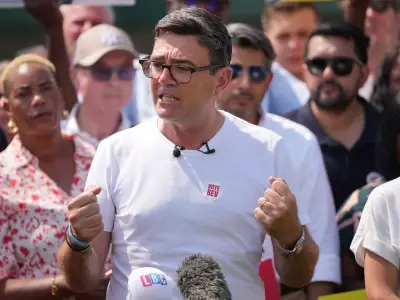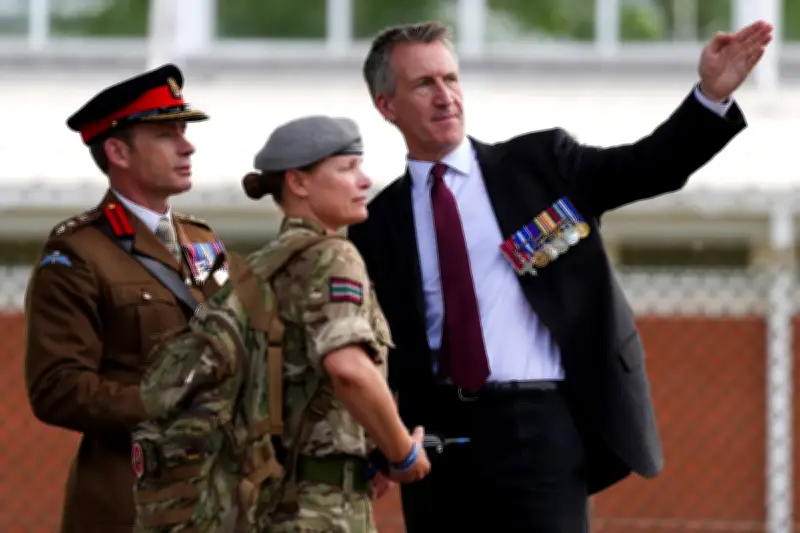
Defence Secretary Dan Jarvis has expressed confidence that incoming prime minister Andy Burnham will provide the necessary investment for Britain's armed forces, even as a £4.7 billion funding shortfall awaits him. Speaking to reporters during a visit to Cambridge Aerospace on Wednesday, Jarvis stated he had the “assurance that, as prime minister, Andy Burnham will make sure that we’ve got the investment coming into defence.” However, he acknowledged that “conversations” would be needed with Burnham, who is expected to succeed Sir Keir Starmer in less than three weeks, and vowed to “fight hard for defence.”
£15 billion defence boost with uncertain funding
Tuesday’s Defence Investment Plan (Dip) saw Jarvis secure a £15 billion uplift in defence spending, largely funded by cuts to other departments’ capital budgets. However, the Treasury has not yet detailed how it will finance almost a third of this increase, leaving £4.7 billion to be addressed at the next budget. This decision presents a potential challenge for Burnham in his first budget, forcing him to choose between higher taxes, increased borrowing, or further spending cuts to bridge the gap.
Jarvis defended the postponement of some funding decisions, calling it “not unreasonable” for “those kind of commitments are made in the context of a major fiscal event.” When pressed on the source of the extra money, he deferred to the Treasury, saying, “My job is about securing more money for defence.”

Timing of Burnham's briefing questioned
Earlier, defence minister Luke Pollard suggested that Burnham only learned of the £4.7 billion gap when the Treasury figures were published on Tuesday. Pollard told Sky News: “Downing Street have a close dialogue with Andy’s team… I understand they’ve been keeping him close to the process, and told him yesterday when the Treasury published the statement and the breakdown of the financial costs.” However, he later declined to answer questions on when Burnham was informed, telling BBC Radio 4’s Today programme he was “not involved with those conversations.”
The long-delayed plan, published on Tuesday, includes the £15 billion boost. In a written statement to Parliament, Chancellor Rachel Reeves confirmed that only two-thirds of the sum—£10.3 billion—had been identified, with the remaining £4.7 billion to be “confirmed at Budget 2026, in a fair and balanced way.” Downing Street insisted the plan was “credible” but declined to “get ahead of” the next budget on funding specifics.
Political tensions and warnings
Prospective prime minister Burnham was briefed on the Dip before its publication, but it is understood he was not told about the need to find additional funding in his first budget. In what appeared to be advice to Burnham, Chancellor Reeves warned that borrowing more for defence would risk national security. Writing in The Telegraph, she stated: “By preserving economic resilience, keeping borrowing costs down, and supporting growth, they enable us to spend what is needed to secure Britain. A Britain spending beyond its means is a weak Britain – one that is more vulnerable to global shocks like the ones caused by Russia’s invasion of Ukraine and more recently the war in Iran. That weakness would be something that our adversaries could exploit, to the detriment of our national security, right down to the pounds in people’s pockets. I will never let that happen.”
Jarvis denied that the funding gap was a “hand grenade” for Burnham and his new chancellor, insisting it was “absolutely the opposite.” He sidestepped repeated questions on whether Burnham was made aware of the gap, telling BBC Newsnight: “Of course we’ve been talking to Andy Burnham and his team about this plan,” pointing to Sir Keir’s focus on a “smooth transition” of power.

Spending cuts and project impacts
Reeves said the Treasury would focus on finding “efficiencies” and cancelling or delaying “lower priority programmes,” while emphasising that the Government would not cut day-to-day spending to pay for defence. Transport and energy budgets will face larger cuts than other departments, but Downing Street could not specify which projects would be scrapped or scaled back. The Prime Minister’s official spokesman said details would be provided “by the autumn.” The spokesman also declined to rule out cuts to some hospital building programmes but confirmed that plans to remove dangerous Raac concrete from hospitals and the first wave of the New Hospitals Programme would proceed.
The plans include billions more for next-generation stealth jets, the largest ever investment in drone warfare, and confirmation that the UK will buy F-35A planes capable of carrying nuclear bombs. However, older equipment, including two Type 23 frigates and older Chinook and Wildcat helicopters, will be retired. The Dip, originally due last year, was delayed partly due to Whitehall wrangling over money. The funding comes on top of the £270 billion already promised for defence from 2025/26 to 2028/29.