

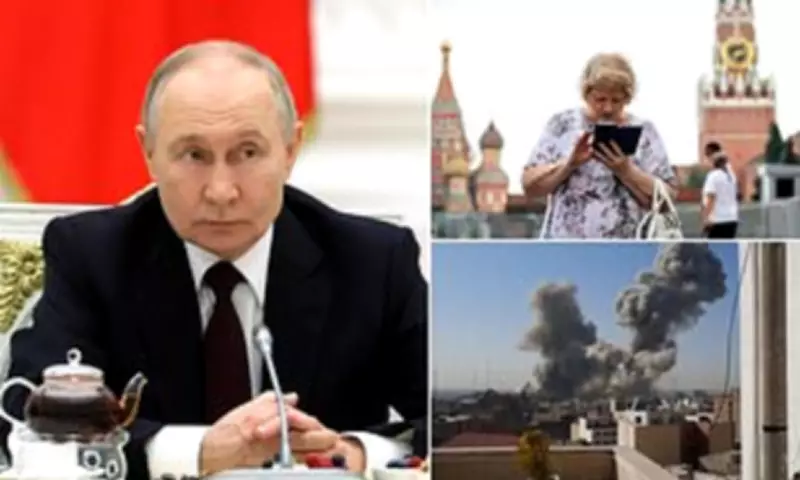
Putin's Internet Crackdown Intensifies Across Russian Cities
Vladimir Putin is dramatically tightening control over Russia's internet infrastructure as mounting fears within the Kremlin suggest digital surveillance systems could potentially be turned against the state itself. This heightened security posture follows Israel's sophisticated operation against Iran, where Tehran's own networks were exploited to eliminate Supreme Leader Ali Khamenei.
Widespread Disruption and Daily Blackouts
Across Moscow, St Petersburg, and other major urban centers, the impact of these measures is becoming increasingly visible. Office workers are grappling with blocked connections, teenagers are forced to constantly switch between virtual private networks, and taxi drivers find themselves navigating without reliable online maps. Over the past week, mobile internet has reportedly been completely down daily in parts of central Moscow and beyond.
Kremlin spokesman Dmitry Peskov confirmed these measures, stating they are partly related to foreign companies refusing to comply with Russian legislation and partly due to security measures against the threat of Ukrainian drones. Russian authorities maintain that attack drones can utilize cellular networks for navigation assistance, making restrictions on services like Telegram and WhatsApp essential for national security.

Iranian Precedent Sparks Kremlin Anxiety
The strategic shift comes amid elevated security concerns following the assassination of Iran's supreme leader. Reports indicate Israeli intelligence successfully hacked Tehran's extensive CCTV systems, allowing them to track movements of Iran's leadership with precision. Israel reportedly gained access to nearly all of Tehran's cameras, which Iran extensively uses to monitor regime opponents and its own population, enabling Mossad to develop intimate knowledge of bodyguards' routines and protective assignments.
This electronic snooping capability is even more extensive under Russia's police state apparatus, raising fears that similar vulnerabilities might exist within Russian systems. In response, Putin's public appearances at the Kremlin have reportedly been halted or severely limited in what appears to be an effort to confuse potential adversaries.
Expanding Legal Framework for Control
Diplomats and analysts suggest the scale of the clampdown indicates a broader objective of tightening domestic control as the war in Ukraine continues. New legislation now empowers security services to disconnect users at will and expands detention powers significantly. Moscow has already blocked more than 400 VPN services while slowing Telegram and fully banning WhatsApp for non-compliance with local laws.
Russian officials have alleged that Telegram was penetrated by Ukrainian and NATO intelligence agencies, claims the company vehemently denies. Telegram founder Pavel Durov criticized the measures, stating authorities fabricate new pretexts daily to restrict Russians' access as they seek to suppress privacy and free speech rights.
Learning from Authoritarian Models
Two sources revealed that Russia has studied internet control models in China and Iran, developing capabilities to shut down large portions of both mobile and fixed internet while maintaining tight communications control. Analysts believe the motivation extends beyond the current conflict, rooted in the Kremlin's long memory of instability.
Security expert Andrei Soldatov explained that Russia's leaders remember 1991 and what happened when Moscow ended the Afghanistan war: The country collapsed, security services split apart - it was a disaster. What's happening now is security services trying to create a situation where neither peace nor protracted war would destroy everything.
Public Response and Alternative Platforms
The Kremlin insists all actions are lawful and necessary for stability, with officials close to Putin denying the measures are repressive, claiming they're essential to maintain unity against Western attempts to sow discord. Meanwhile, younger Russians are finding ways around restrictions, switching between VPNs not for political reasons but to access platforms like Instagram and Snapchat.

Moscow is reportedly attempting to force Russians to use MAX, a state-backed messenger app that schools and universities have been instructed to use for parent and student communication groups. This push toward domestic platforms represents another facet of the broader control strategy unfolding across Russia's digital landscape.





