The Rise of Drone Swarms and AI in Modern Middle Eastern Warfare
Military commanders across the Middle East are increasingly turning to lethal drone swarms and sophisticated artificial intelligence systems to gain strategic advantages in contemporary conflicts. This new paradigm of warfare, blending virtual cyber operations with physical drone attacks, represents a significant evolution learned extensively from the ongoing conflict in Ukraine. Both American and Iranian forces have absorbed crucial lessons from the Ukrainian battlefield, applying them to regional confrontations.
Iran's Underground Drone Arsenal Revealed
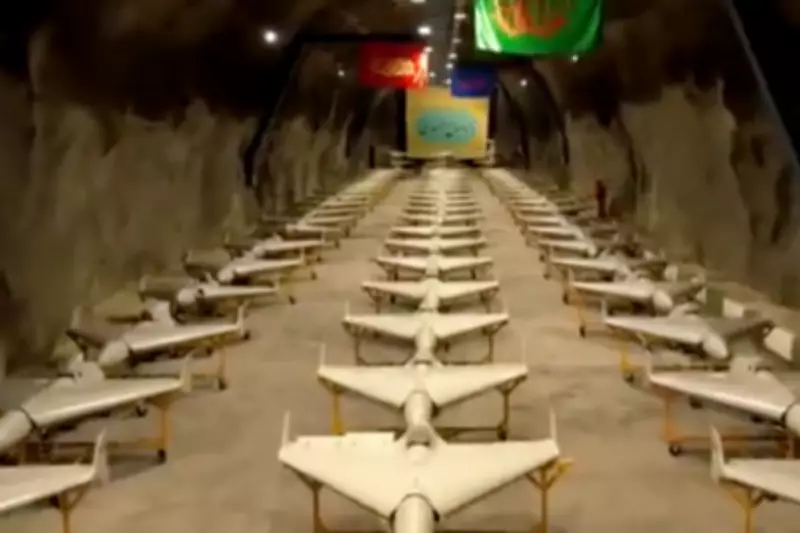
Iran recently unveiled a substantial underground stockpile of attack drones through a chilling propaganda video, demonstrating their commitment to this new form of warfare. The battle for aerial dominance over Israel and Iraq mirrors lessons learned repeatedly in Ukraine, where drone superiority has become fundamental to modern close-quarters combat. Since last Saturday alone, Iran has launched over a thousand missiles across the Middle East, predominantly using the ubiquitous Shahed 136 kamikaze drone.
This standard one-way attack vehicle, employed by both Iranian and Russian forces, has now been surpassed by the enhanced 136b model with greater range and payload capacity. Russian forces have progressed further, deploying jet-powered drones that offer increased speed and lethality. Ukrainian military authorities now estimate that approximately eighty percent of all casualties on primary battlefronts result from unmanned vehicle attacks.

The Drone Production Race and Its Consequences
Ukraine aims to manufacture four million drones annually to meet roughly half their requirements for continuing the war another year. Meanwhile, Russia suffers devastating losses, with 415,000 battle casualties annually and monthly recruitment deficits for the first time. The convergence of drone warfare and cyber operations creates a new pattern of hybrid conflict that threatens to trap nations in cyclical on-off warfare for generations.
Significant differences exist between drone applications in Ukraine and the Middle East. While drone supplies to Russian and Ukrainian forces appear nearly limitless, Iran's substantial arms industry has suffered severe damage from Operation Midnight Hammer's twelve-day bombing campaign last June and Operation Epic Fury this weekend. The Revolutionary Guard Corps may now possess only their final thousand or so Shahed 136 drones.
Gulf State Vulnerabilities and Homeland Defense Concerns
The haunting imagery of Shahed drone strikes on high-rise buildings and airport lounges in Dubai, Kuwait, Bahrain, and Doha should provoke serious concern. Although Gulf States maintain relatively effective missile defense systems, surveillance videos demonstrate that some Shahed drones penetrate these defenses, and debris from Patriot battery interceptions can still cause substantial damage.
This raises alarming questions about Western homeland defense capabilities. How would London fare if multiple Shahed drones launched from the Thames Estuary targeted Waterloo Station? The sobering answer is "not very well." Investment in integrated air defense systems against surprise drone and missile attacks remains woefully inadequate, while the threat of rogue attacks grows more realistic monthly, as evidenced by drone campaigns in Ukraine and the Middle East.
The Ukrainian Model of Improvisation and Adaptation
Ukraine's conflict demonstrates ultimate military improvisation, with increasingly autonomous units from small platoons to entire brigades generating their own autonomous weapons. These forces constantly update systems and circumvent enemy countermeasures, utilizing 3-D printers as essential tools. Their drones, ranging from large surveillance models to individual first-person view vehicles, monitor a "grey zone" no-man's land extending up to twenty miles deep along front lines.
In this thoroughly surveilled environment, nearly all movement is detected from above, making traditional massed tank, howitzer, or infantry attacks virtually impossible. Automated and autonomous vehicles now handle much frontline coverage, becoming standard components of military doctrine and training manuals worldwide.

FPV Drones and Internal Conflict in Iran
Currently, three to four thousand FPV drones are being deployed by anti-regime protesters in Iran to track and confront members of the Baij militia police, military police groups, and IRGC elements. Reports indicate hundreds, possibly thousands, of IRGC members fleeing across the eastern border from Mashad into Afghanistan. The cat-and-mouse game enabled by FPV drones proves simultaneously remote, deadly, and intensely personal.
Challenges for Traditional Military Structures
The proliferation of autonomous weapons and their command systems, combined with battlefield artificial intelligence for organization and deployment, presents profound challenges to conventional armed forces like Britain's. Automation disrupts traditional command and discipline norms, while AI and autonomy require devolving responsibility to individual soldier levels. Paradoxically, this technological shift demands enhanced human tactical skills and decision-making capabilities.
Ultimately, the most fundamentally human military task—taking and holding ground—remains exclusively achievable by human soldiers rather than machines. Human cohesion, cooperation, and community solidarity can be enhanced virtually through cyberspace's expanding toolkit, creating a new mashup of virtual and physical realities that rewrites traditional warfare rules and, hopefully, peacebuilding approaches.
The Enduring Human Element in Technological Warfare
The moral from Ukraine's unfinished conflict, recent Middle Eastern wars, and Afghanistan's legacy is that strategic planning remains essential, even when initial plans collapse upon first contact with combat reality. This isn't necessarily negative—Ukrainian forces have demonstrated remarkable genius in modification and improvisation.
The crucial element remains people rather than boots on the ground—those who already inhabit war zones and are too often ignored or forgotten, as occurred in Iraq and Afghanistan. Drones may temporarily dominate skies, but the men and women on the ground must serve as both providers and recipients of peace, whether in Kabul, Baghdad, Jerusalem, Gaza, or Tehran.