The United States' dramatic military incursion into Venezuela, culminating in the arrest of President Nicolás Maduro and his wife, has been framed by the Trump administration as a necessary strike against narco-terrorism and illegal migration. However, a closer examination by a leading Venezuelan criminologist exposes this as a cynical pretext for a resource grab.
The Flimsy Pretext of a Drug War
In the early hours of 3 January 2026, US forces bombed Caracas and other Venezuelan cities, kidnapping President Maduro and First Lady Cilia Flores. The operation, which has caused at least 100 deaths from the bombings and approximately 100 more from prior US attacks on boats, was initially justified as a mission to combat drug trafficking and stem migrant flows allegedly orchestrated by Caracas.
Andrés Antillano, a social psychology professor who has studied Venezuelan drug trafficking for two decades, finds this narrative far-fetched. While Venezuela historically served as a cocaine transit route, its role has diminished sharply. According to the UN World Drug Report 2025, only 5% of Colombian cocaine now passes through Venezuela.

Antillano argues that Venezuela's profound state fragmentation and internal competition among criminal and state actors make it an unreliable route for traffickers, who require predictability. "Securing the collaboration of one state actor does not guarantee escape from another," he notes, undermining the idea of a centrally controlled narcostate.
Debunking the 'Cartel de Los Soles' and Migration Myths
The Trump administration specifically invoked the 'Cartel de Los Soles' – a term used for decades to allege high-level military involvement in drugs – as a key reason for Maduro's capture. Yet, as Antillano points out, US prosecutors in New York notably avoided charging Maduro with leading such a coordinated cartel structure, likely due to a lack of evidence.
On migration, Trump has repeatedly claimed the Venezuelan government empties prisons to send criminals to the US. He designated the Venezuelan gang Tren de Aragua a 'foreign terrorist organisation' and deported thousands. However, studies show no disproportionate Venezuelan crime rates in host countries and US intelligence finds no link between the gang and the Venezuelan government.
The Real Motive: Plunder and Regional Dominance
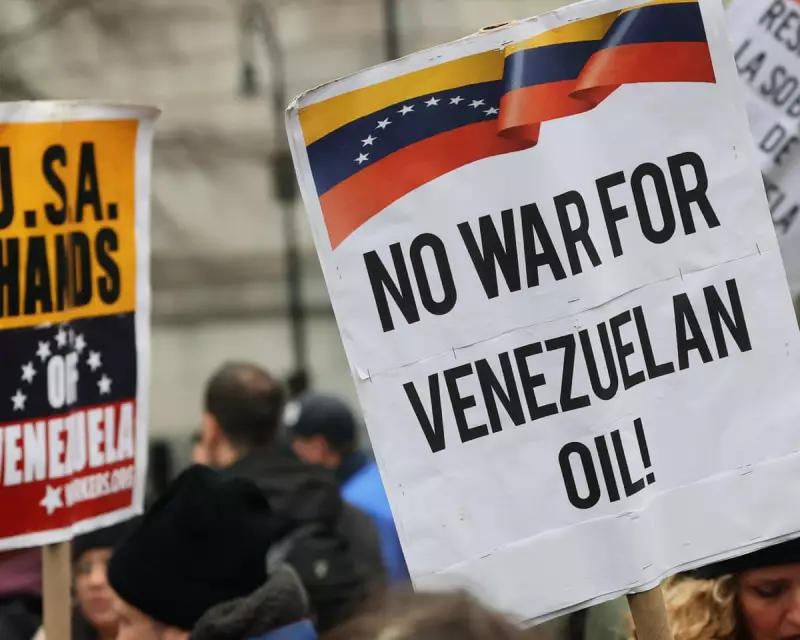
Antillano concludes that the familiar scapegoats of drugs and migration are folk devils, trotted out to legitimise aggression. The underlying motives, he asserts, are the plunder of Venezuela's vast natural wealth and the intimidation of the region into submission to Washington's will.
The sight of a demonstrator outside a New York courthouse on 5 January 2026, where Maduro and Flores were arraigned, symbolises a contentious new chapter. This act of extraterritorial enforcement, built on contested justifications, sets a dangerous precedent for international relations and the use of military force under the guise of law enforcement.