Army Pilot Wounded in Maduro Raid Receives Medal of Honor at Trump's Address
A helicopter pilot who sustained severe injuries during the audacious raid that captured former Venezuelan President Nicolás Maduro has been honoured with the Medal of Honor. The prestigious award was presented during President Donald Trump's State of the Union address on Tuesday evening, highlighting a mission that has remained largely secretive since its execution.
Details of the Daring Operation
President Trump revealed that Army Chief Warrant Officer 5 Eric Slover, aged 45, piloted the lead CH-47 Chinook helicopter during the operation. The mission targeted a heavily fortified military fortress where Maduro was residing, plunging the South American capital into darkness as U.S. troops infiltrated the compound. Months of covert planning culminated in this brazen action, which successfully extradited Maduro to the United States to face drug trafficking charges.
Trump described how Slover's helicopter faced intense enemy fire while preparing to land. "Enemy machine guns fired from every angle, and Eric was hit very badly in the leg and hip, one bullet after another," the President stated. He emphasised that Slover "absorbed four agonizing shots, shredding his leg into numerous pieces" yet continued to manoeuvre the aircraft to safety.

Heroic Actions Under Fire
The President provided new, detailed insights into the military action, which occurred in the early hours of January 3. As Slover attempted to land, he confronted two machine gunners who had evaded previous airstrikes. "Eric manoeuvred his helicopter with all of those lives and souls to face the enemy and let his gunners eliminate the threat," Trump recounted, noting that this decisive action prevented a catastrophic crash in hostile territory.
Trump asserted that "the success of the entire mission and the lives of his fellow warriors hinged on Eric's ability to take searing pain." The raid resulted in seven U.S. service members sustaining gunshot wounds and shrapnel-related injuries, underscoring the perilous nature of the operation.
Award Ceremony and Recognition
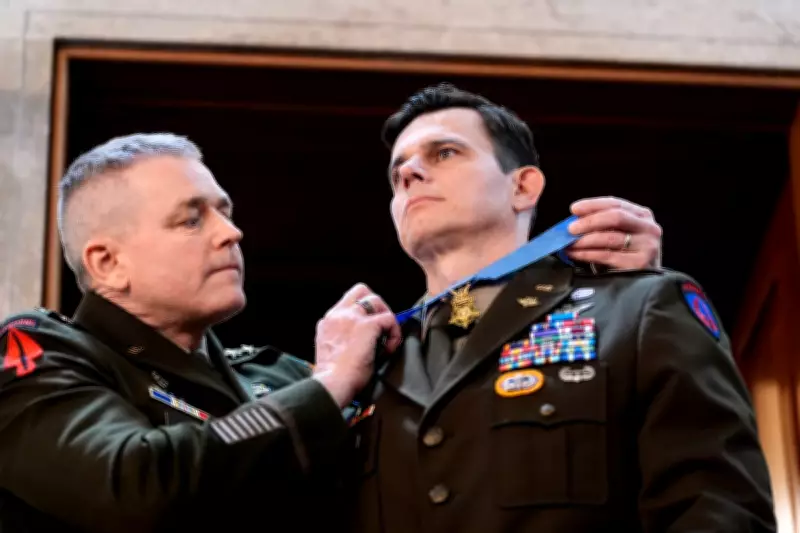
Lt. Gen. Jonathan Braga, commander of Joint Special Operations Command, presented the Medal of Honor to Slover in the gallery overlooking the House chamber. Slover, who appeared in his dress uniform using a walker for support, is still recovering from his wounds. Trump acknowledged his ongoing rehabilitation, highlighting the soldier's resilience.
According to Lt. Col. Allie Scott, a spokeswoman for Army Special Operations Command, Slover enlisted in the U.S. Army in August 2005. After completing basic training, he attended Warrant Officer Candidate School and flight school, qualifying as a Chinook pilot. Over his 20-year career, Slover has accumulated numerous accolades, including:
- Two Distinguished Flying Crosses, one with a V Device for valor
- Two Bronze Stars
- Two Meritorious Service Medals
- Two Air Medals
- A Purple Heart
Additional Honours and Secrecy Protocols
Trump announced that ten other service members involved in the operation will receive medals at a private White House ceremony soon. This public recognition is unusual, as the military typically avoids identifying special operations personnel, often obscuring their faces during training to maintain secrecy.
During the same address, Trump also awarded the Medal of Honor to retired Navy Captain E. Royce Williams, a 100-year-old former fighter pilot who shot down multiple Soviet jets during the Korean War. His existing Navy Cross was upgraded, with Trump hailing him as "one of the last living legends." This dual recognition underscored the administration's commitment to honouring military valor across generations.