Army Secretary Dan Driscoll Stands Firm Amid Pentagon Power Struggles
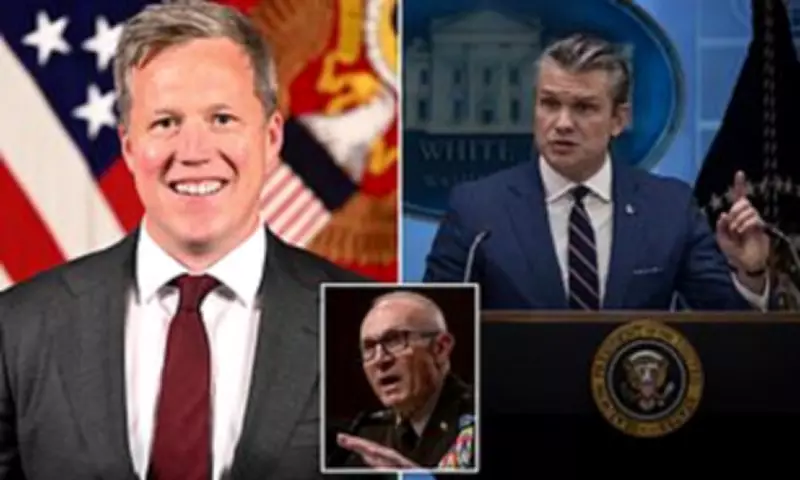
Army Secretary Dan Driscoll has publicly vowed that he will not resign from his position, despite mounting speculation about his future following clashes with Defense Secretary Pete Hegseth. This declaration comes in the wake of last week's abrupt removal of Driscoll's ally, General Randy George, amid the contentious war in Iran.
Disagreements and Denials
Officials have revealed to the Washington Post that Driscoll and Hegseth have disagreed on several critical issues recently, including the Defense Secretary's moves to block the promotion of multiple Army officers. However, Driscoll has categorically denied any intention to leave his role at the Pentagon.
'Serving under President Trump has been the honor of a lifetime, and I remain laser-focused on providing America with the strongest land-fighting force the world has ever seen,' Driscoll stated in an official communication to the Post. 'I have no plans to depart or resign as the Secretary of the Army.'

White House Support and Pentagon Dynamics
The White House has appeared to back Driscoll, who shares a longstanding friendship with Vice President JD Vance dating back to law school. Spokeswoman Anna Kelly emphasised the president's confidence in Driscoll's leadership, noting that Trump has 'effectively restored a focus on readiness and lethality across our military with the help of leaders like Secretary Driscoll.'
Kelly further highlighted the Army's performance in Iran, stating, 'The extraordinary talent of the United States Army is on full display as our warfighters meet or exceed all of their benchmarks under Operation Epic Fury and Iran's military capabilities diminish more every day.'
Hegseth's spokesman, Sean Parnell, has disputed assertions of tension, telling the Daily Mail, 'Secretary Hegseth maintains excellent working relationships with the secretaries of every military service branch, including Army Secretary Dan Driscoll.' Parnell added that Hegseth and Vance are 'fully aligned in executing President Trump's America First agenda' and work seamlessly together.
Behind-the-Scenes Tensions and Speculation
Despite public assurances, sources indicate that Hegseth has harboured concerns about Driscoll potentially replacing him since the March 2025 group chat controversy, often referred to as Signal-gate. One official told the New York Post, 'This is all driven by the insecurity and paranoia that Pete has developed since Signal-gate. Unfortunately, it is stoked by some of his closest aides who should be trying to calm the waters.'
By autumn, Driscoll reportedly grew concerned enough about his deteriorating relationship with Hegseth that he sought assistance from Vice President Vance, according to three individuals familiar with the situation. Meanwhile, speculation has emerged that if Driscoll were fired, Parnell is positioning himself as a potential successor.
A senior Pentagon official told The Daily Mail, 'It wouldn't be out of line to speculate that Sean would be considered as a successor as he is one of the highest profile Army veterans serving at the top of Department right now, but both men are focused on serving the President and doing the job they have now.'
The Ouster of General Randy George
General Randy George's removal last week has intensified scrutiny on Driscoll's position. George, who was confirmed by the Senate in 2023, had long been viewed as a target within the Trump administration due to his selection by the previous administration and his role as a senior military assistant to former Defense Secretary Lloyd Austin.
George had also advocated for diversity training in the military, telling lawmakers during his confirmation hearing that it was a component in building cohesive teams. He worked closely with Driscoll, who supported George's efforts to integrate drones and emerging technologies, even traveling with him to Ukraine to gather lessons from the conflict.
One official noted, 'There have been multiple instances where Secretary Hegseth has tried to remove George and Driscoll has said, "No he's done nothing wrong. He's good,"' adding that Driscoll 'has been very clear that merit should speak for itself.'

However, George was asked to retire early during a phone call with Hegseth, and the decision quickly leaked to CBS News, preventing Driscoll from intervening. The reasons for George's ouster remain unclear, but it followed controversies including Hegseth blocking promotions of two black and two female officers, and an incident involving Apache helicopters hovering over Kid Rock's home.
George had favoured letting an investigation into the helicopter incident proceed, but Hegseth rescinded suspensions and quashed the probe. An official remarked, 'It shouldn't be a surprise that a man who enlisted at the age of 18, later commissioned as an officer and spent his entire adult life in the military would be committed to standards and discipline.'
Broader Army Changes and Iran Ceasefire
George was not the only high-level official removed recently. The Pentagon confirmed to the Daily Mail that General David Hodne, head of the Army Transformation and Training Command, and Major General William Green Jr, head of the Army's chaplain corps, were also let go. Hodne had run a department initiated by George.
A Pentagon official stated, 'We are grateful for his service, but it was time for a leadership change in the Army.' These terminations occurred amid the war in Iran, before President Trump announced a two-week ceasefire and the reopening of the Strait of Hormuz.
Trump posted on Truth Social, 'I agree to suspend the bombing and attack of Iran for a period of two weeks,' after earlier threatening severe consequences if Iran did not reopen the Strait. He cited assurances from Pakistani Prime Minister Shehbaz Sharif that Iran would agree to 'the complete, immediate, and safe opening of the Strait of Hormuz.'
Trump described the ceasefire as 'a double-sided ceasefire' and noted, 'The reason for doing so is that we have already met and exceeded all military objectives, and are very far along with a definitive agreement concerning long-term peace with Iran.' Israel also agreed to halt attacks, with the ceasefire taking effect once the Strait is reopened.
Iranian officials confirmed the truce, with foreign minister Abbas Araghchi stating that 'safe passage through the Strait of Hormuz will be possible' during the two-week period. Trump indicated that a 10-point peace proposal from Iran is 'a workable basis on which to negotiate,' despite earlier reservations.