British Naval Pride Eclipsed by French Military Display in Cyprus
In my youth, the centrepiece of my bedroom wall was not a football icon or a cinematic star, but a striking print of British battleships cutting through the waves. The painting depicted a formidable line of First World War dreadnoughts, their billowing white ensigns and dark smoke stacks evoking an almost audible growl of patriotic pride. I adored that image—the sheer width and muscular presence of those vessels. God save the Royal Navy, indeed.
A Flutter of Envy at a Foreign Fleet
This week, a similar sentiment stirred within me upon seeing another photograph of warships, this time steaming towards the Persian Gulf to bolster defences against Tehran's rocket threats. The image showed a squadron of destroyers escorting a mighty flagship, their slicing prows creating white wakes that spoke of undeniable heft. Sound the hornpipes. Let slip the salty dogs of war.
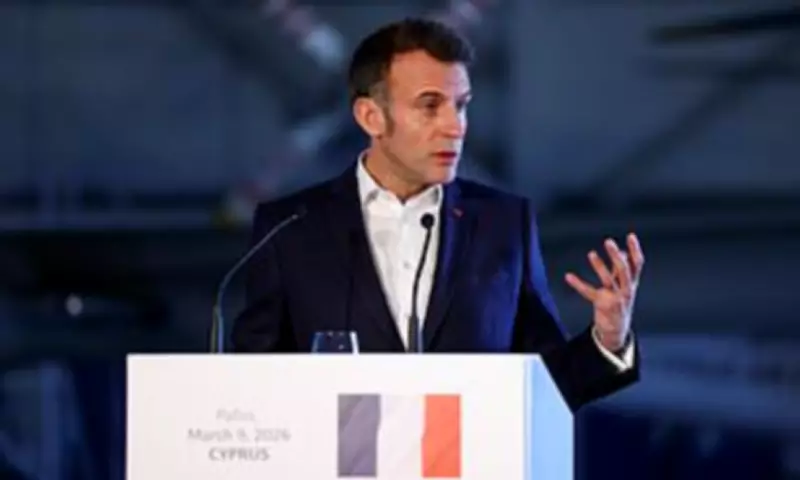
However, there was a singular, jarring problem: these ships were not British. They were, astonishingly, French. Zut! On that very same day, the official aircraft of France's president touched down in Cyprus, an island that was a British colony until 1960 and has historically relied on the United Kingdom for military protection.

The plane's jets whined to a halt, steps were wheeled to its glistening fuselage, and out stepped the egregious Emmanuel Macron, one hand casually tucked into his trouser pocket. The Cypriot president eagerly sprang forward to shake his hand as if greeting Liberty herself.
The Gallic Contrast with British Hesitancy
Soon, Macron was spotted wearing large sunglasses, the epitome of sangfroid. This provoked a previously alien feeling in my robustly British bones. It discombobulates me to admit, but I found myself thinking: 'Blimey, I wish I were French.'
Should those naval vessels heading towards danger not have been manned by stalwart British sailors? Should the captain on the bridge not have been some modern-day Jack Hawkins, quietly handed a steaming cup of cocoa by a gap-toothed orderly during the long night watch? Instead, the sailors were Frenchies. Garlic-munching Gallics.
And should the head of government landing on Cypriot soil not have been Sir Keir Starmer? Yes, I acknowledge the Labour leader can be somewhat of an oblong booby, with an adenoidal tone and the gait of a constipated potato. Yet, in times of international tension, even the most zealous political observer should be able to set aside party preferences and rally around the nation's elected leader.
Would it not have been uplifting to witness the British Prime Minister's official aircraft whisk him to the fringes of Donald Trump's warzone to show solidarity with endangered Cypriots? Alas, Sir Keir was otherwise engaged, visiting a mundane community centre in London where his opening remarks were: 'I know people are worried sick.' He persistently drones on about how dreadful everything is and how worried we all are. It is profoundly defeatist.
Macron's Theatricality Versus Starmer's Legalism
How starkly different is the approach of Monsieur Sexy-Legs Macron, adorned in swanky shades, executing macho handshakes and dispensing presidential assurance before hopping into an open-flanked French naval helicopter to be choppered, godlike, to a waiting aircraft carrier.
One nurtures a nasty suspicion that had that been Sir Keir, he would have worn a high-visibility bib and spent minutes securing his seat belt, having first double-checked with his attorney-general, the small-print specialist Lord Hermer, that nothing could be construed as an infringement of precious International Law.
Not that Sir Keir would have had the option of being whisked off to a waiting Royal Navy ship. Our nearest vessel was an auxiliary in Gibraltar. The destroyer Dragon remained stuck in Portsmouth, awaiting work-to-rule dockers to load the last tins of corned beef.
A belated offer to dispatch our sole operational aircraft carrier to the region—the other being in dry dock for repairs—was subsequently rejected by the White House. President Trump took umbrage over Sir Keir's lawyerly refusal to permit the US Air Force to use British bases and Diego Garcia for initial raids on Iran. Trump declared he no longer needed our carrier. It, and effectively we, were surplus to requirements.

The Sting of French Superiority
It is dismaying to articulate such thoughts. Generally, I have long adhered to the late Arthur Marshall's leathery perspective on our nearest Continental neighbours. 'The French hate us,' Arthur asserted, 'and we hate them right back.' Well, hate may be too strong a verb. I have French friends, appreciate their language, admire Baudelaire's poetry and Moliere's plays, and marvel at 'Les Bleus' on the rugby field. I have even been known to enjoy a glass of red Burgundy or cool, white Cotes de Gascogne. But to envy the French—their martial prowess and political leadership—this is new, and it stings.
Mais c’est vrai. The Elysee Palace has managed recent events with significantly more brio than Downing Street. The French have outmanoeuvred us to the extent that they, not we, now appear as the second most crucial member of NATO after the United States.
Our Navy was not at the races. When RAF bases in Cyprus required naval protection, it had to be provided by the French, Spanish, and Greeks. The Greeks! This might be the first instance since the triremes of Themistocles that they have surpassed us on the high seas.
Beyond Logic: A Visceral Reaction
A reasonable observer might argue that this is precisely the purpose of allies: to come to our defence in perilous times. Not that Sir Keir adopted that view when the Americans requested assistance. Next time a NATO ally asks for protection, will Sir Keir agree? Or will Lord Hermer intervene with a legal objection?
My reaction here transcends logic or even legal considerations. It is more visceral, rooted in the gut, and connected to memories of that print on my bedroom wall.
Emmanuel Macron may be a ridiculous peacock whose domestic power, in his closing years of office, has largely evaporated. He may have married a former schoolmistress old enough to be his auntie, sport Gary Glitter sideburns and Cuban heels, and tweezer his thinning hair into an absurd, pomaded, possibly inky-dyed meringue. But he possesses a sense of theatre. He comprehends political va-va-voom.
When you observe the French president up close, you notice he is always accompanied by a gold-braided attache with a nuclear-codes briefcase chained to his wrist. You think: 'Gulp—he could initiate World War Three here and now if he so desired.' Sir Keir is more likely to be trailed by a male nurse equipped with a nose-bleed prevention kit and a legal textbook.
France is not merely a nation of cheeses, Cap d’Agde nudist beaches, long lunches, indolent Augusts, and adulterous afternoon liaisons. It is not solely Arthur Marshall's republic of anti-British grievances, though clearly Macron relished outmanoeuvring perfidious Albion this week.
France is a country where they still grasp the value of projecting political power and exhibiting national pride. Their political leader may be irritating, but he stands up for his nation and, despite being a midget, the world takes notice. Is that not magnifique? And compared to our own dud of a leader, terribly refreshing?