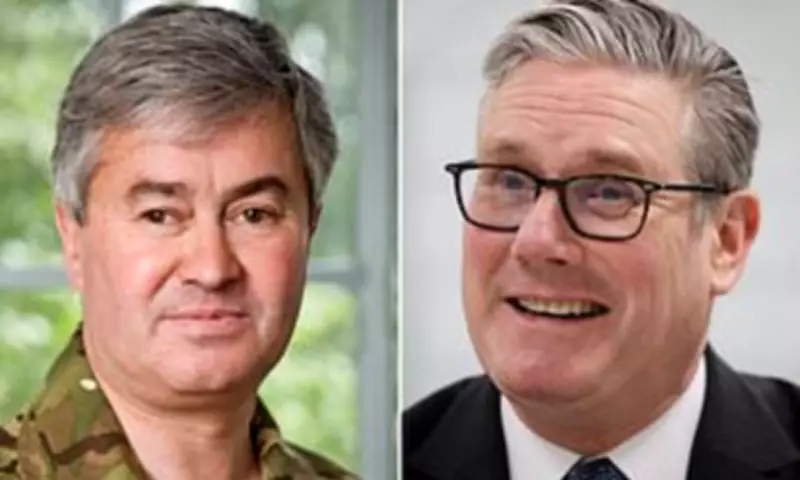
A stark new survey indicates that a majority of British citizens now believe the outbreak of a third world war is probable within the coming decade, with senior military figures concurring that the threat is alarmingly real.
Dramatic Surge in Public Anxiety Over Global Conflict
The YouGov poll, conducted last week among 2,079 British adults, found that 53 per cent consider it 'likely' or 'very likely' that the nation will be drawn into a major international war within the next five to ten years. This represents a significant 12-point increase compared to the previous year, highlighting a rapid escalation in public concern.
Concurrently, dissatisfaction with the government's management of defence matters has surged, with 56 per cent stating it is being handled badly—an 11-point rise. The survey also uncovered a troubling lack of faith in the nation's military capabilities, as 54 per cent expressed little to no confidence in the UK armed forces' ability to defend the country should war erupt.

Expert Analysis: A 'Broken' Military and Shifting Global Order
General Sir Richard Barrons, the former commander of Joint Forces Command, asserted that these public fears are entirely justified. He attributed the heightened risk to the diminished state of the Armed Forces, describing them as 'small and broken,' and to a fundamental transformation in international relations.
'We inhabit a new era of state confrontation that is radically different from the world of just a few years ago,' General Barrons explained. 'Previously, global stability was maintained through supranational institutions like the United Nations and the framework of international law. Today, we witness major powers acting with impunity, attacking others as they see fit.'
He pointed to conflicts in Ukraine and the Gulf as key factors driving public nervousness, alongside a pivotal shift in American foreign policy. 'The public rightly perceives that the United States has decided it will no longer underpin our security as it has consistently done since 1949. Our security, prosperity, and core values are now at direct risk, and we cannot rely on an American bailout.'
General Barrons warned that the UK faces a critical choice: 'We must make exceptionally difficult decisions to repair our defence and national resilience immediately. This will inevitably involve reallocating funds from other priorities such as welfare, infrastructure like pothole repairs, and the NHS. Failure to act decisively could lead to catastrophic consequences.'
Political Divisions and a 'Clear Path' to War
The poll revealed notable political divides in confidence towards the military. Among Reform UK voters, only 22 per cent expressed confidence in the armed forces, compared to 34 per cent of Conservative voters and 44 per cent of Labour supporters. This comes amid criticism directed at Prime Minister Keir Starmer for what some describe as a 'limp' response to the ongoing crisis involving Iran.
Adding to the grave outlook, former army colonel and intelligence officer Philip Ingram MBE, with over four decades of experience analysing global hostilities, stated he now sees a 'clear path to global conflict.'
'For the first time in my career, I can visualise a direct trajectory towards worldwide war. Current events are systematically pushing us closer to that possibility. This is a very real and genuine concern I have harboured for some time,' Ingram stated.
He criticised political leaders for failing to recognise the coalescing threat posed by an alliance of adversarial states. 'Our politicians are not acknowledging the danger mounting on the horizon from China, Russia, Iran, and North Korea, who are increasingly collaborating, exchanging technologies, and enabling each other's ambitions.'
Ingram suggested that American actions in Iran may have initiated a chain of events beyond its control, increasing the likelihood of broader conflict. 'America may have started something it cannot finish in Iran, and developments are not proceeding as planned because they failed to consider the wider geopolitical picture. This makes a global war more probable than not.'
'This is an exceptionally frightening period,' Ingram concluded. 'I do not say this lightly, as no one who has experienced conflict desires more of it. Yet, I believe we are on a path leading directly towards it.'

Context: Cuts and Ongoing Conflicts
Matthew Smith of YouGov noted that this survey follows widely reported reductions in defence spending and unfolds against the backdrop of persistent wars in Ukraine and Iran. The combination of a perceived weakened military, geopolitical realignments, and ongoing international crises has evidently forged a potent mix of public apprehension and expert alarm regarding the future of global peace.