

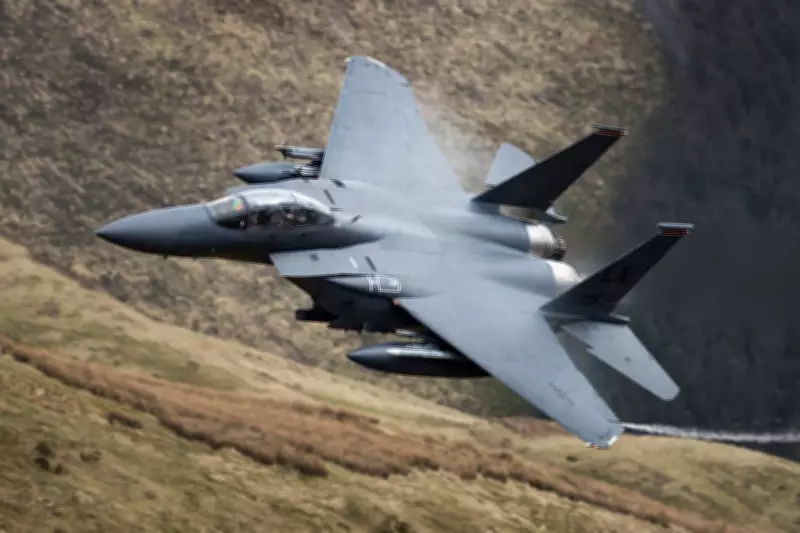
In a dramatic rescue operation, the CIA deployed a previously undisclosed top-secret technology called "Ghost Murmur" to save a US airman downed in the remote mountains of Iran. The device, which detects human heartbeats using advanced quantum magnetometry, pinpointed the injured aviator's exact location after his F-15E Strike Eagle jet was shot down southwest of Isfahan on Friday.
Frantic Search in Hostile Territory
The incident involved two US airmen aboard the stricken aircraft. While the pilot ejected safely and was rescued by military helicopters on the same day, the second officer - identified only by his "Dude 44 Bravo" callsign - faced a more perilous situation. Injured and armed with only a handgun, he found himself 200 miles behind enemy lines with a bounty on his head, forcing him to evade capture in the barren wilderness for 36 grueling hours.
Trained in Survival, Evasion, Resistance and Escape (SERE) techniques, the airman managed to activate a Boeing-made Combat Survivor Evader Locator beacon before taking cover in a mountain crevice. However, his precise whereabouts remained uncertain as he hid from potential captors in the challenging terrain.

Breakthrough Technology Enables Rescue
The turning point came with the deployment of the Ghost Murmur system, which sources revealed to The New York Post. This sophisticated equipment uses long-range quantum magnetometry - technology that measures magnetic fields - to trace the electromagnetic signals produced by a human heartbeat. The system then employs AI software to isolate these faint biological signatures from distracting background noise, ultimately pinpointing their exact source.
"It's like hearing a voice in a stadium, except the stadium is a thousand square miles of desert," one source explained. "In the right conditions, if your heart is beating, we will find you."
Presidential Praise and Cautious Disclosure
At a White House briefing on Monday, President Donald Trump praised CIA Director John Ratcliffe for his agency's "phenomenal job" in the rescue operation. In a characteristically theatrical moment, Trump invited Ratcliffe to discuss the new technology while joking that he might have to jail the director if he revealed classified information.
Ratcliffe cautiously acknowledged the use of "exquisite technologies that no other intelligence service" possesses, comparing the rescue effort to "hunting for a single grain of sand in the middle of a desert" without naming the specific Ghost Murmur technology or providing operational details.
Technical Specifications and Limitations
According to reports, the Ghost Murmur technology was developed by Skunk Works, the secretive advanced development division of aerospace giant Lockheed Martin. The system has undergone testing on Black Hawk helicopters with plans for future integration with F-35 fighter jets.
The remote Iranian wilderness provided "an ideal first operational use" according to sources, with the absence of electromagnetic interference creating "almost no competing human signatures" and favorable thermal contrast conditions at night between a living body and the desert floor.
"Normally this signal is so weak that it can only be measured in a hospital setting with sensors pressed nearly against the chest," explained a source. "But advances in a field known as quantum magnetometry - specifically sensors built around microscopic defects in synthetic diamonds - have apparently made it possible to detect these signals at dramatically greater distances."
The technology does have limitations, however. Sources noted that "the capability is not omniscient" and works best in remote, low-clutter environments while requiring significant processing time to analyze the collected data.
Successful Recovery Before Dawn
Thanks to the Ghost Murmur technology's precise location data, a team of commandos was able to find and retrieve the injured airman before dawn on Sunday, completing a daring rescue mission that combined cutting-edge technology with traditional special operations expertise. The successful operation highlights the evolving nature of search and rescue capabilities in modern military conflicts.






