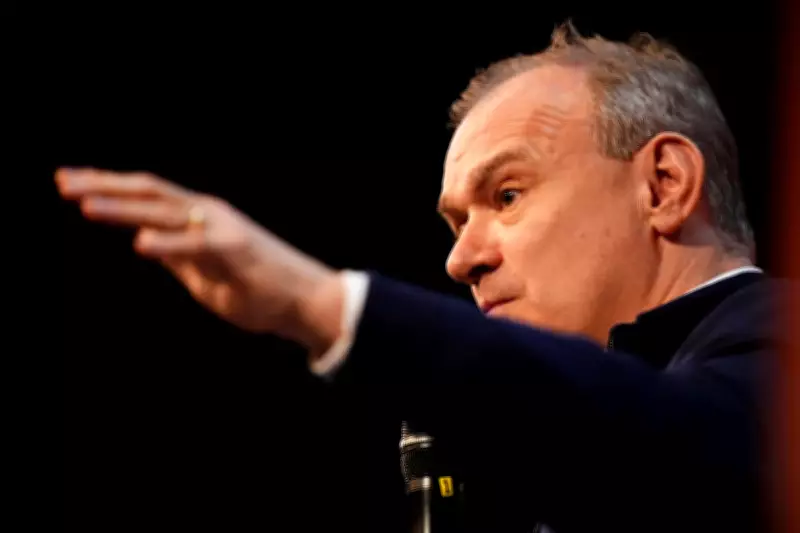
Ed Davey Demands UK Nuclear Deterrent Independence from US
Sir Ed Davey, the Liberal Democrat leader, will deliver a stark warning that Britain must urgently decouple its nuclear deterrent from American reliance, arguing that dependence on an increasingly unpredictable United States undermines national security. In a speech at the party's spring conference in York, Davey will call for a "genuinely, verifiably" independent nuclear system to replace the current Trident missiles, which are manufactured and maintained by the US.
Trump's Unreliability Sparks Defence Rethink
The push for independence comes as US President Donald Trump's foreign policy actions have strained traditional alliances. Davey will emphasise that "Trump has proven we can't rely on America as a dependable ally," pointing to his criticism of the UK's stance in the American-Israeli war against Iran and threats to halt trade with Spain over airbase access. These tensions highlight the risks of tying Britain's nuclear capabilities to a volatile partner.
Two-Phase Plan for British Sovereignty
Davey will outline a clear strategy to achieve nuclear independence:

- Short-term: Develop a UK-based maintenance programme for Trident to reduce immediate reliance on US support.
- Long-term: Create a fully British-made alternative to replace Trident when it reaches the end of its lifespan in the 2040s, investing billions domestically rather than in the US.
He will argue that Britain possesses the scientific and engineering expertise to build its own deterrent, citing historical precedent from the 1950s when the UK became the third nation to develop nuclear weapons independently.
Costs and Challenges of Going Alone
While advocating for sovereignty, Davey acknowledges the financial implications. Trident currently consumes approximately 6% of the annual defence budget, and independent development would require significant investment. The Chatham House think tank has noted that pursuing a solo deterrent is hugely costly, and even cooperation with France—which maintains its own independent system—would entail reliance on another ally.
Strategic Context and Global Implications
The call for decoupling emerges amid broader geopolitical shifts, including Trump's clashes with European allies over issues like Greenland and ongoing conflicts in the Middle East that disrupt global energy markets. Davey will stress that Britain's nuclear deterrent must be "truly independent" to ensure security regardless of who leads the US in the future.
Currently, the UK maintains its deterrent through four Vanguard-class submarines based at Faslane, Scotland, with one always at sea. These are being replaced by new Dreadnought-class submarines built in Barrow-in-Furness, Cumbria, but the underlying reliance on US technology remains a critical vulnerability in Davey's view.