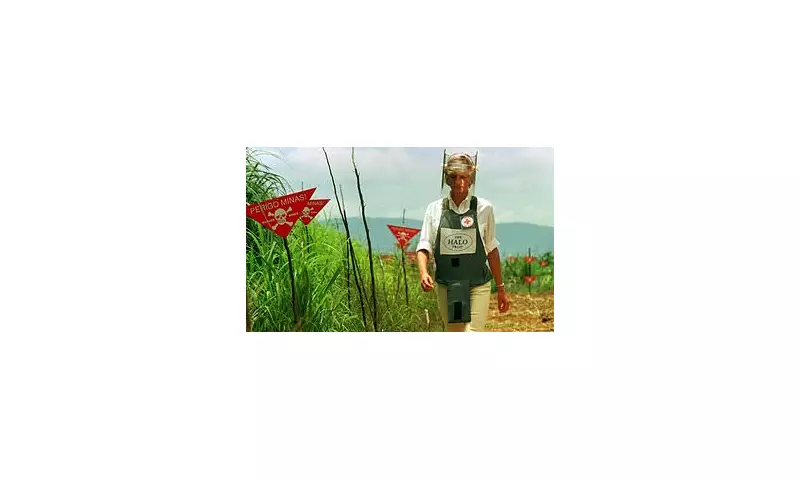
In January 1997, the Princess of Wales embarked on a landmark humanitarian visit to Angola that would ignite a fierce political row in Westminster and ultimately reshape the global campaign against landmines. Her powerful actions, captured in images seen around the world, drew both intense criticism and lasting praise.
A Walk Through a Live Minefield
On 15 January 1997, dressed in protective body armour, Diana calmly walked a path flanked by live landmines of East German, Russian, and Chinese origin. She was accompanied by Paul Heslop, a mine removal expert from the charity The Halo Trust. Heslop later confessed to the BBC that his mind was 'in overdrive' trying to ensure he did not become infamous for accidentally causing an explosion.
During the visit, the Princess remotely detonated a live landmine, declaring 'one down, 17 million to go' as she pushed the button. This direct action was intended to highlight the scourge of unexploded ordnance plaguing Angola, where at the time, one in every 300 people had lost a limb.

Political Backlash and the 'Loose Cannon' Label
The visit immediately provoked a deluge of criticism from Conservative government ministers. They argued that Diana's public calls for a worldwide ban appeared to endorse the opposition Labour Party's policy, while the Tory stance was to support a ban only if all nations agreed unanimously.
Earl Howe, then a junior defence minister, reportedly described the 35-year-old princess as a 'loose cannon' who was 'ill-informed on the issue of anti-personnel landmines'. This characterisation framed the visit as a misguided foray into political waters.
Diana, however, remained steadfast. She told reporters, 'I am not a political figure, nor do I want to be one. I come with my heart... I am a humanitarian figure, always have been and always will be.' British ambassador Roger Hart noted she saw the criticism as an 'unnecessary distraction'.
The Human Impact and a Lasting Legacy
Beyond the politics, the trip's profound human impact was undeniable. Diana was visibly moved when she met 16-year-old Sandra Thijika, who had lost a leg to a mine and was finally being measured for a prosthetic after a nine-year wait. A poignant image of Sandra sitting on Diana's knee was broadcast globally, personalising the crisis.
Tragically, this was the start of a campaign cut short. Diana died in a Paris car crash on 31 August 1997, just seven months later. She had planned further trips to countries like Vietnam and Cambodia.
Yet, her influence endured. According to Lou McGrath of the Mines Advisory Group (MAG), her Angola trip was a definitive 'turning point'. In December 1997, 122 governments signed the Ottawa Treaty, the international agreement banning anti-personnel mines. New Prime Minister Tony Blair pledged to ratify it shortly after Diana's death.
Today, the very minefield she walked has been cleared by The Halo Trust and transformed into a thriving community hub, Avenida 28 de Maio, which includes the Princess Diana School. While nations like the US, Russia, and China remain outside the treaty, Diana's walk in Angola 29 years ago remains a powerful symbol of humanitarian advocacy that transcended political controversy.