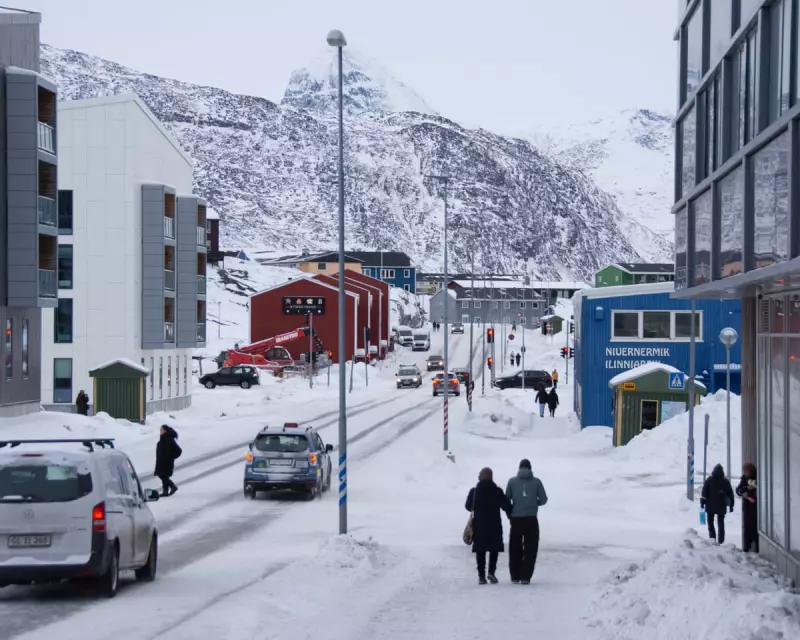
For Najannguaq Hegelund, the immense, icy stability of Greenland was once a comforting thought. Living in Denmark, she would joke with family during global instability: "Well we will just go to Greenland, nothing ever happens in Greenland." Today, that long-held certainty has shattered.
A Population on Edge: From Jokes to Invasion Plans
Over the last fortnight, Donald Trump has repeatedly threatened military action to acquire the largely autonomous Arctic territory, which he claims the US "needs" for national security. For Hegelund, 37, and Greenland's 57,000 residents, the abstract geopolitical threat has become a terrifyingly personal prospect.
"Look where we are today," Hegelund says from a Nuuk coffeeshop, laughing incredulously. "It's just so crazy." Like many, she now worries about evacuation plans, debates fleeing to Denmark pre-emptively, and fields questions from her children about becoming American.

The mood in the snow-covered capital has darkened significantly since Trump first floated the idea of purchasing Greenland a year ago. Then, the response was more lighthearted scepticism. Now, there is open alarm. Hegelund, who works for the NGO Sila360 monitoring Inuit legal rights, points to the precedent of Venezuela as a key difference driving the fear.
Surveillance, Sleeplessness, and a Legacy of Trauma
Many Greenlanders report anxiety and sleeplessness. Some watch the skies and seas, tracking US planes on flight trackers and discussing how to respond if captured. Hedvig Frederiksen, 65, and her daughter Aviaja Fontain, 40, have taken surveillance upon themselves.
"It's scary," says Fontain, who struggles to focus on university exams. Her mother uses flight trackers and recently panicked seeing a Hercules plane leave Pituffik, the remote US base in north-west Greenland, fearing it was heading to invade Nuuk.
Their fears are compounded by history. Frederiksen is among 143 women who recently won a legal case against Denmark after being forcibly fitted with IUDs as girls. "If the soldiers are coming here, then what will they do?" she asks, via her daughter's translation. Fontain speaks of the existing generational trauma from Danish colonisation: "Are we going to have another one?"
She adds, "I'm so afraid if they take over are they going to bring their violence here? We are not violent here."
Political Maneuvering and a Search for Security
A high-stakes meeting in Washington offered a glimmer of hope. Greenlandic and Danish foreign ministers, Vivian Motzfeldt and Lars Løkke Rasmussen, were set to meet US Secretary of State Marco Rubio. However, the last-minute inclusion of US Vice-President JD Vance, who in March called US control of Greenland "critical" and criticised Denmark's stewardship, introduced a worrying unknown.
While Copenhagen has announced an additional 27.4 billion Danish kroner (£3.26bn) for Arctic security, including new vessels and a Joint Arctic Command (JAC) headquarters, visible signs of bolstered defence in Nuuk are scant. The current JAC HQ appears cosy, and the US consulate is an unfenced, hygge-style red building.
For the younger generation, like 19-year-old artist Aviâja Korneliussen, the threats are divisive and dehumanising. She notes a positive cultural shift, with more Indigenous Greenlanders openly expressing Inuk identity through tattoos and art, distancing from Danish (Qallunaaq) influence. Yet, the prospect of invasion leaves her conflicted: "I think I would just lock myself inside and find a way out of here... It is the land you were born and raised in."
A Stark Choice and the Limits of International Law
Politically, the crisis has forced clarity. After weeks of ambiguous statements, Greenland's Prime Minister, Jens-Frederik Nielsen, stood alongside Danish PM Mette Frederiksen on Tuesday and declared: "If we have to choose between the US and Denmark here and now, we choose Denmark, Nato and the EU."
This unified stance was welcomed by veteran activist Aqqaluk Lynge, who said it was "what we have been waiting for." However, opinions vary. Pele Broberg, leader of the US-friendly Naleraq party, argues Greenland should be allowed to discuss a potential free association deal with the US, accusing Denmark of forcing a false unity.

For Inuit film-maker and independence activist Aka Hansen, recent global events in Ukraine, Gaza, and Venezuela prove international law is "ineffective." This leaves her in a paradoxical position: "Which is weird for me to say as someone who fights for independence that I actually have to rely on Denmark right now."
As the world watches, the people of Greenland are left grappling with a fundamental question of power. "What could we do?" asks Hegelund, summing up a widespread feeling of vulnerability. "We are like 20,000 in Nuuk. How are we going to go against American troops?" For a peaceful population on the front line of a new Arctic great game, the unthinkable has become a daily dread.