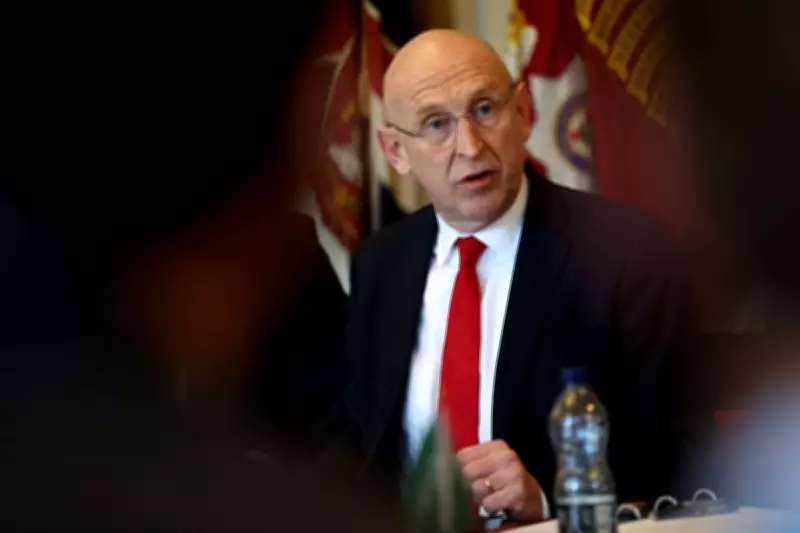
Defence Secretary Avoids Direct Answer on Iran's UK Strike Capability
Defence Secretary John Healey has declined to explicitly rule out whether Iran possesses the technical ability to launch missile strikes against the United Kingdom. This comes in the wake of confirmed Iranian attacks targeting the joint UK-US military facility located on Diego Garcia island in the Indian Ocean. While addressing concerns on national television, Healey emphasised that British military assessments do not indicate Tehran has any active plans to attack London or other UK territories.
Reassurance Amid Regional Aggression
When pressed repeatedly during a Sky News interview about the potential for Iranian missiles to reach the British capital, Healey stated, "We have no assessment of Iranian plans to strike London." He further elaborated, "What I’m saying, and trying to reassure people, is that we’ve got no assessment that Iran has any plans to attack. But we have the resources, we have the alliance in place to be able to defend Britain, and we do that with allies, and we do that with Nato."
The Defence Secretary connected Iran's actions to broader geopolitical strategies, noting, "As far as Iran goes, they’re demonstrating a capacity to hit across the Middle East, we see the same tactics and technologies that we see employed by Russia in Ukraine, and this is the hidden hand of Putin in both conflicts." He previously confirmed that missiles aimed at Diego Garcia fell significantly short of their target.

Royal Navy Shortfalls and International Support
Separately, Healey addressed operational challenges within the Royal Navy. He confirmed that Germany will provide a frigate for a forthcoming Nato mission, replacing HMS Dragon, which was redeployed to defend Cyprus in response to the escalating Iran crisis. When questioned if this reliance on allied vessels was embarrassing, Healey framed it as a demonstration of Nato solidarity, but conceded dissatisfaction with the UK's warship fleet, citing the six-year construction timeline for new vessels.
In a possible verbal slip, Healey referenced the UK having 17 frigates and destroyers, whereas the Royal Navy's official website lists a total of 14 frigates and six destroyers. He defended deployment decisions, stating, "I have to make decisions based on what we’ve got. We were preparing Dragon in order to play that flagship role, the way that Iran hit back in an indiscriminate, widespread way, meant I needed to reinforce the defences that we’d already, before the conflict broke out, put into the Middle East."
Economic and Supply Chain Fallout
The conflict has triggered significant economic concerns within the UK. The government has approved a grant of up to £100 million to reopen the mothballed Ensus carbon dioxide plant on Teesside. This intervention aims to avert potential shortages, as CO2 is a critical by-product for industries including beverages and nuclear energy. The plant was previously closed due to changed trade conditions with the US affecting its primary bioethanol output.
This marks the first major governmental step to mitigate supply disruptions caused by the Iran war. However, warnings extend beyond CO2. Former BP executive Nick Butler cautioned that the UK could face oil and gas shortages within two to three weeks, urging the government to develop contingency plans. Shell's chief executive, Wael Sawan, echoed similar concerns at a recent industry conference.
Energy Minister Michael Shanks sought to allay public fears, telling Parliament that the government is "absolutely not" planning for blackouts or petrol rationing, emphasising the UK's "strong and diverse range of supplies." The duration of Iran's effective blockade of the Strait of Hormuz remains a pivotal uncertainty affecting global shipping and energy markets.
Diplomatic Moves and International Rhetoric
Foreign Secretary Yvette Cooper is set to urge Iran to reopen the Strait of Hormuz during the G7 foreign ministers' meeting in France. She will announce an additional £2 million in humanitarian aid for Lebanon and reaffirm the UK's commitment to ensuring safe maritime passage. Cooper is scheduled to hold discussions with key counterparts, including US Secretary of State Marco Rubio.

Diplomatic tensions continue to flare. US President Donald Trump launched a fresh critique of Nato allies via Truth Social, asserting they have done "absolutely nothing" regarding Iran and that the USA "needs nothing from NATO." Meanwhile, Iranian Foreign Minister Abbas Araghchi denied ongoing negotiations with the US, suggesting Washington's call for talks signals an implicit admission of defeat, contrary to White House claims of "productive" discussions.
The Strait of Hormuz remained closed to commercial traffic, despite Iranian assertions that it was accessible to "non-hostile" shipping. The White House warned it would respond "harder" if Tehran refuses to acknowledge its military setbacks, underscoring the volatile and protracted nature of the conflict.