

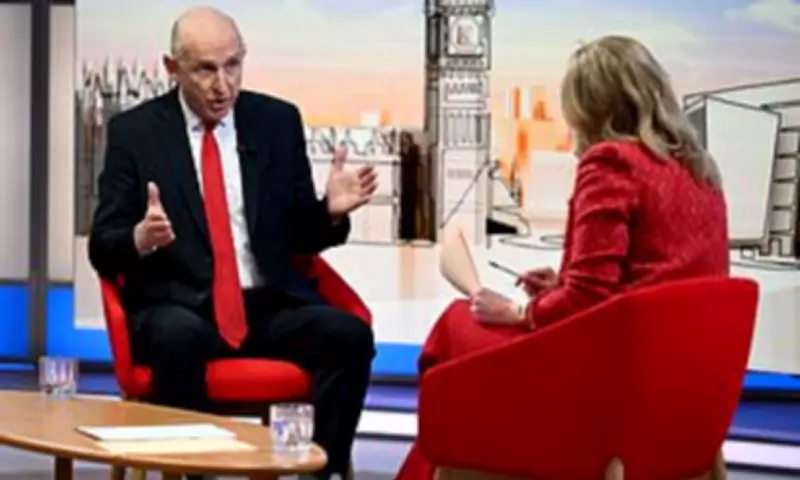
Labour Defence Secretary Dodges Questions on UK Support for US-Iran Strikes
Defence Secretary John Healey has faced intense scrutiny after repeatedly refusing to clarify the British government's position on recent US and Israeli military strikes against Iran. During a televised interview, Mr Healey declined six times to state whether the United Kingdom supports the actions taken by its American and Israeli allies or whether the government considers the strikes to be legally justified under international law.
Evasion on Legal and Political Support
When pressed on the BBC's Sunday with Laura Kuenssberg programme, Mr Healey consistently avoided direct answers regarding British backing for the military operations. Instead, he emphasised that Britain "played no part" in the strikes on Iran and stated that it was "for the US to set out the legal basis of the action that it took." This stance comes despite other Western allies, including Australia and Canada, publicly endorsing the American-led action aimed at preventing Iran from obtaining nuclear weapons.
The Defence Secretary did acknowledge that Britain shares the "primary aim" of ensuring Iran never develops a nuclear weapon, aligning with broader allied objectives in the region. However, his refusal to comment on the legality or explicit support for the strikes has drawn criticism and raised questions about the UK's foreign policy coherence.

Contrast with Conservative Position
Senior Conservative MP Dame Priti Patel established a clear dividing line with the government's ambiguous stance, asserting that the United States and Israel were "absolutely" right to strike Iran. In comments to Sky News, Dame Priti characterised the Iranian regime as "a murderous, barbaric regime sponsoring terror around the world" and stated that the Conservative Party fully supports the military action.
She further questioned why Prime Minister Sir Keir Starmer had not been more proactive in coordinating with American allies prior to the strikes, suggesting that intelligence sharing between the two nations should have facilitated closer collaboration. Dame Priti also expressed that few should mourn the death of Iran's Supreme Leader Ayatollah Ali Khamenei, who perished in the attacks, citing his leadership over a regime responsible for widespread violence against its own citizens.
Diego Garcia and Military Base Usage
Another contentious issue emerged regarding the potential use of British military facilities for the strikes. Former President Donald Trump had previously revealed considerations to utilise the joint UK-US base on Diego Garcia in the Chagos Islands or RAF Fairford in Gloucestershire as launch points for operations against Iran.
Reports indicate that Prime Minister Sir Keir Starmer warned Mr Trump that Britain would not permit the use of its bases for pre-emptive military action. This decision reportedly followed legal advice from Attorney General Lord Richard Hermer, which underscored the importance of adhering to international law. Mr Healey also avoided confirming whether the UK had formally refused American requests to use these facilities, adding another layer of opacity to the government's position.
International Context and Reactions
The strikes have garnered support from key allies beyond the United States. Canadian Prime Minister Mark Carney affirmed his country's backing for actions to prevent Iran from acquiring nuclear capabilities and to curb threats to international peace. Similarly, Australian Prime Minister Anthony Albanese echoed this stance, highlighting a coordinated Western approach despite the UK's reticence.
This development underscores ongoing tensions in UK-US relations and internal political divisions regarding foreign policy and defence strategy. The Labour government's cautious, non-committal approach contrasts sharply with the Conservative opposition's unequivocal support for military intervention, setting the stage for continued debate over Britain's role in global security matters.






