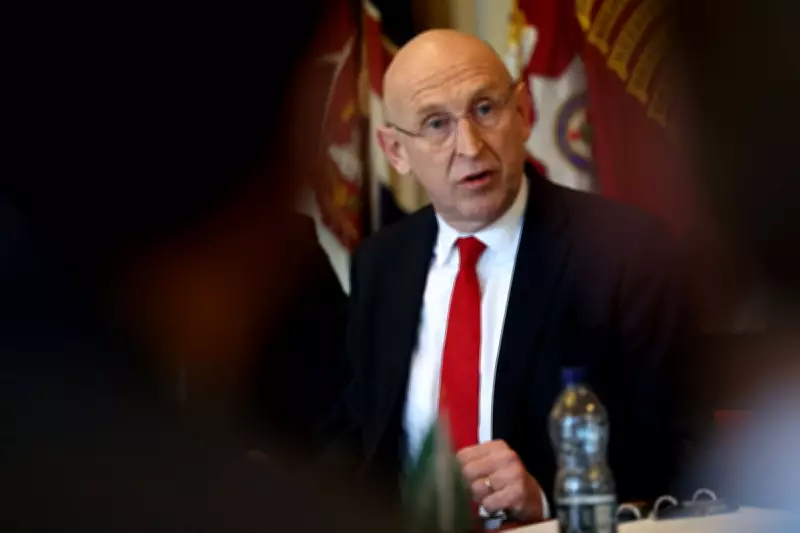
Defence Secretary John Healey has steadfastly refused to explicitly rule out the possibility that Iran possesses the military capability to launch missile strikes directly against the United Kingdom. However, he emphasised that British military assessments currently indicate Tehran has no active plans to carry out such an attack. This statement follows confirmed reports that Iran has targeted the joint UK-US military base located on Diego Garcia island in the Indian Ocean with missile fire.
Healey's Reassurance on Iranian Intentions
During a detailed interview on Sky News, Mr Healey was pressed repeatedly on whether Iranian missiles could potentially reach London. In response, he stated, "We have no assessment of Iranian plans to strike London." When questioned further, he elaborated, "What I’m saying, and trying to reassure people, is that we’ve got no assessment that Iran has any plans to attack. But we have the resources, we have the alliance in place, to be able to defend Britain, and we do that with allies, and we do that with NATO."
He went on to draw parallels between Iranian military tactics and those observed in other global conflicts, noting, "As far as Iran goes, they’re demonstrating a capacity to hit across the Middle East, we see the same tactics and technologies that we see employed by Russia in Ukraine, and this is the hidden hand of President Vladimir Putin in both conflicts." He had previously indicated that the missiles fired at Diego Garcia fell well short of their target.

Trump's Criticism and NATO Dynamics
In a separate development, former US President Donald Trump launched a fresh verbal assault against NATO allies, specifically targeting the United Kingdom's naval capabilities. He derogatorily described the UK's flagship aircraft carriers, HMS Queen Elizabeth and HMS Prince of Wales, as mere "toys" when compared to American vessels.
Speaking at the outset of a White House cabinet meeting, Trump accused allies of doing "absolutely nothing" to assist the United States in the Middle East conflict. He sarcastically recounted, "We had the UK say that ‘we’ll send’ – this is three weeks ago – ‘we’ll send our aircraft carriers’, which aren’t the best aircraft carriers, by the way. They’re toys compared to what we have. But ‘we’ll send our aircraft carrier when the war is over’. I said ‘oh that’s wonderful, thank you very much. Don’t bother. We don’t need it’."
Defence Investment and Naval Shortfalls
Mr Healey also addressed concerns regarding the UK's defence investment strategy, firmly denying that the Treasury is responsible for holding up a long-delayed defence investment plan. This comes after Labour MP Tan Dhesi, who chairs the Defence Committee, suggested the plan might be postponed until after the May elections, labelling the situation a "mess".
The Defence Secretary further commented on the Royal Navy's current operational challenges, noting that Germany is providing a frigate for a NATO mission next month to replace HMS Dragon, which was redeployed to defend Cyprus in response to the Iran crisis. When asked if he was embarrassed by the need to borrow a ship from an ally, Healey responded that it was a "sign of the strength of the NATO alliance… but I’m not happy with the situation we have with British warships, and that’s because it takes six years to build a warship".
In a potential verbal slip, Mr Healey appeared to mistakenly state that the UK possesses 17 frigates and destroyers, whereas the Royal Navy's official website lists only 14. He defended the decision not to allocate another ship for the planned NATO mission, explaining, "I have to make decisions based on what we’ve got. We were preparing Dragon in order to play that flagship role – the way that Iran hit back in an indiscriminate, widespread way meant I needed to reinforce the defences that we’d already, before the conflict broke out, put into the Middle East."

Government Intervention on CO2 Shortages
Amid growing fears of supply chain disruptions caused by the Iran conflict, the UK Government has announced a major intervention. A mothballed carbon dioxide plant on Teesside is set to be reopened with a government grant of up to £100 million. The Ensus UK plant, which produces CO2 as a by-product of bioethanol manufacturing, had halted production last September following a US trade deal that cut bioethanol tariffs.
Ensus UK has now entered into an agreement with the Government to resume operations for a three-month period. This facility is the UK's last remaining major industrial manufacturer of biogenic carbon dioxide, a substance critical to various sectors including the drinks and nuclear industries. Supply has been severely disrupted due to soaring energy costs affecting other sources like fertiliser factories. This grant marks the first significant governmental step to address potential shortages stemming from the Iran war.
Diplomatic Efforts at the G7
On the diplomatic front, Foreign Secretary Yvette Cooper was scheduled to attend the G7 foreign ministers' meeting in France. Her agenda included urging Iran to reopen the strategically vital Strait of Hormuz, a key channel for global oil and gas shipping. She was expected to clearly communicate that the UK stands ready to help ensure safe passage for vessels through the strait and to pledge an additional £2 million in humanitarian aid to Lebanon.
Ms Cooper was also anticipated to hold crucial talks with several international counterparts, including US Secretary of State Marco Rubio, France's Jean-Noel Barrot, and Germany's Johann Wadephul, as part of coordinated efforts to manage the escalating regional tensions.