US Defense Secretary Hegseth Brands Iranian Leader 'Wounded and Disfigured'
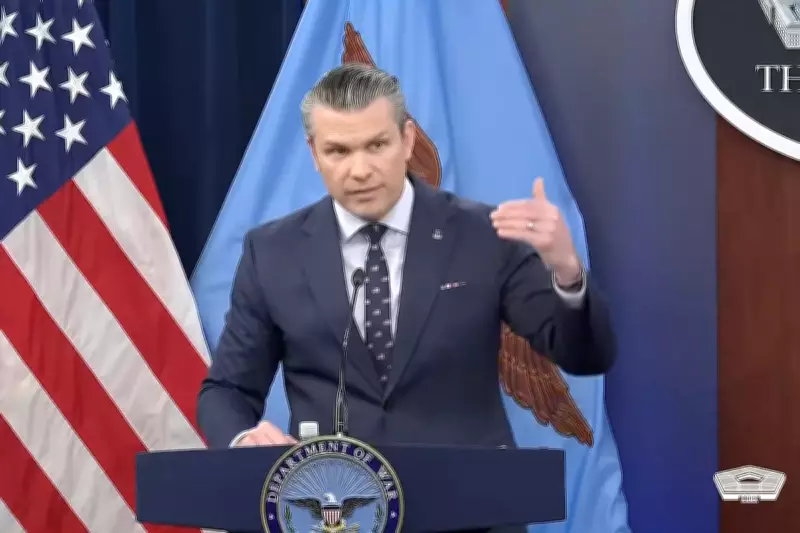
A visibly irate US Defense Secretary Pete Hegseth has launched a scathing attack on Iran's leadership, comparing them to "rats" in hiding and claiming the new supreme leader is "wounded and likely disfigured." The comments came during a tense Friday press briefing where Hegseth boasted about the devastating impact of US military strikes while chastising American media coverage of the escalating conflict.
Hegseth's Fiery Rhetoric Against Iranian Regime
"The U.S. is decimating the radical Iranian regime's military in a way the world has never seen before," Hegseth declared at the Pentagon briefing. "We said it would not be a fair fight, and it has not been." The defense secretary, a former Fox News host, provided staggering statistics about the campaign's impact, stating that more than 15,000 Iranian targets have been hit, obliterating the nation's air defenses, air force, and navy while reducing missile capabilities by 90 percent.
Hegseth saved his most colorful language for Iran's leadership, describing newly installed leader Mojtaba Khamenei as the "so-called not-so-supreme leader" who is "wounded and likely disfigured." He added, "Iran's leadership is in no better shape. Desperate and hiding, they've gone underground, cowering. That's what rats do." The defense secretary warned that Friday would see the most intense day of US strikes on Iran to date.

Mounting Human and Economic Costs
The conflict, now in its 13th day, has taken a significant toll on both sides. US Central Command confirmed that six crew members were killed when a KC-135 refueling aircraft went down in western Iraq on Thursday. To date, at least 13 US service members have died in the Iran war with 140 injured. Meanwhile, Iran's representative to the UN, Amir Saeed Iravani, stated Wednesday that at least 1,940 Iranians have been killed, most of them civilians.
The economic consequences are equally severe. Oil prices have surged past $100-a-barrel multiple times in the past week following attacks on vessels in the Strait of Hormuz. In response, the Trump administration announced it would release 172 million barrels from the Strategic Petroleum Reserve over the next four months. The Pentagon reported spending $11 billion during just the first six days of the conflict, drawing criticism from lawmakers like Senator Elizabeth Warren who noted, "While there is no money for 15 million Americans who lost their health care, there's a billion dollars a day to spend on bombing Iran."
Media Criticism and Contradictory Claims
Hegseth began his briefing by berating the press, specifically targeting ABC News and CNN, while maintaining what observers described as "barely concealed contempt" throughout. "Another example of a fake headline I saw yesterday: 'war widening,'" he complained. "Here's a real headline for you, for an actual patriotic press: 'Iran shrinking, going underground.'"
The defense secretary made several controversial claims during the briefing, including insisting there is "no evidence" that Iran has laid mines in the strategically vital Strait of Hormuz despite multiple news outlets reporting otherwise. He told Americans they "don't need to worry about it," a statement that contrasted sharply with Joint Chiefs of Staff Chair General Dan Caine's more cautious assessment that the situation in the strait is "complex." Energy Secretary Chris Wright acknowledged the US is not ready to escort tankers through the waterway following recent attacks on vessels.
International Reactions and Investigations
The conflict has drawn condemnation from multiple nations. Iran has denounced US and Israeli attacks as illegal and accused both countries of perpetrating war crimes. Russia, China, and Brazil have also come out against the war, while close US allies like the UK have warned Tehran to refrain from retaliatory strikes.

Several troubling incidents remain under investigation, including last week's strike on a girls' school in southern Iran that killed at least 175 people, most of them children according to Iranian officials. Sources familiar with the matter told The New York Times that a preliminary report indicates an American Tomahawk missile struck the school. Hegseth reiterated that the US military "never targets civilians" and said the investigation is being handled by a "general officer" from outside US Central Command.
When asked about the war's timeline, Hegseth deferred to President Donald Trump, stating, "President Trump holds the cards, he'll determine the place, the tempo and the timing of this conflict." Trump himself has shown little concern about rising oil prices, writing on Truth Social that while higher prices benefit the US as the world's largest oil producer, his greater priority is "stoping an evil Empire, Iran, from having Nuclear Weapons."
Recent polling indicates public skepticism about the conflict, with a Quinnipiac Poll finding 53 percent of registered voters oppose US military action against Iran, and an Ipsos poll showing more Americans disapprove than approve of the campaign.