

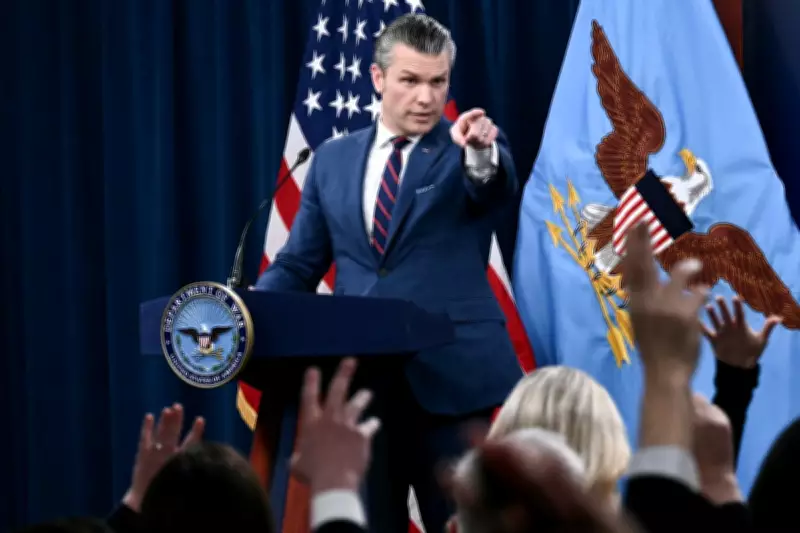
US Defense Secretary Hegseth Outlines Iran Strategy Amidst Ongoing Conflict
In a pivotal press conference at the Pentagon on March 2, 2026, US Defense Secretary Pete Hegseth addressed the escalating military actions in Iran, marking the first public remarks by an administration official since hostilities commenced. Hegseth described the joint US-Israeli air strikes as the "most lethal and precise air power campaign in history," emphasizing that the operation aims to dismantle Iran's naval capabilities, ballistic missile production, and nuclear weapon potential.
No Clear Timeline as Hegseth Rejects 'Endless' War Narrative
Hegseth firmly stated that the United States would not become "bogged down" in the conflict, asserting that this is not a "democracy-building exercise" and drawing a clear distinction from past engagements like Iraq. However, he refused to establish a definitive timeline for the operation's duration, noting that President Trump retains full authority to determine the pace. "Four weeks, two weeks, six weeks. It could move up, it could move back," Hegseth remarked when questioned about an exit strategy.
Trump Leaves Door Open for Ground Troops Deployment
Shortly after Hegseth's briefing, President Donald Trump indicated in an interview with the New York Post that he does not rule out sending US ground troops into Iran if deemed necessary. Trump diverged from typical presidential rhetoric, stating, "I don't have the yips with respect to boots on the ground... I say 'probably don't need them,' [or] 'if they were necessary.'" This contrasts with Hegseth's confirmation that there are currently no US boots on the ground in Iran, though he declined to speculate on future actions.

Casualties and Military Details Emerge
Hegseth disclosed that four US service members were killed by a ballistic missile that penetrated allied air defenses, describing it as an unfortunate "squirter" that breached defenses. He expressed resolve to honor their sacrifice and continue the mission effectively. General Dan Caine, Chairman of the Joint Chiefs of Staff, elaborated on the operation's scope, revealing that US cyber and space commands initially disabled Iranian communications before over 100 aircraft launched from land and sea, including involvement from two carrier strike groups and B-2 stealth bombers.
Regional Escalation and Economic Implications
The conflict has rapidly expanded, with Iran launching ballistic missiles and drones at multiple countries, including Israel, Saudi Arabia, and others in the Gulf region. Major shipping companies have suspended operations through the Strait of Hormuz, raising concerns about a surge in oil prices and potential stock market declines. Hegseth defended the strikes, asserting, "we didn't start this war, but under President Trump we're finishing it," and mocked traditional allies for their hesitance regarding the use of force.
Objectives and Operational Philosophy
Hegseth emphasized a no-nonsense approach to warfare, criticizing past "politically correct wars" and advocating for maximum operational authority without restrictive rules of engagement. He praised Israel as "capable partners" and reiterated that the US operation is conducted entirely on its own terms. While he avoided specifying long-term objectives beyond military targets, he affirmed that the mission focuses on winning efficiently without unnecessary casualties.






