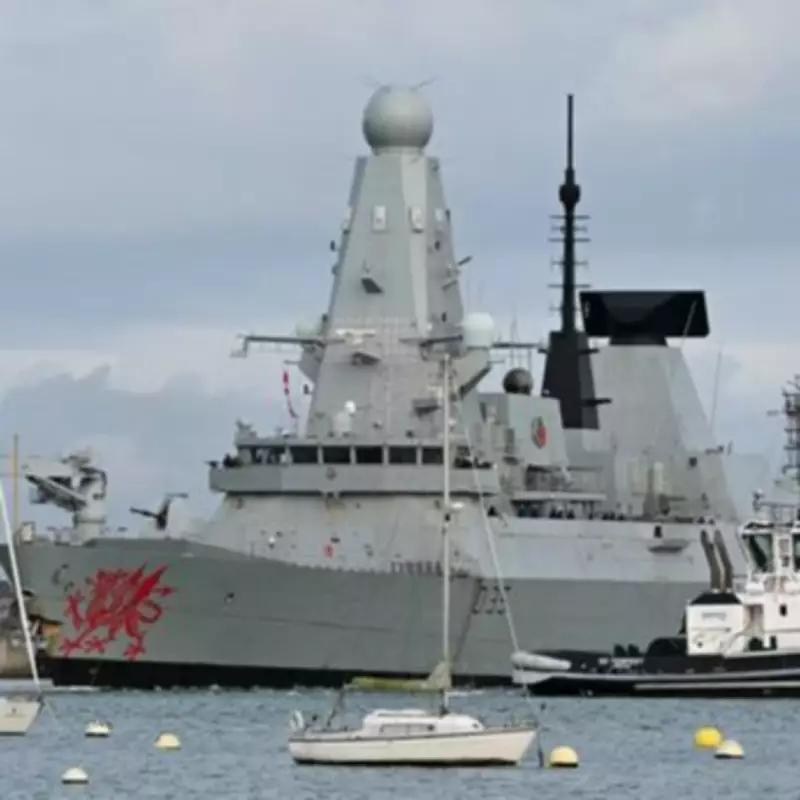
HMS Dragon Deploys as UK's Advanced Maritime Fortress to Middle East
The British Type 45 destroyer HMS Dragon is now steaming towards the Eastern Mediterranean as the Iran crisis intensifies, marking a significant deployment of one of the Royal Navy's most formidable warships. Valued at approximately £1.2 billion, this maritime fortress is bristling with state-of-the-art weaponry designed to smash incoming Iranian missiles and drones.
A Lethal Arsenal for Modern Warfare
HMS Dragon represents a quantum leap in naval capability, replacing the older Type 42 warships. In an intense attack scenario, military analysts suggest that just one Type 45 destroyer could engage more targets than five of its predecessors combined. The vessel is packed with deadly armaments, led by a 4.5-inch Mark 8 naval gun capable of firing 25 rounds per minute.
Additional weapon systems include:

- Two 30mm DSM Mark 2 guns
- Two 20mm Phalanx CIWS guns
- Two 7.62mm miniguns
- Six general purpose machine guns (GPMGs)
The miniguns and GPMGs are particularly effective against smaller suicide vessels packed with explosives, while Wildcat helicopters—already positioned at RAF Akrotiri—will join Dragon's flight deck. These helicopters can carry Sting Ray torpedoes, a 12.7mm cabin-mounted machine gun, and Martlet and Sea Venom missiles, with the Martlet system being ideal for intercepting the kind of small drones that struck Akrotiri earlier in the conflict.
Rapid Deployment and Advanced Defence Systems
Remarkably, HMS Dragon was loaded, maintained, and made battle-ready within just six days—a process that typically requires up to six weeks for proper preparation. This rapid deployment underscores the urgency of the situation in the Middle East.
The destroyer's primary role is air defence, specialising in protecting against saturation attacks from multiple directions, including fearsome swarms of incoming drones. Its advanced systems include:
- Sea Viper missiles for long-range interception
- SAMPSON Active Electronically Scanned Array (AESA) radar
- S1850 radar for enhanced detection capabilities
These sensitive radar systems can detect incoming missiles from considerable distances, addressing concerns raised after the RAF Akrotiri drone strike, where the relatively small size of the drone posed detection challenges. A senior military source emphasised: "With the Wildcat helicopters in the region and their incredibly good sensor systems, plus Dragon, the hope is that nothing will get through the net."
Strategic Debates and Regional Context
Despite its capabilities, the deployment has sparked debate among defence experts. Former Royal Navy commander Rear Admiral Chris Parry criticised the move as "tokenism," arguing that the Eastern Mediterranean is already well-protected by allied forces. He noted the presence of the French carrier Charles de Gaulle with escort warships, German and Greek navy frigates, and UK F-35B and Typhoon jets operating from RAF Akrotiri.
Parry suggested that HMS Dragon might be more effectively deployed further towards the Gulf or Red Sea, where it could counter potential Houthi involvement if called upon by Iran. He also criticised previous governments for depleting UK defence capabilities, leaving Britain insufficiently prepared for this crisis.
Operational Costs and Capabilities
Operating this 7,500-tonne Daring-class ship comes at a substantial cost—approximately £126,000 per day at sea. However, its capabilities justify the expense: with a top speed of 27 knots (equivalent to about 30 mph on land) and a range of roughly 7,000 miles, HMS Dragon is a versatile asset. Its 190-strong crew manages not only the weaponry but also the sophisticated radar and missile systems that make it a seafaring killer capable of neutralising incoming threats.
As tensions escalate, the deployment of HMS Dragon highlights the UK's commitment to regional security while exposing ongoing debates about defence strategy and readiness in an increasingly volatile global landscape.