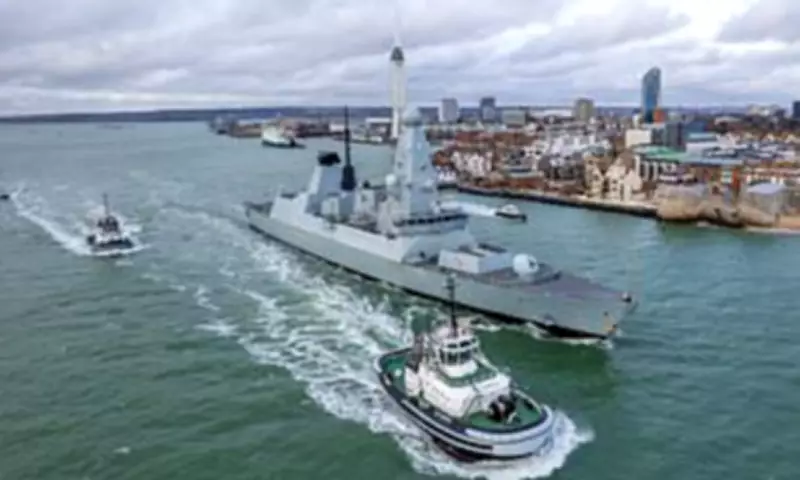
HMS Dragon's Delayed Mediterranean Mission Sparks Defence Concerns
The Royal Navy's £1 billion Type-45 destroyer, HMS Dragon, spent three days essentially 'bobbing about in the Channel' after receiving urgent orders to deploy to Cyprus to help protect British forces from drone attacks. The warship only departed UK waters yesterday, despite originally setting sail from Portsmouth on Tuesday, highlighting significant delays in its critical mission.
Operational Secrecy and Rushed Preparations
Immediately after leaving Portsmouth Harbour, where family and friends waved off the crew, HMS Dragon switched off its transponder. This system, which publicly broadcasts a vessel's position, was deactivated, meaning the destroyer's movements could no longer be tracked by external observers. The warship had also been scheduled to stop at Plymouth for a crew change, but those plans were reportedly abandoned as pressure mounted to expedite its journey to the eastern Mediterranean.
Sir Keir Starmer ordered HMS Dragon's departure following a drone strike on RAF Akrotiri, a key British base in Cyprus, on March 1. However, critics argue this response was too slow, leaving the air base vulnerable to further attacks. Notably, all six of the Royal Navy's Type-45 destroyers, which carry the UK's most advanced air defence missiles, were in port when the initial drone hit occurred.

Maintenance Challenges and Political Criticism
Although HMS Dragon is classified as operational and should be ready to sail within 72 hours' notice, the vessel was actually in dock undergoing welding work when abruptly thrust back into service. Navy sources have insisted that 'they did six weeks' work in six days' to prepare the destroyer for deployment. This explanation has done little to assuage concerns, with former First Sea Lord Admiral Lord West telling The Sun: 'There is no understanding in government of the importance of maritime power.' He added, 'It's astonishing that no one had the geopolitical sense to make these decisions earlier.'
An MOD spokesperson confirmed HMS Dragon is in transit to the Eastern Mediterranean, stating that ships sometimes complete final preparations while at sea. They emphasised: 'For reasons of operational security we won't provide a running commentary on ship movements.' The spokesperson praised the crew and support staff for their remarkable effort, completing six weeks of work in just six days to deploy the vessel.
Evacuation Readiness and Regional Security
HMS Dragon is expected to take approximately a week to reach Cypriot waters, where it will join naval assets from Greece, France, Italy, Spain, and the Netherlands. Meanwhile, the UK's designated civilian evacuation vessel, RFA Lyme Bay, is being prepared for potential deployment. With 173,000 Britons registered in the region, the 579ft Bay-class dock landing ship could play a crucial role in evacuating civilians from countries like Lebanon to safety in Cyprus.
Defence officials described preparations for RFA Lyme Bay as 'prudent planning,' though the ship could have been readied as early as January when other measures were taken. Importantly, neither HMS Dragon nor RFA Lyme Bay is expected to participate in operations to unblock the Strait of Hormuz, the world's most vital maritime oil and gas route. Defence Secretary John Healey commended the military and civilian teams, saying: 'I have only praise for our teams who worked flat out. What is normally six weeks of work was completed in just six days. A remarkable effort delivered around the clock.'