

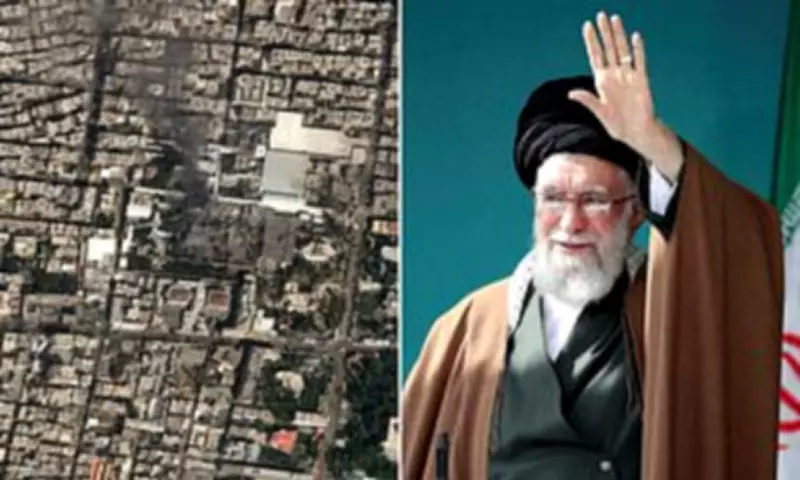
The Dawn Strike That Shattered Tehran's Fortress
On a seemingly ordinary Saturday morning in central Tehran, the fortified compound known as Beit Rahbari – the heavily armored residence of Iran's Supreme Leader Ayatollah Ali Khamenei – stood as an imposing symbol of the regime's power. Guards maintained their posts while traffic moved sluggishly through Pasteur Street, unaware that this fortress of bureaucratic and religious authority had already been thoroughly compromised by foreign intelligence agencies.
A Devastating Five-Minute Assault
At precisely 8:10 AM local time, the coordinated Israeli and American military operation commenced with catastrophic effect. Explosions reverberated across the Iranian capital as buildings disappeared in fire and dust, with plumes of black smoke billowing skyward. Within just five minutes, the aging Ayatollah lay dead – a victim of the same extreme violence he had inflicted upon countless innocents throughout his lengthy rule.
The strike represented poetic justice delivered via precision payload, eliminating not only Khamenei but also numerous high-ranking regime officials including the Revolutionary Guard commander-in-chief, Iran's defense minister, and the secretary of the Defense Council. More than thirty missiles instantly obliterated the Pasteur Street compound, with only one official surviving due to oversleeping and missing the meeting.

Years of Intelligence Penetration
This extraordinary military operation was no spontaneous action but rather the culmination of years of meticulous planning and intelligence gathering. Israeli and American agencies had achieved unprecedented penetration of Iran's security apparatus through a sophisticated fusion of cyber warfare, surveillance technology, and human espionage.
"The intelligence used in these operations is on another level," revealed a former Israeli defense official. "The combination of the latest technology crunching data and visuals – alongside unprecedented levels of human intelligence – all led to this incredible feat. Multi-agency, multinational, multifaceted: the number of layers is truly remarkable."
The Technological Edge
Israeli intelligence had systematically hacked Tehran's entire traffic camera network years earlier, with one strategically positioned camera near the compound entrance providing invaluable real-time surveillance of security personnel movements. From this and other intercepted signals, analysts constructed detailed dossiers on key regime figures – documenting their home addresses, shift patterns, travel routes, and even their parking preferences.
When Iranian officials banned VIPs from carrying mobile phones to prevent geolocation tracking, Mossad and Israel's elite Unit 8200 simply shifted their focus to the bodyguards' and drivers' devices. This adaptation demonstrated the flexibility of Western intelligence operations against one of the world's most paranoid and heavily guarded regimes.
The Psychological Warfare Component
Alongside the kinetic strikes, Israel executed a sophisticated psychological operation targeting ordinary Iranian citizens. The popular prayer-time calendar app BadeSaba, with millions of downloads across Iran, had been infiltrated long before the military operation began.
At 9:52 AM Tehran time, just minutes after the initial explosions, the app suddenly pushed a message to users nationwide: "Help is on the way." Subsequent alerts encouraged civilians to rise against the clerical regime while urging security forces to lay down their weapons and join liberation forces.
A New Paradigm of Warfare
The missiles that struck Tehran represented merely the visible conclusion of a far more complex and extensive operation. This coordinated assault has established a new paradigm for modern warfare, seamlessly integrating cyber capabilities, surveillance systems, and human intelligence to create conditions for battlefield success long before conventional weapons are deployed.

Following the initial decapitation strike, Israeli aircraft launched the largest air raid in the nation's history – approximately two hundred planes sweeping across Iran to destroy ballistic missile depots, silos, mobile launchers, and production facilities. Within hours, Iran's air defenses, missile infrastructure, and leadership hierarchy had been effectively neutralized.
Continuing Operations and Succession Questions
In the aftermath of Khamenei's elimination, Israel and America have continued precision strikes against remaining regime targets. On Tuesday night, they successfully attacked a secret meeting of Iran's Supreme Council as officials gathered to select a new Supreme Leader.
Intelligence suggests that Khamenei's son Mojtaba has been chosen as successor, though Israeli sources express skepticism about his longevity. "We wonder how long he'll last," commented a well-placed Israeli source. "It wouldn't be a surprise if we were tracking him, too. We are much further inside Iran than people understand. He'll be lucky to make it to Friday prayers."
The operation's mastermind, former Mossad chief Yossi Cohen – who oversaw the 2018 Iranian nuclear archive heist – emphasized the critical importance of technological dominance in modern intelligence work. "You need to be inside your enemy's systems," he stated during an interview last year, "or he will be in yours." Mossad has clearly internalized this philosophy, creating what military analysts now recognize as a revolutionary approach to twenty-first century conflict.





