

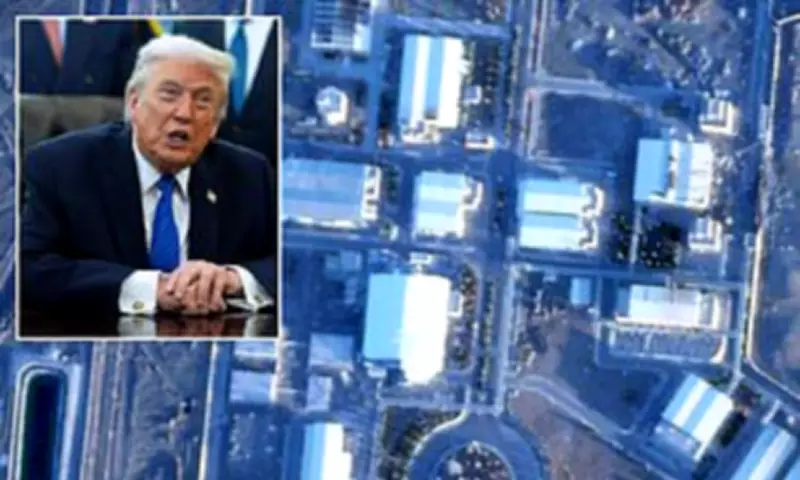
Fresh satellite imagery has uncovered significant construction activity at Iranian nuclear facilities that were heavily damaged during military strikes by the United States and Israel last year. The images, captured by Planet Labs PBC, show new roofs being erected over two severely damaged buildings at the critical Isfahan and Natanz nuclear sites, which were left devastated following attacks in June.
Blocking Satellite Surveillance
The construction represents the first major visible activity at any of Iran's damaged nuclear locations since the twelve-day conflict with Israel last summer. Experts have noted that these protective coverings effectively block satellite observation of ground activities, which currently serves as the only method available to the International Atomic Energy Agency for monitoring these restricted sites.
Strategic Recovery Operations
Analysts suggest the roofing structures do not indicate reconstruction efforts but rather appear designed to facilitate assessment of whether "key assets," including stocks of highly enriched uranium, survived the devastating attacks. "They want to be able to get at any recovered assets they can get to without Israel or the United States seeing what survived," explained Andrea Stricker, an Iran specialist at the Foundation for Defense of Democracies, in comments to the Associated Press.

Satellite imagery reveals that Iran began constructing the roof over the damaged Natanz facility in December, completing the work by month's end, though the country never publicly acknowledged these operations. The electrical system at Natanz appears to remain completely destroyed despite these developments.
Expanding Underground Facilities
Experts have also identified growing piles of earth and soil that are believed connected to the development of a new nuclear bunker. Fresh photographs further indicate that Iran continues excavation work that commenced in 2023 at Pickaxe Mountain, located just a few hundred yards south of Natanz's perimeter fence.
Meanwhile, at the Isfahan Nuclear Technology Center, which primarily produces uranium gas for centrifuge enrichment processes, satellite images show Iran completed a roof over a structure near the site's northeast corner in early January. According to Sarah Burkhard, a senior research associate at the Institute for Science and International Security, the roofs appear to be "an attempt to recover any sort of remaining assets or rubble without letting us know what they are getting out of there."
Defensive Tunnel Modifications
The satellite photographs reveal additional defensive measures, including two tunnels into a nearby mountain that have been filled with dirt, a precaution Iran implemented before last June's conflict. A third tunnel appears to have been cleared of soil, with new walls constructed at its entrance.
Sean O'Connor, an expert at open-source intelligence firm Janes, suggested Iran's objective was likely "to obscure activity" rather than to "repair or rebuild a structure for use." This assessment aligns with observations that the roofing serves primarily to shield recovery operations from surveillance.
Mounting International Tensions
These developments occur amidst escalating rhetoric from US President Donald Trump, who has repeatedly demanded Iran negotiate a new nuclear agreement while threatening military action. On Wednesday, Trump warned Tehran via Truth Social that "a massive Armada is heading to Iran" and added that "the next attack will be far worse! Don't make that happen again."
The American president described the fleet as "larger" than one previously sent to Venezuela and "ready, willing, and able to rapidly fulfill its mission, with speed and violence, if necessary." Trump called last year's strikes "a major destruction of Iran" while urging Tehran to "quickly 'Come to the Table' and negotiate a fair and equitable deal – NO NUCLEAR WEAPONS."
Inspection Access Denied
Iran has consistently refused to allow IAEA inspectors access to the damaged sites since the attacks occurred. The Natanz complex, located approximately 135 miles south of Tehran, encompasses extensive above-ground and underground facilities that previously handled most of Iran's uranium enrichment operations.

Last June, a leaked "top secret" assessment suggested Tehran's stockpile of enriched uranium remained largely intact following the bombings, though the White House dismissed this report as "flat-out wrong." Anonymous sources claimed the unprecedented missile strikes had only set Iran's nuclear program back "a few months, tops," according to documents leaked to CNN.
The White House's National Security Strategy published in November stated that American strikes "significantly degraded Iran's nuclear program," though the latest satellite imagery suggests recovery and assessment operations are now underway behind newly constructed protective coverings.





