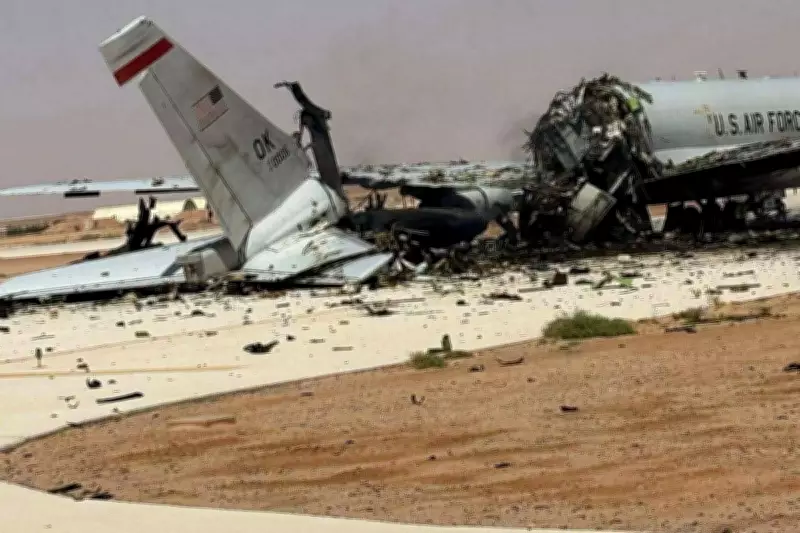
Iran's Attack Destroys Critical US Radar Aircraft, Raising Fears Over Surveillance Capabilities
Iran has delivered a significant blow to American military operations by destroying a vital US Air Force E-3 Sentry aircraft in a strike on a Saudi Arabian air base. Military experts are warning that the loss of this key surveillance platform could severely degrade the United States' ability to monitor incoming threats in the region.
Images Reveal Extensive Damage to AWACS Aircraft
Photographs circulating over the weekend show the wrecked E-3 Sentry with its tail section completely severed from the main body of the aircraft. The attack occurred on March 27 at Prince Sultan air base in Saudi Arabia, where several US service members were injured. The Boeing-built aircraft serves as a crucial component of the military's Airborne Warning and Control System (AWACS), capable of tracking hundreds of targets simultaneously across thousands of square miles.
The distinctive rotating radar dome above the fuselage makes the E-3 Sentry an airborne command post that provides all-weather surveillance, command, control, and communications capabilities in battle spaces. Former Air Force colonel and CNN military analyst Cedric Leighton described the destruction of one aircraft from a fleet of just 17 AWACS planes as "a serious blow" to American surveillance capabilities.

Reduced Fleet Creates Coverage Gaps
According to Air & Space Forces Magazine, the US fleet has effectively been reduced to 16 E-3 Sentry aircraft following the attack. Six of these critical surveillance planes were stationed at Prince Sultan air base prior to Friday's strike. Heather Penney, a former F-16 pilot and director of studies at the Mitchell Institute for Aerospace Studies, explained that these aircraft serve as essential "battle managers" that analyze airspace for attacks and coordinate lethal effects across the entire force.
"They're the chessmaster, while fighter pilots are the bishops," Penney told the magazine, emphasizing how the E-3 Sentry aircraft provide the "bigger picture" perspective that guides tactical operations.
Experts Warn of Strategic Implications
Andreas Krieg, a senior lecturer at King's College London's School of Security Studies, told NBC News that "Iran is gradually eating away at the network of early warning systems that the US has built over decades in the region." He warned that the destruction of such critical assets "further degrades the overall monitoring capability of the US" at a crucial time in the conflict.
Retired US Army Lt. Col. Daniel Davis, a Bronze Star recipient with 21 years of service, expressed grave concerns about American military preparedness. "We're not doing OK at all," Davis told NBC News, adding that the US is "not militarily prepared for this to be a sustained war."
The military expert noted that many in the administration had anticipated a quick resolution, but Iran "still has plenty of missiles to keep going at a sustained rate." Davis posed a troubling question about broader implications: "If we've had this much trouble with what was considered a militarily inferior Iran, what does anybody think would happen if we had to fight on the ground, in the sea and in the air against a Russia or a China?"
Conflict Enters Fifth Week With Mounting Casualties
The White House maintains that a 4-6 week timeline remains in place as the war with Iran enters its fifth week. CENTCOM commander Adm. Brad Cooper reported last week that Iran's missile and drone launches have decreased by more than 90 percent since the US war began on February 28. However, experts caution that Iran retains the capability to launch attacks impacting critical sites and vessels despite allegedly diminished supplies.
The human toll continues to mount with more than 300 American service members injured since attacks began last month, at least 13 service members killed, and approximately 20 US aircraft damaged. The Independent has requested comment from both the Pentagon and US Central Command regarding the latest developments.

Escalating Threats and Potential War Crimes Concerns
President Donald Trump threatened on Monday to "completely" destroy Iran's key oil export hub at Kharg Island along with other energy sites unless Iran agrees to lift its blockade of the Strait of Hormuz and pursue a peace deal. The administration is reportedly considering a potentially risky ground operation to seize uranium from deep inside Iran, marking what would be a major escalation of the conflict.
When questioned about the president's threats to destroy electricity plants and desalination facilities—civilian infrastructure that could constitute war crimes under international law if targeted—White House press secretary Karoline Leavitt told reporters that the US will "operate within the confines of the law."
Leavitt added: "Of course this administration and the United States armed forces will always act within the confines of the law. But with respect to achieving the full objectives of Operation Epic Fury, President Trump is going to move forward unabated, and he expects the Iranian regime to make a deal with the administration."