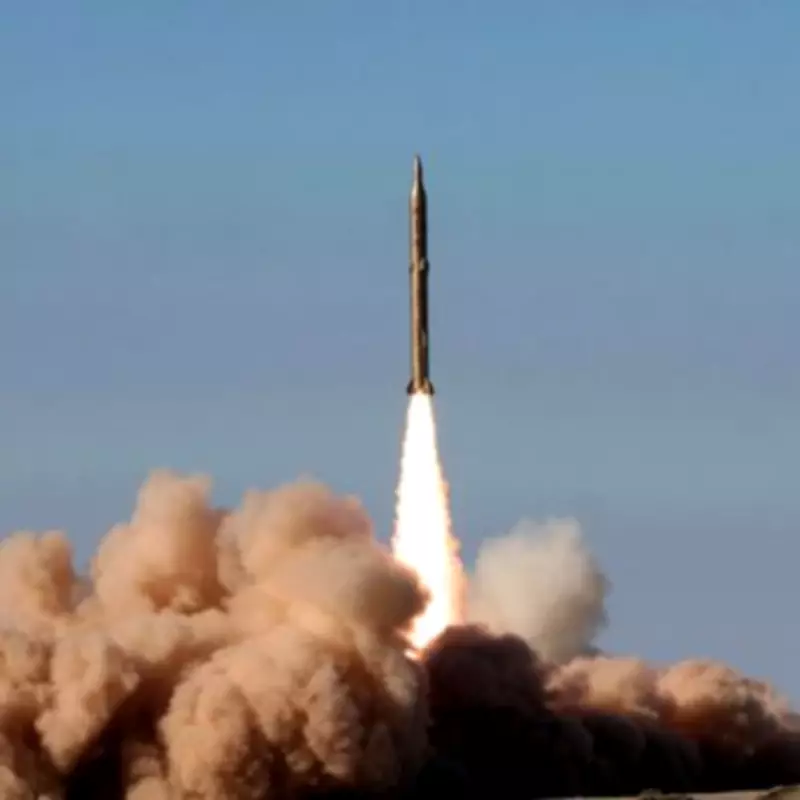
Iran possesses missile technology theoretically capable of reaching the United Kingdom, but a critical technical limitation makes such an attack extremely improbable for the foreseeable future, according to military analysis. As the United States and Israel continue their bombardment campaigns against Iranian targets across the Middle East, the question of Iran's retaliatory capabilities has gained renewed urgency.
Assessing Iran's Missile Arsenal
Military historian and author Dr Mark Felton has provided detailed commentary on Iran's current missile capabilities and their potential threat to European nations. In the aftermath of recent assaults, Iran has launched retaliatory strikes against Gulf neighbours, triggered dramatic oil price increases, and opened new conflict fronts in Lebanon while closing the strategically vital Strait of Hormuz to global oil shipments.
Felton began his assessment by referencing previous analysis of hypothetical Russian non-nuclear attacks using cruise missile swarms deployed from aircraft and submarines. He detailed how such assaults could target critical British infrastructure including power grids, radar systems, early warning networks, ports, bridges, and military installations.

Britain's Defence Vulnerabilities
In a concerning observation, Felton asserted that the United Kingdom remains "not prepared for any such attacks." He highlighted the absence of comprehensive air defence systems comparable to Israel's Iron Dome technology or sufficient surface-to-air missile coverage protecting national infrastructure and nuclear facilities.
Shifting focus specifically to Iran, Felton addressed commentary suggesting Iranian ballistic missiles could potentially reach "deep into Western Europe." He confirmed this assessment as "completely true" while posing the critical question: "Could an Iran fighting for its existence against its enemies and possessing vast stocks of missiles lob a few at us Europeans as punishment for our government's support of the Israeli US attack?"
Range Capabilities and Limitations
Felton noted that Iran has apparently "self-limited" most of its ballistic missiles to approximately 2,000 kilometers range. However, the nation also possesses the Khorramshahr-4 missile, capable of achieving an "absolute maximum range" of 3,000 kilometers depending on warhead weight specifications.
Based on expert analysis, if these range estimates prove accurate, Iran could theoretically launch missiles from western territories that might reach Copenhagen, Denmark. However, London remains "completely out of range" of these conventional ballistic systems according to current assessments.
Space Launch Vehicle Potential
Felton explained that Iran does possess other rocket types with sufficient range "probably to hit the UK," though these have not been modified to deliver conventional warheads. These systems form part of Iran's space program, which has successfully placed satellites into orbit using space launch vehicles (SLVs) for several years.
"Western nations have been concerned for years that Iranian SLVs could provide a pathway to an intercontinental ballistic missile capability, ICBM, if Iran successfully develops a nuclear warhead," Felton observed. Fortunately, no evidence currently suggests Iran has achieved this technological milestone.
Among Iran's SLV inventory, the Ghaem-100 possesses a 3,000 to 4,000 kilometer range, while the more advanced Simorgh system boasts capabilities between 4,000 and 6,000 kilometers. Despite these impressive range specifications, Felton highlighted critical technical obstacles preventing effective deployment against distant targets like the United Kingdom.
Technical Barriers to UK Attack
The primary limitations involve accuracy challenges and engineering difficulties creating re-entry vehicles robust enough to protect warheads from extreme heat and stress during atmospheric re-entry. These technical hurdles currently render effective long-range conventional missile attacks against the UK "technically impossible" for Iran according to Felton's analysis.

Summing up the situation, Felton stressed that while Iran possesses rockets with theoretical range to reach British territory, the nation lacks the sophisticated systems required to effectively deploy warheads across such distances with precision. This fundamental technical limitation represents the key reason why Iranian missile attacks against the United Kingdom remain highly unlikely despite ongoing Middle Eastern conflicts and escalating geopolitical tensions.