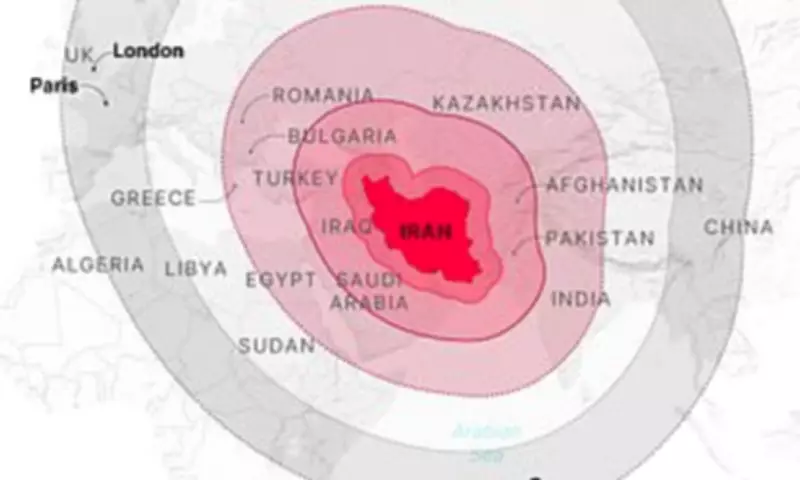
Iran's Missile Strike on Diego Garcia Reveals Extended Range Threat to Europe
Iran's ballistic missile strike on a British military base in the Chagos Islands has dramatically escalated fears that major European capitals are now within reach of further attacks by the extremist regime. Defence experts warn that London has moved closer to the edge of vulnerability following this significant development in hostilities.
The Attack on Diego Garcia
Two ballistic missiles were fired toward Diego Garcia, a strategically vital base in the Indian Ocean jointly operated by the United States and the United Kingdom, on Friday night. This aggressive action represents a substantial escalation that occurred mere hours after Prime Minister Keir Starmer authorized Donald Trump to utilize UK-based bombers threatening the Straits of Hormuz.
Military sources confirmed that one missile failed during flight, while the other was successfully intercepted by a US warship. This incident marks what is believed to be the first-ever direct strike on the Diego Garcia military installation, raising alarm across international defence circles.

Extended Missile Range Capabilities
Defence analysts emphasize the profound significance of this event, noting it represents the first deployment of intermediate-range missiles in the ongoing conflict. These weapons can cover far greater distances than Iranian ballistic missiles were previously known to possess.
Diego Garcia lies approximately 3,800 kilometers (2,360 miles) from Iran, directly contradicting the regime's longstanding assertion that its ballistic missiles could only reach 2,000 kilometers (1,240 miles). This revelation fundamentally alters the strategic landscape of Middle Eastern and European security.
Experts now warn that if Iran has indeed proven its capabilities extend this far, the missile threat could potentially encompass most capital cities in Western Europe. Paris sits 4,198 kilometers (2,609 miles) from Tehran, while London positions itself on what analysts describe as the edge of vulnerability at around 4,435 kilometers (2,750 miles).
Military and Political Reactions
General Sir Richard Barrons, former head of the UK's Joint Forces Command between 2013 and 2016, stated that Iran's military power may have been serially underestimated by Western intelligence agencies. Responding to questions about the UK's involvement, he noted that both critics and supporters of British policy might have valid perspectives.
General Barrons explained: War generally does not follow a script and the enemy always gets a vote. In this case, the enemy's vote, Iran, has been serially underestimated. We are where we are - this conflict now puts British interests and those of our allies at risk.
The former forces chief added that the UK was helping the United States apply military force despite potential reservations about initial involvement, stating that obligations to allies had drawn Britain into the conflict.
Strategic Implications and Analysis
Foreign affairs analyst Nawaf Al-Thani responded to the Diego Garcia strikes on social media, declaring that long-held assumptions about Iran's missile capabilities have just collapsed. He emphasized that reaching Diego Garcia suggests capabilities in the neighborhood of 4,000 kilometers, pushing Iranian missiles from medium-range into intermediate-range classification.
Al-Thani elaborated: The real story is not whether the missile was intercepted. It is that Iran may have demonstrated reach far beyond what much of the world believed it possessed. This would mean the missile threat is no longer confined to the Gulf, Israel, or parts of South Asia.
He concluded that if confirmed, the attack on Diego Garcia represented not merely a target but a message to Western powers about Iran's expanded military capabilities.

Political Context and Warnings
Just hours before the missile launch, Iranian Foreign Minister Abbas Araghchi warned that Prime Minister Starmer had placed British lives in danger by consenting to Trump's request to use B-52s and other aircraft flying from RAF Fairford and Diego Garcia. In a social media post, Araghchi claimed the vast majority of the British people opposed involvement in what he characterized as a US-Israeli war of choice against Iran.
The Friday night attack coincides with the third week of conflict and follows a joint US-Israeli strike against Iran's Natanz uranium-enrichment facility. Additional military actions included strikes on an ammunition airbase in Dezful, with Israel pledging that attacks would significantly increase in coming days.
Official Responses and Strategic Value
A Ministry of Defence spokesman described Iran's actions against Diego Garcia as a threat to UK interests, stating: Iran's reckless attacks are a threat to British interests and British allies. RAF jets and other UK military assets are continuing to defend our people and personnel in the region.
Diego Garcia holds immense strategic value for US military operations, having served as a launchpad for Middle Eastern missions for decades. The base features:
- A large airfield capable of handling heavy bombers
- Major fuel storage facilities
- Advanced radar installations
- A deep-water port for naval vessels
International Tensions and Economic Impact
President Trump criticized the UK government for what he characterized as a slow response to allow US use of British bases, stating: It's been a very late response from the UK. I'm surprised because the relationship is so good, but this has never happened before. He added that Britain initially resisted allowing US use of Diego Garcia.
Prime Minister Starmer has maintained that Britain would not be drawn into wider conflict while protecting national interests, telling Parliament: We will protect our people in the region. We will take action to defend ourselves and our allies, and we will not be drawn into the wider war.
The economic consequences continue to mount as Iran has effectively shut the Strait of Hormuz, through which approximately one-fifth of global oil supplies pass. This action has triggered what analysts term Trumpflation - a spike in oil and gas prices with direct impact on UK consumers.
Britons received official advice to consider working from home and using energy-efficient appliances like air fryers to reduce demand. A government spokeswoman confirmed that Cabinet ministers condemned Iran's expansion of its targets to include international shipping, warning that reckless strikes risked pushing the region further into crisis while worsening economic impacts felt in Britain and globally.
With attacks damaging Qatar's liquefied natural gas facilities requiring three to five years for repair, and energy bills projected to increase by more than one-fifth when caps change in July, the geopolitical conflict continues to generate significant domestic consequences for British households and national security planning.