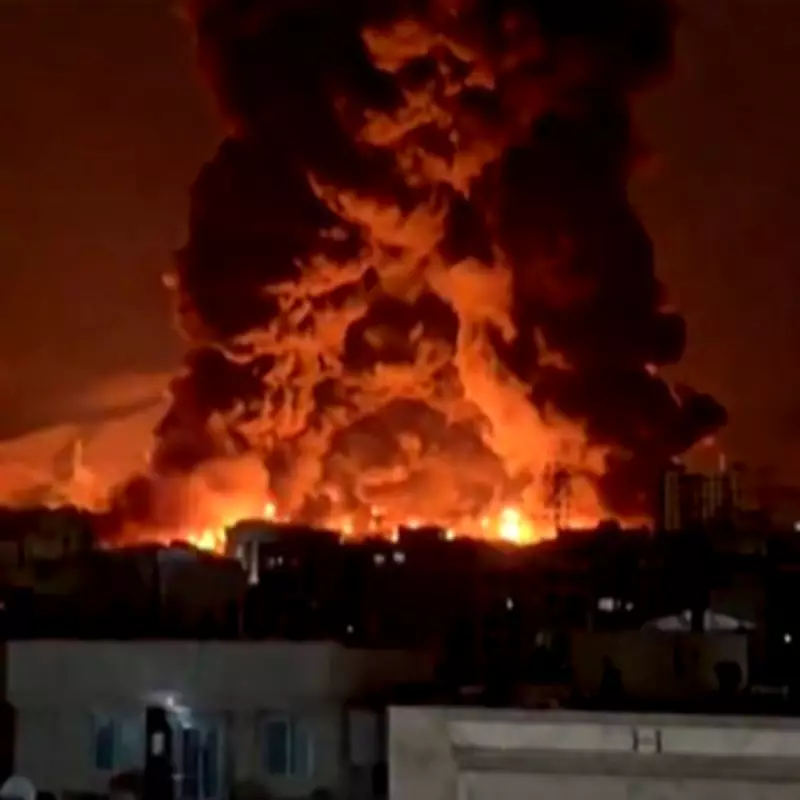
Iran's Ambassador Issues Stark Warning to United Kingdom Over Military Options
Iran's ambassador to the United Kingdom, Seyed Ali Mousavi, has delivered a chilling statement indicating that all military options remain open for potential action against British territory. This warning comes amidst escalating tensions in the Middle East, with concerns mounting that the conflict could directly impact UK soil. Ambassador Mousavi explicitly stated that any British military bases connected to United States operations could become legitimate targets if diplomatic relations continue to deteriorate.
Specific UK Installations Identified as Potential Targets
The ambassador's comments have placed particular focus on RAF Fairford in Gloucestershire and the RAF base on Diego Garcia in the Indian Ocean. These installations have been utilised by American forces to launch strikes against Iran since hostilities erupted last month. In a significant development, Iran confirmed it fired two long-range ballistic missiles towards Diego Garcia recently, marking its first deployment of such weaponry in this conflict. One missile was successfully intercepted, while the other failed mid-flight.
Prime Minister Starmer's Evolving Position on Military Involvement
Initially, Prime Minister Keir Starmer resisted American requests to use UK bases for operations against Iran, rejecting a direct appeal from former US President Donald Trump. However, the British government's position shifted dramatically after Iran moved to restrict the vital shipping route through the Strait of Hormuz. This strategic waterway handles approximately one-fifth of the world's oil shipments, and its blockade has sent global energy prices soaring.

Ambassador Mousavi acknowledged Starmer's initial reluctance to become embroiled in what he termed the criminal act of the American side and the Israeli regime. Nevertheless, the diplomat suggested that Britain's subsequent decision to permit American bombers to operate from RAF Fairford has fundamentally altered the strategic calculus.
Growing Concerns Over UK Defence Capabilities
The ambassador's warning has intensified existing fears about Britain's vulnerability to missile attacks. Defence specialists have cautioned that current air defence systems may prove insufficient against sophisticated ballistic threats. Despite a £1 billion commitment to bolster national air defences, implementation delays have hampered progress, leaving the United Kingdom increasingly dependent on NATO partners for protection.
International Reactions and Economic Fallout
The economic consequences of the Strait of Hormuz blockade continue to worsen, with former President Donald Trump using his Truth Social platform to criticise allies who have refused direct military involvement. Trump specifically singled out the United Kingdom, suggesting British authorities should build up some delayed courage and take control of the strategic waterway themselves.
US Defence Secretary Pete Hegseth has also questioned Britain's hesitancy, while UK Defence Secretary John Healey has defended his nation's position during diplomatic visits, asserting that Britain remains a crucial American ally. Meanwhile, France has maintained its refusal to permit military supply flights to Israel through its airspace, with President Emmanuel Macron's office affirming it will not support military action against Iran.
Transatlantic Tensions Exposed
The escalating situation has exposed significant tensions across the Atlantic, with Prime Minister Starmer previously criticising US strikes as lacking coherent strategy. This assessment prompted a curt retort from Donald Trump, who declared the British leader was not Winston Churchill. As diplomatic channels strain under pressure, Ambassador Mousavi's warning that all options remain open underscores the precarious nature of current international relations and the very real possibility of expanded conflict reaching British shores.