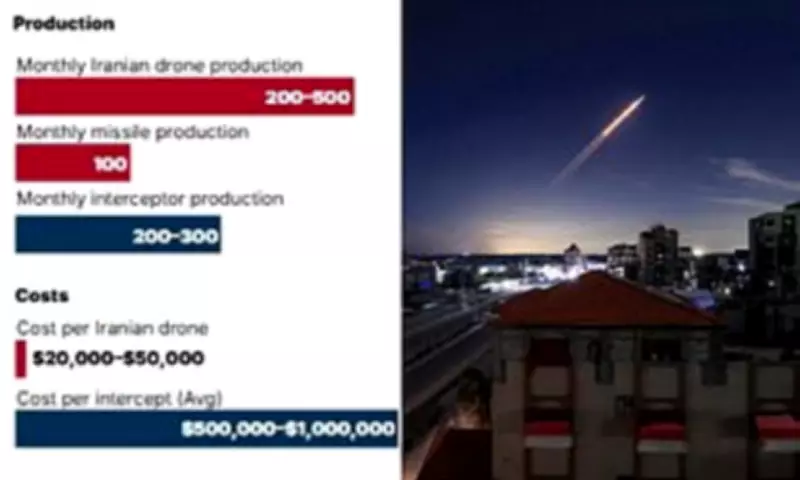
Iran's Drone Strategy Reveals Critical Defence Imbalance
The ongoing retaliatory campaign by Iran has starkly highlighted a growing and concerning imbalance in modern warfare: the disparity between inexpensive drone production and the exorbitant cost of shooting them down. A single Iranian drone can be manufactured for as little as $35,000, while intercepting it may require defensive systems costing anywhere from $500,000 to a staggering $4 million. This economic and tactical challenge has been brought into sharp focus during the latest escalation, known as Operation Epic Fury.
Operation Epic Fury and Multi-Theatre Pressure
Iran has launched coordinated attacks against Israel and at US and allied military bases located across the United Arab Emirates, Kuwait, Bahrain, Qatar, and Saudi Arabia. By spreading strikes across more than five distinct theatres simultaneously and sustaining a barrage of over 2,500 drones per day, Tehran is strategically forcing its adversaries to divide their defensive resources. Every interceptor missile deployed to protect one base is consequently unavailable for use elsewhere, creating significant vulnerabilities as interceptors are a finite resource.
This forces military planners to stretch their defensive assets across thousands of kilometres, inevitably resulting in weaker protection at each individual location. Iran's primary advantage lies in sheer scale. According to data compiled from open-source intelligence and defence analysts, rather than possessing merely a few thousand long-range drones, Iran's total Shahed drone fleet is estimated to number between 80,000 and 100,000 units across all variants.

Interceptor Stockpiles Under Severe Strain
Combined with an ongoing production rate of approximately 500 drones per month, if utilised at full capacity, these numbers could translate into sustained waves exceeding 2,500 drones daily for an entire month. Western officials and analysts warn that current interceptor stockpiles would struggle to keep pace with such an onslaught, noting that the strain is already evident. Last year's intense fighting in June 2025 saw defence inventories severely depleted.
During that summer conflict, the United States alone fired around 150 THAAD (Terminal High Altitude Area Defense) interceptors to defend Israel over a mere 12-day period, consuming roughly a quarter of its total stockpile. Each of those THAAD interceptors costs about $15 million and can take between three to eight years to replenish fully. Now, the same limited systems are being relied upon across multiple countries simultaneously as the intensity of Iranian attacks continues unabated.
Interceptors are not the only munitions facing critical shortages. The US is also expanding its use of sea-launched Tomahawk cruise missiles (TLAMs) and aircraft-launched weapons. With US President Donald Trump stating the conflict could persist for another four weeks, these dangerously low stock levels present a severe strategic problem.
The High Cost of Defence Protocols
The standard military practice of firing two or even three interceptors at a single incoming target to ensure a successful hit adds another layer of pressure. This doctrine means even a relatively small wave of drones or missiles can rapidly drain precious defensive supplies. William Alberque of the Pacific Forum noted that 'magazine capacity was already low' following last year's intense engagements. If the current operational tempo continues, officials fear stocks could be exhausted within days.
In April 2024, a coordinated defence effort successfully intercepted 99% of incoming threats. However, that earlier attack was slower, more predictable, and involved a smaller number of weapons. In contrast, this week's attacks are characterised by greater speed, less predictability, and a broader geographical span, making a repeat of that high interception success rate far more challenging.
Exploring More Affordable Countermeasures
Analysing the current exchange rates between cheap drones and expensive interceptors suggests a prolonged campaign could incur costs running into tens or even hundreds of billions of dollars. Consequently, cheaper defensive solutions are being actively considered. One promising option is the use of APKWS (Advanced Precision Kill Weapon System) guided rockets, which cost only about $28,000 per shot.

These systems have demonstrated strong results in testing, achieving a 100% hit rate, and now account for a significant share of drone interceptions in the region, with thousands already deployed. Another potential game-changer is Israel's Iron Beam laser defence system, which can destroy targets for just a few dollars per shot. However, only one or two of these systems are currently operational, and all are based within Israel, leaving other parts of the region without access to this technology.
Regional Escalation and Political Stance
Eyal Pinko, a former Israeli naval commander, framed the conflict's core question as which side will manage to outlast the other, warning that 'a lot more attacks are coming.' This assessment comes as Iran has vowed never to surrender, explicitly rejecting an ultimatum from President Trump to lay down its weapons. The conflict has escalated across the Middle East, with missiles raining down on the region.
The Iranian Red Crescent reported on Monday that a total of 555 people have been killed across Iran since the start of the strikes, which also resulted in the deaths of Ayatollah Ali Khamenei and other senior leaders. Israel's rescue services stated that nine people were killed and 28 wounded in a strike on a synagogue in Beit Shemesh, bringing the country's overall death toll to 11, with another 11 individuals still missing.
On Monday, loud explosions were heard across the Gulf cities of Dubai, Doha, and Manama as Tehran pressed into a third day of strikes against its Gulf neighbours. Saudi Arabia was also targeted, successfully intercepting two drones during an attempted attack on an oil refinery in Ras Tanura. The Saudi defence ministry confirmed that two missiles were intercepted and destroyed at the plant in the Eastern Province. According to Al Jazeera, the site has now been temporarily closed.
Iran's army confirmed it targeted the American Ali Al Salem air base in Kuwait as well as vessels in the Indian Ocean in retaliation for US and Israeli strikes, stating that '15 cruise missiles' were used in these attacks. Kuwait's defence ministry reported that several American warplanes crashed in Kuwait earlier today, though their crews survived.
The situation remains volatile, with the fundamental imbalance between low-cost offensive drones and high-cost defensive systems posing a persistent and expensive challenge for Western and allied forces engaged across multiple fronts.