

Iran's Granite Mountain Fortress Defies US-Israeli Bunker-Busting Strikes
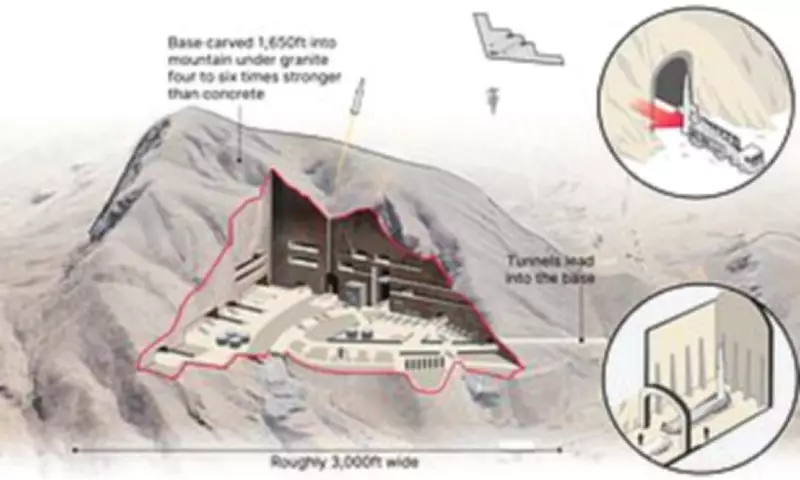
Deep within the mountains of central Iran, approximately 500 metres beneath the surface, lies the Yazd missile base – not merely a bunker but a buried fortress of formidable proportions. Carved directly into Shirkuh granite, one of Earth's hardest rock types, this facility withstands crushing pressures far beyond the capabilities of conventional construction materials.
The Impenetrable Defence
This extraordinary geological barrier presents the toughest possible challenge for even America's most powerful bunker-busting weapon – the GBU-57 Massive Ordnance Penetrator. Inside the mountain, engineers have hollowed out something closer to a hidden city than a traditional military installation.
The secret facility reportedly contains an automated rail system running through extensive tunnels that connect assembly areas, storage depots, and multiple concealed exits carved into different mountain faces. Iranian propaganda videos show similar underground missile cities where launchers move rapidly on lorries, roll out to fire, then withdraw underground behind heavy armoured doors within moments.

Surviving Sustained Attacks
Despite weeks of relentless US-Israeli strikes targeting Iranian facilities, Tehran continues unleashing its hidden arsenal of rockets and drones across the Middle East. According to the Institute for the Study of War, the Yazd missile base alone has been struck at least six times since the conflict's beginning, including attacks on March 1, March 27, and March 28.
Remarkably, footage published by an open-source intelligence account on March 28 appears to show two missiles being launched from the very same site. Analysts remain uncertain whether these launches occurred before or after the latest strikes.
Network of Underground Cities
Across Iran, similar underground 'missile cities' have reportedly been carved into mountains, creating a dispersed web of hardened sites supporting the country's ballistic missile capabilities. The Islamic Republic has spent years constructing these cavernous bunkers to protect its vast missile arsenal from destruction.
While Israel pummelled Tehran's infrastructure during June's twelve-day war, the regime emerged with much of its stockpile of thousands of ballistic missiles intact. Current US intelligence assessments indicate Iran retains approximately half its missile launchers and thousands of drones, according to three well-placed sources speaking to CNN.
These estimates may include launchers rendered inaccessible by strikes but not completely destroyed, suggesting significant remaining firepower. Two sources indicated Iran maintains roughly half its original drone stock, numbering well into the thousands.
Coastal Defence Capabilities
A substantial proportion of Iran's coastal defence cruise missiles – weapons enabling Tehran to threaten traffic through the strategically vital Strait of Hormuz – are believed to remain operational. Israel estimated Iran possessed around 470 ballistic missile launchers at the war's outset, claiming last month to have destroyed or disabled approximately sixty percent.
Since the current conflict began, US and Israeli forces have conducted extensive campaigns targeting Iran's missile infrastructure nationwide. Strikes have collapsed entrances, cratered ventilation shafts, and damaged surface installations, yet the deep underground systems remain largely intact.
Rapid Recovery Capabilities
A recent CNN investigation revealed that while seventy-seven percent of visible tunnel entrances suffered hits, activity at these sites resumed quickly. Construction equipment returned within days, clearing debris and reopening access routes into the mountains.
Reports describe cavernous halls filled with ballistic missiles, drones, and launch systems, all connected by transport corridors designed for rapid movement. A January 2026 assessment by Alma Research found similar data based on damage sustained during June's conflict.

Propaganda Reveals Scale
Footage released by Iran's Fars News Agency one week into the current conflict showed extensive rows of missiles and Shahed drones lined up inside such facilities, with trucks carrying launchers positioned deep within tunnels. Iranian flags hung from ceilings as cameras moved through spaces revealing the concerning scale of these hidden constructions.
Many drones are relatively inexpensive and quick to produce, while interception systems cost far more. Defending against such attacks can expend resources many times greater than launching them, raising concerns that even well-equipped adversaries could face strain during prolonged campaigns.
Architectural Resilience
Experts emphasize the real difficulty lies in penetrating carefully-designed storage architectures. These underground complexes prioritize resilience, with tunnels segmented using blast-resistant doors to contain damage. Multiple entrances and exits allow operations to continue even if several access points are destroyed.
Some openings serve as decoys while others conceal themselves within natural terrain contours, making identification and targeting challenging. Even the most advanced bunker-busting weapons face constraints imposed by the materials they must penetrate.
Analyst Shanaka Anslem Perera told the Statesman: 'The mountain does not care how many sorties are flown above it. The railway does not care how many portals are sealed. The geology is the defence, and the geology has been there for 300 million years.'
Geological Advantages
Penetration depth varies depending on whether targets are covered by soil, concrete, or dense rock. Granite particularly absorbs and disperses explosive energy, reducing effectiveness of even the largest conventional munitions.
According to RUSI analyses, penetrating hardened underground facilities may require multiple strikes on identical points, detailed intelligence regarding internal layouts, and sustained follow-up attacks preventing rapid repairs. All this must occur while suppressing air defences and coordinating attacks across multiple dispersed sites.
Expert Analysis
Tunnelling expert Dr Amichai Mittelman told Globes: 'The mountains in Iran provide a level of protection 50-100 meters thick of rock that is hard to crack even by heavy bombs.' Targeting entrances has limitations since destroying openings may temporarily block access without collapsing networks behind them.
The same logic applies to other potential weak points like ventilation shafts. 'The Iranians thought of everything, so they built many ventilation holes and shafts and installed fans to compress air inside,' Mittelman explained. 'Sometimes this represents a weak point for underground complexes – suffocation of those inside – but doubt remains whether this applies to large missile cities. Electrical infrastructure also incorporates backup systems.'
Ground Operations Challenges
The primary underground missile facility near Yazd, identified at coordinates 31.803792°N, 54.298661°E, presents formidable challenges. Ground operations offer no easy alternatives, with analysts noting that inserting special forces into such deeply buried, complex tunnel systems would involve high risks and scaling difficulties.
Experts say each site requires individual tackling across multiple heavily fortified locations. Tal Inbar, an Iranian missile program expert and senior research fellow at the Missile Defense Advocacy Alliance, stated: 'The effectiveness of ground units in such facilities is limited. To truly solve the problem, you must send units to each of these dozens of bases, making success extremely difficult.'
Continued Strikes Despite Bombardment
Despite weeks of sustained bombing, Iran continues launching missiles at Israel and Gulf neighbours throughout the conflict. In Friday's latest escalation, the Islamic Republic unleashed ferocious attacks on Gulf energy sites, striking an oil refinery and desalination plant in Kuwait plus a major gas complex in Abu Dhabi.
The Islamic Revolutionary Guard Corps claimed shooting down a second American F-35 fighter jet over central Iran, according to statements carried by Mehr news agency. Conflict resolution remains unclear, with Donald Trump threatening to bomb Iran 'back to the Stone Age' while simultaneously claiming the US military has already won.
Political Statements and Realities
Trump vowed late Thursday that the military 'hasn't even started destroying what's left in Iran,' writing on Truth Social about targeting bridges and electric power plants. On Wednesday, the President claimed Iran's 'ability to launch missiles and drones is dramatically curtailed, and their weapons factories and rocket launchers are being blown to pieces, very few of them left.'
Latest intelligence reports suggest more limited effects, though Iran's military has suffered heavily. As of Wednesday, the US had struck over 12,300 targets inside Iran according to US Central Command. Defence Secretary Pete Hegseth noted dramatic reductions in weapons being fired, stating on March 19 that ballistic missile and drone launches had both decreased by ninety percent since the conflict's early days.
Strategic Advantages
Tehran has clearly planned for such attacks for decades. The regime recognizes advantages over America's military machine, including strangleholds over global oil supplies and vulnerabilities of US regional allies in the Gulf who have suffered hard hits from Iranian strikes.
Combined with lethal supplies of hidden weapons, these factors allow Tehran to set tough – perhaps impossible – conditions for negotiations. While cessation of hostilities and ending killings of Iranian officials represent reasonable demands, 'reparations' for US bombing damage and guarantees of Iranian sovereignty over the Strait of Hormuz may prove unacceptable to Washington.
Persistent Infrastructure
Although Iranian strike pace has slowed compared to the war's early days, it has stabilized into steady rhythms suggesting sufficient infrastructure remains operational. Perera concluded: 'The persistence of Iranian missile fire despite three weeks of intensive strikes is not resilience. It is infrastructure.'
'IRGC did not prepare for this war by building rockets. It prepared by building railways inside mountains. The rockets are replaceable. The railways are permanent. And the granite that protects them was formed before mammals existed. The strait is 21 miles wide. The mountain is 500 metres deep. And the railway inside it is still delivering missiles to the surface.'





