

Israeli F-35 Makes History Shooting Down Iranian Fighter Jet Over Tehran
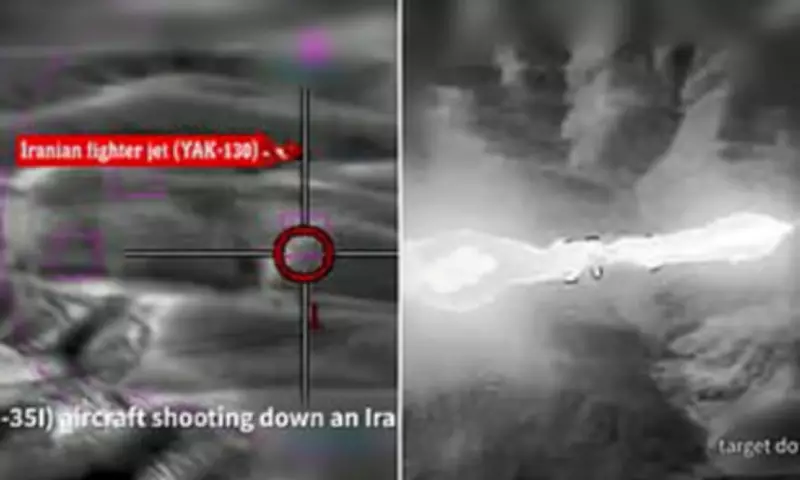
A dramatic video has emerged showing the precise moment an Israeli F-35 stealth fighter jet shot down a manned Iranian aircraft in the skies over Tehran. The footage, which has circulated widely, captures the stealth jet tracking the Iranian plane through its advanced targeting system before obliterating it, with the Israeli pilot audibly declaring, 'Target is down.' The video then appears to show the stricken Iranian warplane plunging towards the ground, trailing a thick plume of smoke.
Historic Military Engagement
The Israeli military confirmed on Wednesday morning that one of its 'Adir' F-35i fighter jets had successfully engaged and destroyed a piloted Iranian Yak-130 jet. This strike represents a historic milestone in the ongoing Middle East conflict. The Israel Defense Forces (IDF) assert that this engagement marks both the first dogfight of the current war and the inaugural instance of an F-35 achieving an air-to-air kill against a manned aircraft. Furthermore, it is believed to be the first time in four decades that the Israeli Air Force has conducted such an air-to-air victory.
The last recorded instance occurred in 1985, during the 'War of the Camps,' when an Israeli F-15 shot down two Syrian MiG-23 fighter jets over Lebanese airspace. As of now, Iran has not officially confirmed the loss of its warplane. The incident unfolded on the fifth day of intensified hostilities between Israel, the United States, and Iran, with multiple airstrikes targeting Tehran and other Iranian cities.

Wider Conflict and Regional Impact
Residents in Tehran were awakened by dawn explosions, and Iranian state television broadcast images showing the ruins of buildings in the capital's centre. The strikes also extended to the Shiite seminary city of Qom and several other urban centres. The intensity of the bombardment was reportedly so severe that Iranian authorities were compelled to postpone a mourning ceremony for Supreme Leader Ayatollah Ali Khamenei, who was killed earlier in the conflict.
Iranian officials claimed on Wednesday that the combined US-Israeli attacks have resulted in 1,045 fatalities, though this figure remains unverified independently. In a related development, Turkey's Defence Ministry announced that NATO defence systems intercepted a ballistic missile launched from Iran before it could enter Turkish airspace. Simultaneously, an Iranian naval frigate, identified as the IRIS Dena, was reported in distress off the coast of Sri Lanka, prompting a rescue operation that saved 32 individuals. The vessel, armed with heavy guns, missiles, torpedoes, and helicopter capability, faced an unclear fate.
Economic and Strategic Repercussions
The US military disclosed that it had already destroyed 17 Iranian vessels, with an explicit goal of neutralizing Iran's entire naval fleet. Given Iran's strategic control over the Strait of Hormuz—a critical chokepoint through which approximately one-fifth of global oil shipments pass—the conflict has triggered significant economic turbulence. Brent crude oil prices surged to $84 per barrel, marking a more than 15% increase since the conflict's inception and reaching its highest level since July 2024.
Global stock markets have experienced substantial declines amid fears that soaring oil prices could stifle the world economy and erode corporate profits. Iran has also targeted regional infrastructure; Saudi Arabia reported that its massive Ras Tanura oil refinery was attacked again, following an earlier unsuccessful drone strike. The Saudi oil ministry confirmed no damage or supply disruptions resulted from the latest assault.
Escalating Attacks and Diplomatic Moves
The American Embassy in Saudi Arabia and the US Consulate in the United Arab Emirates came under drone attacks on Tuesday. In response, the US State Department authorised the evacuation of non-emergency government personnel from Saudi Arabia on Wednesday. US Navy Admiral Brad Cooper, head of US Central Command, revealed that Iran has launched over 500 ballistic missiles and 2,000 drones thus far.

'We've already struck nearly 2,000 targets, with more than 2,000 munitions. We have severely degraded Iran's air defences and destroyed hundreds of Iran's ballistic missiles, launchers and drones,' Cooper stated in a pre-recorded message released online.
Technical Specifications of the Aircraft
The Israeli F-35i, operational since 2017, is a modified version of the F-35A procured from American defence contractor Lockheed Martin. Israel has ordered 75 of these jets, with 36 delivered as of November 2022. The 'i' designation signifies its Israeli defence role, while the 'Adir' moniker derives from the Hebrew word for 'Mighty One.' These aircraft are equipped with new air-to-air missiles, guided bombs in internal weapon bays, and an external jamming device to disrupt enemy signals.
Typically, F-35As measure 51 feet in length with a 35-foot wingspan, achieving a top speed of Mach 1.6 (1,228 mph) at high altitude. In air-to-air configurations, they boast a combat range of 870 miles and are armed with a 22mm rotary cannon carrying up to 180 rounds, alongside various bombs and missiles.
In contrast, the Russian-designed Yak-130, which entered service in 2010, is a light-attack and reconnaissance aircraft capable of carrying up to 6,600 pounds of armaments. It measures 37 feet long with a 32-foot wingspan, reaches speeds up to 660 mph, and has a typical range of 1,300 miles. Manned by a two-person crew, it is armed with a gun-pod requiring manual operation and can deploy rockets, missiles, and bombs. Notably, just days before the war erupted, Iran's air force conducted a demonstration showcasing the Yak-130's capabilities, including footage of a pilot striking an aerial target during military drills.





