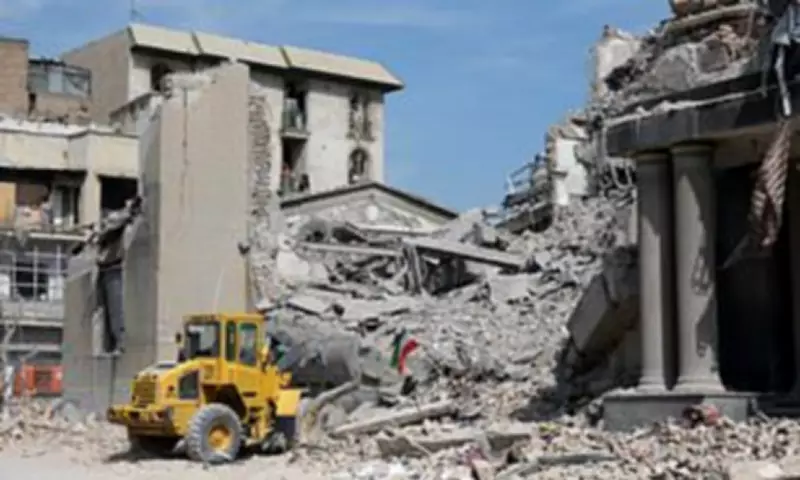
Israeli special forces are undertaking "extraordinary missions that can spark one's imagination" in the ongoing conflict with Iran, according to a statement from the country's Air Force chief on Wednesday. Major General Tomer Bar praised his troops as the war entered its fifth day, revealing that hundreds of Iranian regime targets have been struck by missiles and hinting at possible ground deployments inside Iran.
Helicopter Airdrop in Iraq and Regional Escalation
Reports emerged suggesting that between four and seven US-Israeli helicopters conducted an airdrop in the Najaf desert of Iraq earlier today. While the purpose remains unclear, speculation points to potential equipment supplies for anti-Iran regimes. An Iraqi convoy sent to investigate the helicopters was subsequently hit by airstrikes, resulting in one soldier killed and two wounded, as reported by Independent Arabia.
Major General Bar's Detailed Statement
In his evening statement, Major General Bar declared: "On this Shabbat morning, over 200 Israeli Air Force aircraft are attacking targets in Iran. This is not a drill. This is a real operation to defend the State of Israel. We have been fighting for about 100 hours alongside ground and naval forces. We have already struck hundreds of targets of the Iranian regime and its proxies."

He emphasized that "Iranian aggression against Israel has crossed a red line," adding that Israel is "precisely striking the Iranian nuclear program, missile production facilities, and other strategic sites. We will continue with full determination to protect Israel's citizens."
Tehran Under Sustained Attack and Leadership Crisis
The Iranian capital of Tehran has faced relentless missile strikes from US and Israeli forces since the conflict erupted on Saturday, coinciding with the death of Supreme Leader Ayatollah Ali Khamenei. A scheduled funeral ceremony for Khamenei was cancelled due to continuing airstrikes, while the Iranian Assembly of Experts indicated they are "close" to selecting a successor after his four-decade reign.
Reports suggest Mojtaba Khamenei, the 56-year-old son of the late leader, is a leading candidate to succeed him. Mojtaba maintains strong connections with the Iranian Revolutionary Guard Corps (IRGC), which is reportedly pressuring the Assembly of Experts to make a swift appointment.
US Sinks Iranian Warship in Historic Attack
As strikes on Iran continued, US Secretary of War Pete Hegseth announced that an American submarine torpedoed and sank an Iranian frigate, IRIS Dena, off the coast of Sri Lanka in the Indian Ocean. The attack resulted in at least 80 sailors confirmed dead and 78 wounded from the 180-crew vessel.
Video footage released by the US showed the torpedo strike causing a massive explosion. Hegseth described it as "the first sinking of an enemy ship by a torpedo since World War Two," though this statement overlooked the British sinking of the Argentinian cruiser Belgrano during the 1982 Falklands War.
Regional Conflict Spreads and Humanitarian Toll
The conflict has expanded across the Middle East, with Israel targeting Iranian-backed Hezbollah militants in Lebanon, while Iran launched attacks on Bahrain, Kuwait, and Israel. Turkey reported that NATO defenses intercepted a ballistic missile from Iran before it entered Turkish airspace.
Official figures indicate the war has killed more than 1,000 people in Iran and dozens in Lebanon, with eleven fatalities in Israel and six US troops. The fighting has severely disrupted global oil and gas supplies, snarled international shipping, and stranded hundreds of thousands of travelers throughout the region.
Strategic Targets and Economic Impact
Israel stated it struck buildings associated with Iran's Basij, the volunteer force of the Revolutionary Guard that suppressed protests earlier this year, as well as facilities linked to Iran's internal security command. Strikes were also reported in Qom, targeting a building connected to the clerical panel responsible for selecting Iran's next supreme leader.
Iranian state television has begun referring to the conflict as the "Ramadan war," suggesting preparations for a prolonged engagement. Admiral Brad Cooper, the top US military commander in the Middle East, reinforced this outlook, stating: "We've just begun."

The economic consequences are mounting, with a container ship attacked in the Strait of Hormuz, a critical passage for approximately one-fifth of the world's oil. This has driven oil prices higher and hammered global stock markets amid fears of economic slowdown.
Leadership Threats and Future Uncertainties
Iran's Revolutionary Guard issued a severe threat, warning that strikes against them would lead to "the complete destruction of the region's military and economic infrastructure." Meanwhile, Israel's Defense Minister Israel Katz threatened that any new Iranian supreme leader continuing hostile policies "will be a target for elimination."
The head of Iran's judiciary warned that "those who cooperate with the enemy in any way will be considered an enemy," signaling a consolidation of power amid the crisis. The international community watches closely as Iran navigates its leadership transition while engaged in a rapidly escalating regional conflict.