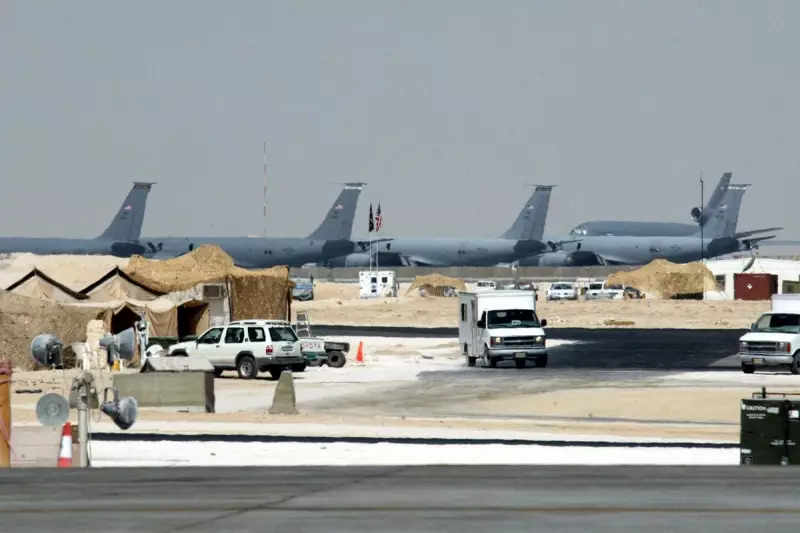
Amid heightened regional tensions following warnings from former US President Donald Trump to Iran, the network of American military installations across the Middle East remains a cornerstone of Washington's strategic posture. The presence, which supports operations from counter-terrorism to integrated air defence, spans several key allied nations.
Strategic Hubs: Command Centres and Naval Power
Bahrain serves as a pivotal naval hub, hosting the headquarters of the US Navy's Fifth Fleet. This command's area of responsibility is vast, covering the Persian Gulf, Red Sea, Arabian Sea, and parts of the Indian Ocean.
In Qatar, the massive Al Udeid Air Base is arguably the most critical US facility in the region. Situated in the desert outside Doha, this 24-hectare site acts as the forward headquarters for US Central Command (CENTCOM). CENTCOM directs American military operations across a huge area stretching from Egypt to Kazakhstan. The base houses approximately 10,000 troops.

In a significant development in January 2026, CENTCOM announced the opening of a new coordination cell at Al Udeid. Known as the MEAD-CDOC, this cell is designed to enhance integrated air and missile defence cooperation with regional partners, improving how forces coordinate and share responsibilities.
Key Operational and Staging Posts
Kuwait contains several sprawling installations. These include Camp Arifjan, the forward headquarters of US Army Central, and Ali Al Salem Air Base, located roughly 40 kilometres from the Iraqi border. Another key site, Camp Buehring, was established during the 2003 Iraq War and continues to act as a vital staging post for US Army units deploying into Iraq and Syria.
The United Arab Emirates hosts the Al Dhafra Air Base south of Abu Dhabi, a critical US Air Force hub. This base has supported key missions against the Islamic State and regional reconnaissance deployments. Furthermore, Dubai's Jebel Ali Port, while not a formal base, is the US Navy's largest port of call in the Middle East, regularly hosting aircraft carriers.
Presence in Conflict Zones and Allied Nations
In Iraq, the US maintains a presence at Ain Al Asad Air Base in Anbar province, supporting Iraqi security forces and the NATO mission. This base was targeted by Iranian missile strikes in 2020 in retaliation for the killing of General Qasem Soleimani. Further north, Erbil Air Base in the Kurdistan Region serves as a hub for US and coalition training exercises and intelligence sharing, as detailed in a 2024 Library of Congress report.
Saudi Arabia hosted 2,321 US soldiers in 2024, according to a White House letter. These personnel operate in coordination with the Saudi government, providing air and missile defence capabilities. Many are stationed at Prince Sultan Air Base, roughly 60 kilometres south of Riyadh, which supports Patriot and THAAD missile systems.
Jordan's contribution includes the Muwaffaq al Salti Air Base in Azraq, which hosts the US Air Force's 332nd Air Expeditionary Wing for missions across the Levant.
Finally, Turkey jointly runs the Incirlik Air Base in Adana province with the US. This strategically vital site hosts US nuclear warheads and has been used to support operations against the Islamic State in Syria and Iraq. It is home to 1,465 US military personnel stationed in Turkey.
This extensive network underscores the deep-seated US military commitment in the Middle East, a presence that continues to evolve in response to regional threats and diplomatic relationships.