Marine Corps Investigation Finds 'One in a Million' Misfire Rained Shrapnel on California Highway
A comprehensive military investigation has concluded that an extremely rare malfunction, described as a "one in a million" event, occurred during a live fire demonstration over Camp Pendleton in October last year. This incident resulted in a misfire that sent shrapnel raining down onto Interstate 5 in California, according to the findings detailed in a newly released report.
Details of the Incident and Investigation
The mishap took place during a celebration marking the 250th anniversary of the U.S. Marine Corps, an event attended by high-profile officials including Vice President JD Vance and Defense Secretary Pete Hegseth. An artillery shell exploded prematurely at an altitude of approximately 1,480 feet (450 meters) above the closed roadway, scattering pieces of shrapnel that struck two California Highway Patrol vehicles—a patrol car and a motorcycle.
In a detailed 666-page report dated December 19 and first reported recently, the Marines stated that there "is no definitive answer" to explain why the M795 high explosive round detonated early. The report emphasizes that such a premature detonation was "beyond reasonable expectations and should not have happened, but it did," attributing it to a manufacturing tolerance of one defect in a million. Investigators ruled out any negligence or wrongdoing by Marine Corps members involved in the exercise.

Political Fallout and Safety Concerns
The incident has intensified conflicts between President Donald Trump and California leaders, notably Governor Gavin Newsom. In the days following the malfunction, 26 U.S. House members from California, along with the state's two senators, sent a letter to Defense Secretary Hegseth demanding answers about who authorized the live artillery firing over the freeway and how safety risks were assessed.
Some Republicans initially criticized Governor Newsom for closing a 17-mile (27-kilometer) stretch of Interstate 5 ahead of the live fire exercise, while local leaders expressed frustration over what they viewed as an unorthodox military display orchestrated for the benefit of Trump administration officials. Diana Crofts-Pelayo, a spokesperson for Newsom's office, commented in an email, "We're thankful to the Marines for their thorough and precise investigation—in stark contrast to the dangerous and performative demands by JD Vance and Pete Hegseth to shoot live ammunition over a civilian area for their entertainment."
Prior to the celebration, Newsom had announced the highway closure, describing the live fire exercise as a show of force intended to intimidate Trump's opponents, who were demonstrating at "No Kings" protests across San Diego that day. He stated at the time, "Firing live rounds over a busy highway isn't just wrong—it's dangerous."
Background and Immediate Aftermath
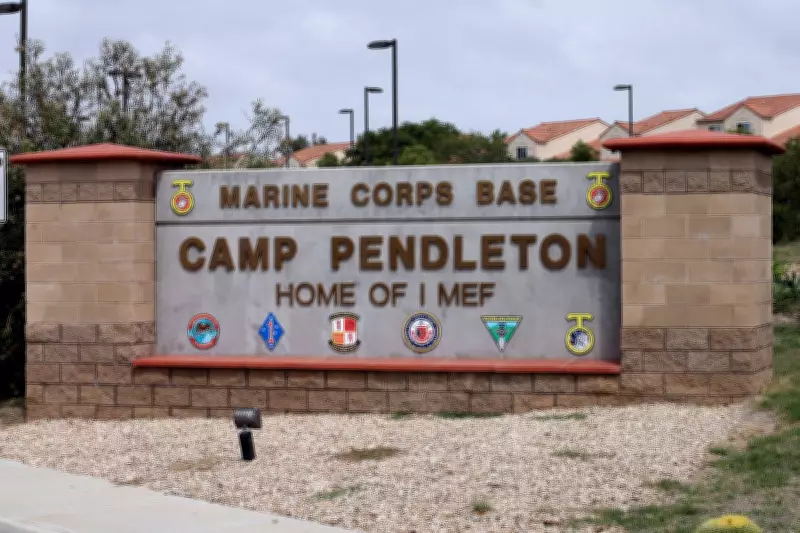
The demonstration on October 18 at Marine Corps Base Camp Pendleton featured aircraft, ships, and amphibious assault vehicles as part of the anniversary festivities. According to an October California Highway Patrol incident report, the planned demonstration involved firing 60 rounds of artillery across the coastal freeway. Military and public safety officials noted that this location was unusual, as live fire training typically occurs on designated ranges within the 195-square-mile (505-square-kilometer) base north of San Diego.
The first round was launched at 1:46 p.m. from M777 howitzers positioned on a beach west of Interstate 5, heading east. This artillery round failed to clear the roadway and detonated midflight near the southbound lanes of I-5, sending shrapnel flying toward protective service details assigned to the vice president. Following this, the exercise was immediately halted, and no additional munitions were fired.
An officer described hearing sounds similar to "pebbles" falling on his CHP BMW motorcycle, while other shards struck an empty Ford patrol vehicle. The two officers who had been driving the vehicle later discovered a piece of shrapnel measuring 2 inches by ½ inch on the hood, which caused a small dent or scratch. Photographs included in the incident reports show the patrol car damaged by shrapnel and an officer holding the metal fragments.

This investigation underscores the rare nature of the malfunction and highlights ongoing debates over military safety protocols and political tensions surrounding such displays.