

Middle East War Could Be Decided by Missile and Interceptor Exhaustion
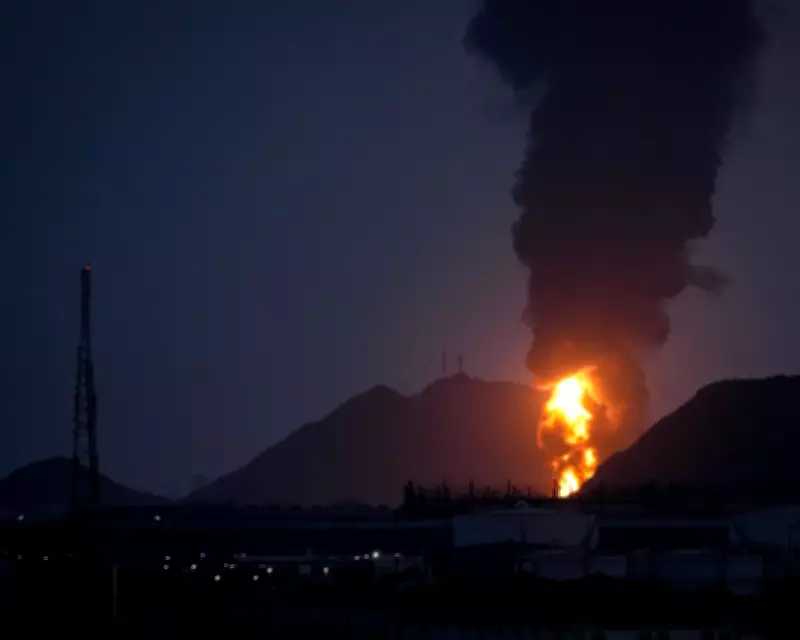
Fire erupted into the sky after the Fujairah oil facility in the United Arab Emirates was reportedly struck by debris from an intercepted Iranian drone on Tuesday. This incident underscores the escalating aerial warfare that analysts suggest may determine the conflict's duration and outcome based on a grim calculus of weapon stockpiles.
A Salvo Competition of Precision Weapons
Since Saturday, Iran and its proxies have launched over 1,000 strikes across nearly a dozen countries spanning 1,200 miles, countering intensive joint US and Israeli offensives. With an antiquated air force unable to match those of Israel and the US, Tehran has heavily relied on its arsenal of missiles and drones, making this the widest Middle East conflict since World War II.
Stacie Pettyjohn, director of the defense program at the Center for a New American Security in Washington, described the situation as "a bit of a salvo competition," where opposing forces exchange large volleys of precision-guided weapons. "The question is who has the deeper magazines of key weapons, and the big unknown is how deep Iran inventories are," Pettyjohn stated.

Air Defence Strains and Strategic Calculations
Israeli and US forces have struck hundreds of sites across Iran without losing a single aircraft to hostile fire, aiming to degrade Iran's missile stockpile and infrastructure. However, sirens sounded again over Jerusalem on Tuesday as interceptor missiles destroyed incoming threats, though Iranian attacks on Israel have become less frequent in the past 36 hours.
Analysts speculate that Iran, where the Red Crescent reports over 787 killed, may be conserving missile reserves or facing operational disarray due to decapitation strikes targeting senior commanders. "Iran has fewer weapons that can range Israel than hit the Persian Gulf, and a lot of drones heading to Israel are being intercepted," Pettyjohn noted, adding that coordination issues might be limiting Iran's offensive capabilities.
Gulf States Bear the Brunt of Attacks
The United Arab Emirates issued a detailed statement on Tuesday denying reports of interceptor missile shortages, asserting "a robust strategic stockpile of munitions" for sustained defence. The UAE claimed destruction of 161 out of 174 ballistic missiles launched toward the country, with the rest falling into the sea, along with intercepting 645 out of 689 Iranian drones and destroying eight cruise missiles.
Iranian strikes have also targeted US military and civilian sites in Qatar, Abu Dhabi, Kuwait, Iraq, Bahrain, and Oman, with international hotels in Dubai set alight and oil infrastructure damaged in Saudi Arabia. Qatar reported intercepting the majority of aerial threats, including shooting down two Iranian fighter jets and numerous missiles and drones.
Attrition Warfare and Costly Interceptions
Tal Inbar, a senior research fellow at the Missile Defence Advisory Alliance in Israel, emphasized the attritional nature of the conflict. "There is no such thing as one hundred percent defence. It's a war of attrition ... If a single missile strikes something like a university, a hospital or a power plant it can be very costly," Inbar explained, recalling how air defence missiles ran low during previous conflicts.
Kelly Grieco, a strategic and military analyst at the Stimson Center in Washington, highlighted the strategic implications of depleting inventories. "It is very hard to know the level of inventories in the Gulf but they are burning through a lot of them and soon there will be some difficult decisions to make about what to protect," Grieco said, noting Iran's strategy of "death by a thousand cuts" to wear down stronger opponents.
Broader Implications and Future Scenarios
The sheer expense and limited availability of advanced weapons complicate the conflict further. Grieco estimates intercepting a drone costs five times more than producing one, with stockpiles of US-made munitions being very limited and replenished slowly, amid high demand from other regions like Ukraine or Taiwan.

Pettyjohn suggested that if air defence stockpiles are exhausted, it might force Israel and the US to halt offensive operations and seek a negotiated settlement. "The US could withdraw its forces, Israel clearly cannot, but it's the Gulf states who are now bearing the brunt and they might continue to be pummelled .... If Iran runs out of missiles ... they may just have to sue for peace and try to survive and eventually rebuild their capabilities over time," Pettyjohn concluded.
All parties recognize the critical importance of this aerial battle, making strenuous efforts to reassure anxious citizens while navigating the precarious balance of weapon supplies in a conflict that could hinge on who runs out first.





