

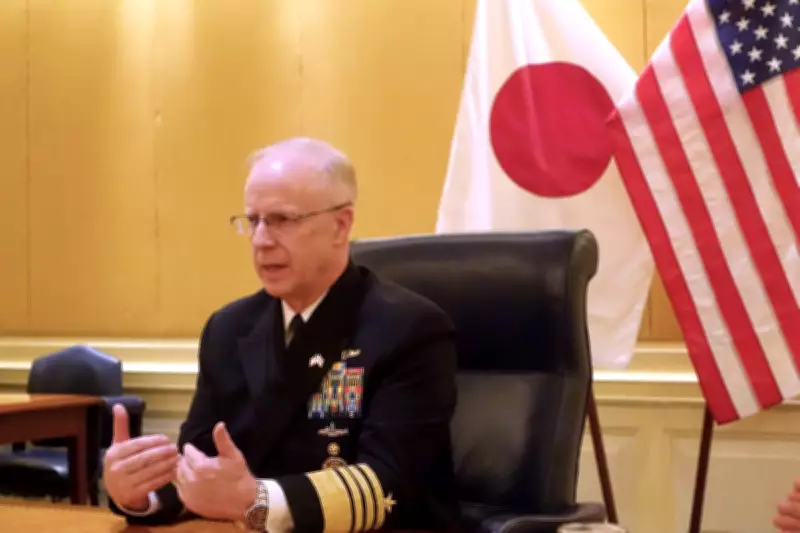
US Navy Admiral Champions Leaner, More Agile Fleet Strategy
The US Navy's top uniformed officer, Admiral Daryl Caudle, has unveiled a transformative vision for the future of naval operations, advocating for a shift away from reliance on massive aircraft carriers towards smaller, newer, and more flexible assets. This strategic pivot, dubbed "Fighting Instructions," aims to enhance the Navy's responsiveness to global crises with tailored force packages.
Redefining Crisis Response with Tailored Assets
Admiral Caudle's strategy emerges against a backdrop of frequent, disruptive deployments of aircraft carriers under the Trump administration, which have strained maintenance schedules and operational plans. Recent examples include the redirection of the USS Gerald R. Ford from the Mediterranean to the Caribbean for operations involving Venezuela, and the USS Abraham Lincoln's redeployment to the Middle East amid rising tensions with Iran.
In an interview with The Associated Press, Caudle emphasized that his approach would create a leaner, more precise naval presence in regions like the Caribbean. He envisions missions focusing on interdictions and monitoring merchant shipping, tasks he argues do not require carrier strike groups. Instead, he proposes using littoral combat ships, Navy helicopters, and coordinated efforts with the Coast Guard.

Shifting from Carriers to Drones and Robotics
To compensate for reduced reliance on large vessels, Caudle plans to leverage drones and robotic systems, offering commanders similar capabilities with less investment. However, he acknowledges challenges in integrating these technologies, noting that education campaigns are needed to help military staff effectively request and employ such niche capabilities.
This strategy contrasts with President Donald Trump's preference for bold, firepower-heavy displays, including references to "armadas" and plans for a "Trump-class battleship" equipped with advanced weaponry. Despite these trends, Caudle asserts that his tailored approach is already operational in Europe and North America, and could soon extend to critical areas like the Bering Strait, where Arctic competition with China and Russia intensifies.
Practical Applications and Future Implications
Caudle has engaged with commanders, such as those at US Southern Command, to tailor force packages to specific threats. He criticizes the inefficiency of using destroyers for routine surveillance, advocating for more suitable assets. Under his plan, redeployments like the Abraham Lincoln's would be offset by smaller, three-ship groups, maintaining regional presence without overextension.
As global tensions evolve, Caudle's vision prioritizes adaptability and resource efficiency, aiming to position the US Navy as a more agile force in an increasingly complex geopolitical landscape.






