

Whenever the President of the United States travels away from the White House, he remains perpetually close to a lethal companion known as the 'nuclear football'. This heavily guarded, aluminium-framed leather satchel weighs approximately 20 kilograms and contains the critical procedures and communication technology required to authorise a nuclear strike. The commander-in-chief's access to catastrophic power is further ensured by the 'nuclear biscuit', a credit-card-sized plastic card holding the essential launch codes.
The Constant Nuclear Shadow
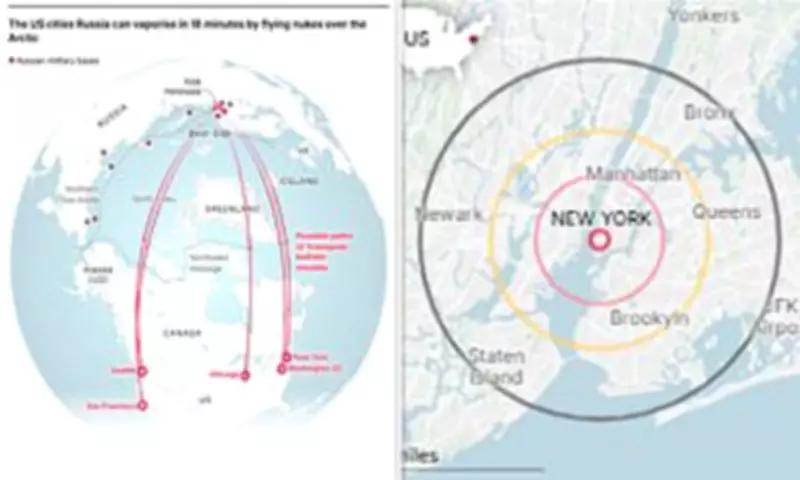
It is absolutely vital that the president remains mere seconds from both the football and the biscuit at all times. This urgency stems from the alarmingly brief window between a potential Russian attack and catastrophic consequences. For instance, a projectile launched from Russia's Kola Peninsula—home to the world's most concentrated nuclear weapons stockpile—could traverse the Arctic, fly over Greenland, and reach American soil in under twenty minutes.
Norway's Minister of Defence, Tore Sandvik, recently emphasised this threat to the Financial Times, stating: 'An intercontinental ballistic missile descends at 7km per second, taking just 18 minutes from launch to impact a major US city.' The destructive potential is almost unimaginable. An 800-kiloton nuclear warhead detonating above midtown Manhattan would generate temperatures around 100 million °C at its core—roughly four to five times hotter than the sun's interior.

Catastrophic Urban Scenarios
The initial fireball would rapidly transform into a hurricane of flames, incinerating vehicles and tearing apart iconic structures like the Empire State Building, Grand Central Station, and the Chrysler Building. Radioactive fallout would settle across tens of miles. Similarly, an 800-kiloton warhead aimed at Capitol Hill in Washington DC would kill or severely injure approximately 1.3 million people, swiftly demolishing landmarks including the White House and the Smithsonian National Museum.
A comparable detonation above Chicago's Loop would instantly vaporise everyone within half a square mile, causing all buildings to vanish. A supersonic shockwave would then bulldoze everything within roughly one mile of ground zero, obliterating the Riverwalk, Cloud Gate, Union Station, much of the financial district, and the Jardine Water Purification Plant.
The Lingering Nuclear Fallout
Beyond the immediate blast, devastating nuclear fallout would emerge from a toxic mushroom cloud composed of vaporised dust, soil, concrete, ash, debris, and radioactive materials. Wind would transport these particles, contaminating people, animals, water, and soil, potentially subjecting millions to severe radiation sickness if not killed instantly by the lethal plume.
The Arctic Theatre: A New Cold War Front
Located on Russia's extreme northwestern flank within the Arctic Circle, the Kola Peninsula serves as the base for Vladimir Putin's prized Northern Fleet and a testing ground for powerful new weapons. While Donald Trump retreated from his demand to purchase Greenland, the battle for Arctic ascendancy intensifies as NATO races to counter years of Russian military build-up.
Following the Cold War, most Arctic states—including Russia—reduced their military presence by closing bases. However, when Putin rose to power in the 2000s, Moscow initiated rapid military and economic revitalisation in the region, outpacing Western powers. Today, the Kremlin operates over 40 military facilities along the Arctic coast, including bases, airfields, radar stations, and ports.
Russian Dominance and Strategic Assets
Russia controls around 50 per cent of the Arctic's landmass and waters, granting it the largest footprint among the eight nations with Arctic presence. The Northern Fleet, Moscow's Arctic naval force founded in 1733, currently holds at least 16 nuclear-powered submarines and the hypersonic Tsirkon missile, capable of travelling at eight times the speed of sound.

Former British military intelligence colonel Philip Ingram notes: 'Russia's Northern Fleet is one of its most capable fleets, and one that they invest in frequently. It has been carefully monitored ever since NATO was created.' Putin also maintains high preparedness at the Novaya Zemlya testing site, where Russia recently completed a successful test of the nuclear-powered Burevestnik cruise missile, which allegedly travelled 9,000 miles during a 15-hour test.
The Nuclear Balance and Western Response
Former British Army colonel Hamish de Bretton-Gordon underscores the fundamental importance of nuclear parity: 'The reason we have had no war between East and West since WWII is because of nuclear parity. As soon as that balance is affected, we're in a really dangerous situation.' He highlights Russia's advantage in polar regions, noting: 'Moscow has something like 12 nuclear icebreakers that can go through any ice, whereas the West has maybe two or three.'
The Kremlin is utilising these icebreakers to develop the Northern Sea Route—a valuable shipping shortcut between Europe and Asia along Russia's northern coastline. This route would halve travel distances between continents, providing an immensely lucrative economic lifeline to Russia's sanctions-hit economy.
NATO's Arctic Awakening
Following Trump's announcement of a 'framework of a future deal' regarding Greenland and 'the entire Arctic Region', focus has shifted to polar security. Denmark's Prime Minister Mette Frederiksen declared at Davos: 'NATO must increase its engagement in the Arctic. Defence and security in the Arctic is a matter for the entire alliance.'
Nordic neighbours of Russia have long warned about the situation, but struggled for NATO's attention partly due to US opposition. Sandvik told the FT: 'We know the Russians are having more activity in the north. When polar ice melts, China rises as a regional hegemon with global interests—they have self-proclaimed as a near-Arctic nation.' However, Arctic security is now near the top of the Western alliance's agenda.
Strategic Chokepoints and Military Exercises
According to Sandvik, Putin aims to control the full Arctic region to block NATO access to two key shipping routes: the GIUK Gap between Greenland, Iceland, and the UK, and the Bear Gap between Norway's Svalbard archipelago and mainland Norway. Norway currently deploys P8 reconnaissance planes, satellites, long-range drones, submarines, and frigates to monitor Russian activity.
Several NATO allies, including the US, UK, and France, have intensified Arctic training exercises in Norway, Finland, and Greenland. In March, around 25,000 soldiers—including 4,000 Americans—will participate in the Cold Response exercise in northern Norway, demonstrating alliance unity and deterrence capability in the High North.
The Hypersonic Era and Missile Defence
As the world enters the 'hypersonic era'—defined by missiles travelling five times the speed of sound—Greenland's strategic importance increases dramatically. Dr Troy Bouffard, an assistant professor of Arctic security, argues: 'Hypersonics can be launched from air, land, or sea, making every inch of the Arctic a potential vector. Greenland's role will amplify significantly.'
The US already operates the Pituffik Space Base in northern Greenland, where about 200 troops monitor for incoming ballistic missiles. Trump's proposed 'Golden Dome' missile defence system envisions expanding ground-based defences and adding experimental space-based elements, though the programme has yet to spend much of its $25 billion appropriation.
The Tangible Hypersonic Threat
Russia is reportedly developing at least three operational or near-operational hypersonic weapons, including the Oreshnik intermediate-range ballistic missile used against Ukraine. With speeds reaching Mach 10-11 and ranges up to 5,500 kilometres, these nuclear-capable missiles theoretically place much of Europe within reach.
Dr Bouffard warns: 'The threat posed by hypersonic missiles is tangible. We are at the early stages of this being fully operationalised. Hypersonics have rendered almost all previous missile defence technology useless.' He concludes: 'This will be the defining threat of our lives for decades, requiring complete redesign of North American and European defence systems.'
The convergence of nuclear preparedness, Arctic militarisation, and hypersonic advancements creates a profoundly unstable global security landscape, demanding unprecedented cooperation and innovation from Western allies.





